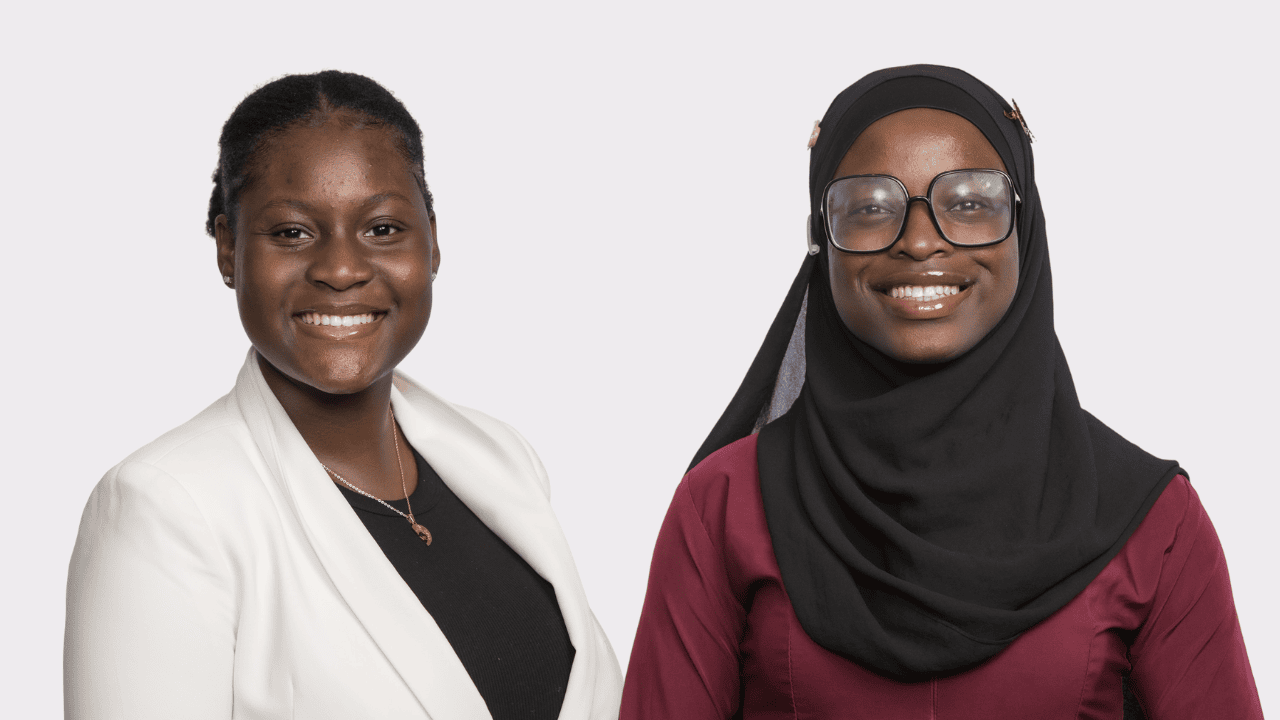
Morehead-Cain Global Fellows Rotdalmwa Joan Dimka ’26 and Eniola Hawawu Salawu ’26
This spring, the inaugural class of Morehead-Cain Global Fellows will conclude their year at the University of North Carolina at Chapel Hill. This miniseries of the Catalyze podcast highlights members of the first class, featuring global fellows from Nigeria, Turkey, and India.
In this episode, Morehead-Cain Global Fellows Rotdalmwa Joan Dimka ’26 and Eniola Hawawu Salawu ’26 speak about their journey to Carolina, experiences in the program, and how the year will inform their future impact.
About the guests
Eniola is an accounting student at the University of Lagos, passionate about financial literacy, climate change adaptation, education, and wealth creation in Africa. She is the founder of the Consulting Club of Lagos, the first fully established consulting club at her university, created to help students from all faculties build the practical, analytical, and professional skills they need to flourish in the labor market. She also cofounded EcoCarbon, a sustainable enterprise focused on promoting corporate sustainability across Africa, reflecting her commitment to aligning finance with climate action. At UNC–Chapel Hill, Eniola and her team won the internal and Mid-Atlantic Regional Finals of the Venture Capital Investment Competition for the first time in six years, further deepening her interest in venture capital and the impact investing space. She is also working to create an innovation hub within her school in Lagos to provide students with the facilities they need to create and scale bold ideas. She ultimately aims to lead a venture capital firm that invests in bold, sustainable solutions to foster a more inclusive global economy.
Rotdalmwa is a biochemistry student at the University of Jos with a passion for proteomics, storytelling, and educational reform. As a course representative and public relations executive for the Biochemistry Study Community, she helped lead a waste management project to the finals of a state hackathon. A former intern at the Centre for Youth Participation, Dialogue and Advocacy Africa, she also founded Student Republic, a student-run editorial supporting first-year university students while promoting intellectual discourse and social consciousness. At UNC–Chapel Hill, she is conducting foundational research in the Arroyo Lab on electrochemical biosensors to explore testing and treatment for UTIs. She is also furthering her craft in storytelling, reading poems at open mics and publishing them in the Daily Tar Heel. Rotdalmwa hopes to pursue research on urinary tract infections, build a career in spoken word, and enter public office to drive systemic change in Nigeria.
About the Morehead-Cain Global Fellows program
The Morehead-Cain Global Fellows program identifies, invests in, and empowers emerging leaders who seek to positively shape communities across the world. Global fellows pursue a fully funded year of undergraduate study and research at the University of North Carolina at Chapel Hill.
During their time at Carolina, global fellows engage in rigorous academics, immersive research, and meaningful cross-cultural exchange. The program includes funded travel within the United States, personal coaching from Morehead-Cain advisers, and yearlong leadership development designed to strengthen purpose, confidence, and impact. Global fellows return home with world-class research experience, an international network, and the skills to lead with clarity and purpose.
Are you ready to step forward and shape the world for the better? Learn more at global.moreheadcain.org.
Music credits
The episode’s intro song is by scholar Scott Hallyburton ’22, guitarist of the band South of the Soul.
How to listen
On your mobile device, you can listen and subscribe to Catalyze on Apple Podcasts or Spotify. For any other podcast app, you can find the show using our RSS feed. You can let us know what you thought of the episode by finding us on social media @moreheadcain or you can email us at communications@moreheadcain.org.
Episode transcription
(Rotdalmwa)
Welcome to Catalyze. I’m your host, Rotdalmwa Joan Dimka, a global fellow from the class of 2026. This spring, the inaugural class of Morehead-Cain Global Fellows will conclude their year at the University of North Carolina at Chapel Hill. The Global Fellows program identifies, invests in, and empowers emerging leaders who seek to positively shape communities across the world. This miniseries of the Catalyze podcast highlights members of the first class featuring global fellows from Nigeria, Turkey, and India. In this episode, I speak with Eniola Hawawu Salawu from the class of 2026 about her journey to Carolina, her experiences in the program, and how the year will inform her future impact. Eniola, thank you so much for joining us.
(Eniola)
Thank you for having me.
(Rotdalmwa)
So what’s happening? How are you doing today?
(Eniola)
I’m doing very well. My day is off to a great start.
(Rotdalmwa)
Is there anything you’re looking forward to this week?
(Eniola)
Yes, I’m traveling to Dallas, so that’s exciting.
(Rotdalmwa)
Okay, that’s exciting. Hopefully we’ll get to hear more about it in the course of the episode. We’re recording at the end of March, which means we have fewer than two months left on campus. How are you feeling about that, and how do you plan to make the most of the time you have left?
(Eniola)
How I feel about that, I’m very sad because all the friends I’ve made and everybody, I’m going to miss them. But I know that we will always have each other and just knowing that makes me happier at the end of the day. And then how I plan to make the most of it is really put more effort into exploring more and going out more with my friends while I still have the time to do so.
(Rotdalmwa)
Okay, I’m happy that you’re looking forward to going out with me. I’ve actually made a bucket list for myself before we leave, right? Do you have anything like that? Do you have any things in particular that you want to do before we go back?
(Eniola)
I don’t think I have anything specifically in mind that I want to do, but then what I do every week is that I try to do something different so every week doesn’t look the same, basically. So it’s random things every week that I will not be able to do back in Nigeria is what I’m doing.
(Rotdalmwa)
Okay, okay, okay. We went through the application process together, but I’d love to hear more about your journey. So tell me, how did you first discover the Global Fellows program?
(Eniola)
I discovered the Global Fellows program from the Bridge Program, which we’re both a part of, and they sent out mails telling us about the Morehead-Cain Program and they had a session on it. Although I couldn’t attend the session, I went online to research about what the Morehead-Cain Program was about and that’s how I found out about it. Because I was so wrapped up in work, I remember recalling a day to the deadline of the Morehead application and sitting down and writing all my essays at one go. And I think that when I write my essays like that, that’s the most honest form you can ever get from me at that point in time. So. I wrote my essays, forgot about it entirely, and I got a callback when I was writing exams in UNILAG on February 18. I cannot forget because I was in my room and I was like, an international number was calling me. I initially thought it was scam. I was like, my true caller, because we have an app that can identify if or say who the person was. And I was like, I don’t know, is this a scam?
(Eniola)
Why is an international number calling me? And I remember picking it up and walking to the quadrangle because my room was loud, and then saying that I have been selected. At first I was so confused. I was like, when did I— what did I apply for? Who is calling me? When? How?
(Rotdalmwa)
Congratulations!
(Eniola)
But then it was interesting after that.
(Rotdalmwa)
Okay, so knowing that, you know, you almost could have missed the deadline. And it shows that probably you were really busy doing a lot of things. What did your life on campus look like at the time when you first heard about it?
(Eniola)
My life on campus was very— I wouldn’t say hectic because I genuinely enjoyed it. So I was working at an investment banking firm at that point in time. So I used to go to work Mondays and Wednesdays. I had to be in school on Tuesdays, Thursdays, and Friday. And then I used to lecture students on the weekends alongside that. So a day in my life would look like me having club activities. I was hosting three programs for my department and faculty at that point in time.
(Rotdalmwa)
Mm-hmm.
(Eniola)
It was just a lot of things happening at the same time, and I guess that that’s why I forgot. But then I remembered at the best time because that’s when the best products came out of me, apparently.
(Rotdalmwa)
Wow, what an active youth. So you’ve been deeply involved in finance, you’re studying accounting at the University of Lagos, and you previously served as the co-head of the Securities and Trading Division. So tell us a little bit about what that position was like, tell us about the CUB, and what initially sparked your interest in finance.
(Eniola)
My interest in finance, I guess it has always been there because my name means a person of wealth. So I guess my parents must have known that this is the path that I would have been interested in and decided to give me that name. But I’ve always seen my dad in his suits, and I just found what he did very interesting. And for me, I was very close to my dad and used to share a lot about his work in taxation, not finance itself.
(Rotdalmwa)
Oh, okay.
(Eniola)
But that was like my initial spark to it, and I thought it was very interesting, the work that he did and knew that that’s what I wanted to do, or some line I wanted to pursue. But getting into the university, I learned about the Investment Society. It’s a finance club that helps students bridge the gap between the theories of finance and the practical aspects of it. It was the first club of its kind that was doing anything like that, and I thought it was very interesting. And I was recommended to join the Securities and Trading Division because apparently the head of the division thought that I would enjoy it. It was somebody seeing into my future and saying, I think you’d enjoy this thing very much. And I became the youngest executive to hold that position while I was at the club. So it was very interesting how somebody could see or recommend something that you’re— that they think you might be interested in, and just giving it your all and finding joy in it.
(Rotdalmwa)
So, Securities and trading is not particularly a term that I would say that I understand how finance plays into. Explain to me like a dummy what your position was like.
(Eniola)
So what my position entailed was giving back the knowledge I had gotten from my time at the Investment Society. So I would organize sessions on different aspects of, or different instruments in the markets. So currently in the financial markets, you can purchase certain products. My role was to help students understand this product well enough that when they go for internship roles and they go for interviews and things like that, they’re able to at least speak on it, talk about it, and to even the grandest point, work in that space themselves. So that’s what securities and trading is about.
(Rotdalmwa)
All right, all right. Yes, so I’m sure you invest a lot of time and energy into the activities that you do. And I just wanted to know, when you choose how to invest your time and energy, whether in leadership roles or extracurriculars, what usually guides those decisions?
(Eniola)
For some leadership roles I’ve taken on, it’s people coming and saying, oh, I’ve worked with you on, I worked with you on this project. I think you’d be amazing in doing this thing. I think you should look into it. So for me, I take recommendations from people. I see how well my time will be used over the course and even the people that will be serving at the bottom line of it. Especially being in UNILAG, you can get caught up in so many activities doing so many things. For me, I try to pick projects that I know that I can give my all to. I have a team that can support me to achieve the broad vision that I hope to achieve and that I can have direct impact on the people that I hope to have that impact on when I actually do the program or post or whatever it is I decide to do.
(Rotdalmwa)
Okay, okay, that’s amazing. So you serve with clubs and with companies and with societies, but we also know that you founded things yourself. You founded EcoCarbon and you’ve launched the One Sound Initiative. So what exactly drives you to build ventures? And is there any common thread or focus across the work that you do?
(Eniola)
I think the major thing that drives me is seeing and identifying a problem, looking around my community to first see if people are doing something around that space, because I don’t believe in flogging a dead horse.
(Rotdalmwa)
Okay, that’s very interesting.
(Eniola)
So if somebody’s already doing that work, how can I contribute to that work? But if nobody’s doing it, how can we even get people to get started in that work? So for EcoCarbon, carbon credits are something— at that point in Nigeria, as of 2023, 2024, there was nothing like a carbon credit system or a carbon registry in Nigeria. 2026, they’re establishing their first carbon registry system. So for me, it’s identifying that problem at that time and seeing how I could work towards it. And same with One Sound, I wanted to learn sign language, and I wasn’t finding any initiative around me that worked. And I was helping people with that, and it got me wondering if I, as a— if I could aim and aspire to be somebody that wants to work in finance and get to the top of my roles, how can somebody that does not— that has hearing disability, how do they get the full potential when the environment is not enabling them to do it? So One Sound was, how can we get all of us to make one sound together.
(Rotdalmwa)
That’s why it’s called One Sound. I see, I see what you did there. That’s really smart. That’s really smart. Really interesting naming technique. When you applied to the Global Fellows program, with all of these things that you’ve been doing, you were already invested. It seems like you already had everything together. And at least to an extent, you knew what you were doing. How did you envision that this program would help support all of the goals that you have and all of the visions that you have? How did it align with your purpose and your idea?
(Eniola)
Okay, so for me: I knew I wanted to take a year off. I did not know when, how, or where it was going to come from. Second was recognizing that where I was in Nigeria, I honestly believe that for me to be at my best capacity, or me to give my best, I needed to still learn more and being open to that learning process.
(Rotdalmwa)
Yeah.
(Eniola)
So for me, the Global Fellows program gave me the opportunity to learn because how much do I know? I’m just learning, I’m just starting out. So for me, it was driven by wanting to learn and knowing that I had told myself, somewhere that I want to take a year off. Where would it come from?
(Rotdalmwa)
So you wanted to take a gap year from university?
(Eniola)
No gap year, but a year off after school. My father did not take me seriously with that, but then that was the plan.
(Rotdalmwa)
I guess you’re here now taking the year off, taking the year of school to do more school. Well, it’s all worth it, right, for knowledge, honestly.
(Eniola)
And it’s not just about school, I think that one of the things, or one of the driving forces for me is exposure and mindset. I think that if there’s anything I’m grateful for, for this process is the exposure and the shift in my mindset that’s happened. I think those two things have driven everything that I’ve done so far and will still drive so much more. So I think that those two things are core to me.
(Rotdalmwa)
How did you find the application process? So you found this, you saw that it aligned with your goals and your ideas, and you decided to apply. Was it a challenging process?
(Eniola)
I don’t think so, because if I was able to sit and write my essays in a day and be like just sitting down and soaking up the questions. The questions that they asked us were not far-reaching. It was questions about our own experiences and things like that. It wasn’t difficult to sit and write. I think that the main thing that the essay gave me before I started writing was it gave me the chance to really sit and reflect. For somebody that is doing everything, my day can get really busy and really fast, and this can go by really fast. So for me, when I was writing my application, it was one of those days where I got to really pause and soak in everything that I’ve been doing to really be able to speak my truth in the truest and honest form.
(Rotdalmwa)
So you wanted a year away, and then even the application itself was a retreat for you, honestly? Okay, okay. I remember when we both got the news and we shared with each other, and you were so excited, and I was excited too, you know. We couldn’t believe it, and I know at some point I didn’t think it was real. It felt, it hadn’t felt real, it hadn’t felt real yet. But for you, how did you unpack those feelings and what did you do? Did everything fall into place immediately you found out? What were the challenges that you experienced throughout the process of getting accepted, trying to get here?
(Eniola)
I still remember Ben Ousley Naseman and Melanie Godinez-Cedillo calling me to tell me that I got selected, and I was so excited. I was fasting that day, and I remember calling my dad and telling him, the program that you took me for the other day, I got in. And my father was like, what do you mean? And because at this point, I think that he has like reached the peak of she’s doing so many programs, he can’t— he could not even keep up. I was like, what does this program— what do you have to do about this program? I said— I was telling him that I’m going to the United States. And it was like, it didn’t first process it. And I was like, let me call you back. And then I remember getting a call back and everybody being excited. I want to say I was overjoyed because the selection process itself was very easy and smooth in the sense that it went by so fast that I kept wondering, is this the end of it? Are we done with it?
(Rotdalmwa)
Like, with the program?
(Eniola)
I wanted more in that sense. So it was very fun and interesting meeting everybody again, seeing everybody again. But the process leading up to coming here was, for me, very chaotic because at that point in time, I was working with another firm and I had to transition back to the firm I was initially working with because I decided to take a period to leave. So it was more of I remember I had an event the day before we had to leave. I hosted that event and then I went home the night before, packed that night, and then came to the airport the next— or came to the airport that day because I ended up having to do everything the night before because I couldn’t take time off school, work, and everything to do it before then.
(Rotdalmwa)
You are so active and so busy doing all of these things. It’s so interesting, hearing about the application. What exactly did you do to prepare, aside from packing?
(Eniola)
For me, the mindset was one thing, and honestly, even checking what UNC was like. I remember checking, staying up late at night to check what classes to take. I was very excited for the classes here because for me it was the ability to take classes or do classes that I had never done before. I was already— I was interested in student government work. I reached out to somebody from student government while I was back in Nigeria, just looking at the clubs and the activities that UNC had to offer and seeing how I could take advantage of that, knowing that I would not be able to do everything I want to do, being able to get to UNC and have a head start and just really put myself into that process.
(Rotdalmwa)
That really brings us to this next part where when we arrived on campus, it was new, it was lively, it was an environment full of opportunities. And when there’s so much opportunity, it could feel overwhelming. How did you approach that? How did you design your experience here with classes, extracurriculars, both in your fall and spring semester?
(Eniola)
Fall semester, we had already decided on our classes beforehand. I knew I wanted to do classes in finance, so I took a corporate finance class and I was also going to take a personal finance class. And then the rest of the classes genuinely just fell into place. I took a class in the economics department. It was more centered around finance and knowing that I wanted to do things around that space, but then also looking at how to explore the interest I had in the most interesting ways. I knew I wanted to join the ASL club here at UNC.
(Rotdalmwa)
What’s the ASL club?
(Eniola)
The American Sign Language club.
(Rotdalmwa)
Okay.
(Eniola)
So I had made a list of, or a visual in my head of, oh, I have my interests are in sustainability, consulting, finance. How do I do things in that space? And I was going to at least do at minimum the maximum number of clubs I was going to join was three, and that was me telling myself that I still wanted to give myself time to explore the campus, make friends, and be able to have conversations like this. So it was, how do I balance and not go into the same spiral that I’m in in UNILAG of doing everything at the same time?
(Rotdalmwa)
So you took finance classes, you took, you wanted to join the sign language club. Are there any other career-focused classes that you took?
(Eniola)
I also took an SLL class. It was about how to think in the age of political polarization, and it was more of a dialogue and discourse class, and I thought that was very interesting. I think that dialogue is very important—it is a skill that will serve you wherever you are, and that was one of the most interesting classes. I wanted to take a class in ASL too, but then I was not able to take that class in ASL. I took a public policy class because I know that I want to work in the public policy space in Nigeria. I think that better laws need to be implemented there. So I took another class there too.
(Rotdalmwa)
Even more interestingly, I have found you speaking French while passing by on some days.
(Eniola)
One of those many things that I want to learn. And I have a very wonderful professor teaching French here in UNC. And I’ve learned so much in less than, let me say, three months now, because we’ve been on campus for three months, than I’ve learned since I took the class for six years. So having an amazing professor like that helps you want to speak French even if you don’t know what you’re saying.
(Rotdalmwa)
Okay, okay. We’ve been here for quite a while. We’re in the second semester. When you came first in fall, did you experience any challenges settling in?
(Eniola)
I think my sleep pattern changed because I definitely— my sleep pattern just, it became the most erratic thing ever. So, that was one of the challenges, getting myself to even fall asleep. Second was getting adapted to the food and the taste and everything. For me, I’m someone— I’m, I like to say that I’m a creature of habit in the sense that when I’m on campus in UNILAG or when I’m in Nigeria, I eat some— I eat mostly the same thing. I’m not the person that’s going out to explore because I have a very weak stomach, if you call that. So I don’t go around exploring things that I’m not supposed to explore.
So here it’s like, even in Lenoir, I’m always surprised every day by the type of food that we can come up with. So, settling into the time, the weather, I was— I’m a very I don’t know, you’re always wearing a sweater, layers. I am always layered up because I cannot take the cold at all. So even the weather was a challenge for me. It was just a new experience and a new environment because I’ve never lived out of Lagos before, and I’ve never lived somewhere outside of my house that was not the university. So it was the first time I decided to explore. I did not even explore in Nigeria. I went all the way outside of Nigeria. So it took a while to adapt to the system and the culture here.
(Rotdalmwa)
Okay. How would you say you made this place feel like home eventually?
(Eniola)
The friends that you have. I feel like my friends have really accumulated into making this place feel like home for me. I look forward to going back and seeing Ezinne or walking down the corridor and, or walking into and hearing music play from a room. And I think that that in itself created that sense of feel, or coming to the foundation every time, or seeing Ben Ousley Naseman, or going to see Ben Ousley Naseman, or seeing— walking up and honestly, just people being very nice to you makes it easy for you to warm up to that process. Because it’s easy for you as an international, and for me, I’m a small person, I mean, a person with a very small friend group. I have two friends back at home. I don’t know how to have lots of people in my circle, but here it made it easy because people leaned into that process. People would say hi to you when I come to the foundation, or when I’m in class, people would reach out to you. I had a friend that I made on the first day of my econ class, and she ran after me when class ended.
(Eniola)
And then I was like, oh, my god, I want to introduce myself to you and I want us to go out together. And like, just having experiences like that really gets you to feeling like— I genuinely feel, when I go back to Nigeria, I would definitely feel like I have left a part of myself here.
(Rotdalmwa)
Oh, that’s so, so warm. Recently, you won the Venture Capital Investment Competition for the first time in six years, placing first in the Mid-Atlantic Regional Round and advancing to Nationals. And you were part of that team. Can you tell us about that experience and what you learned, particularly about investments and storytelling?
(Eniola)
Okay, coming here, I used to— I was head of Securities and trading. I knew I wanted to do something around sales and trading. I’d not even considered venture capital or private equity. I knew that I wanted, wanted to down the line go into that space, but it was not where my head was at.
(Rotdalmwa)
Okay.
(Eniola)
And I remember speaking to Ann Taylor Shaw and she asking me to reach out to somebody from the business school. And then I spoke to Shimul, and then she recommended going to— she recommended me to the head of the finance club that somehow, somehow, somehow I got to know about the Shark Tank being hosted by the Entrepreneurship Club and the Venture Capital Club. Okay, I attended and it was the most interesting thing I have ever seen. For me, it was, it was, it was fun to look at startups and understand what the work that they did. And really, it almost gave me the, an experience of, I don’t even have money yet, but I would put money into your business if I had the money to do that. So for me, that was like my entrance into that venture capital space. I dropped my email address, and I remember Jackson, one person from my team, reaching out and saying, oh, some people had dropped out from their team and they were looking for people to join. I was like, of course. That was a day before the competition. And I was like, I don’t think this can hurt me in any way.
(Eniola)
Explore, experience the process. And then we went, we did our first round. I remember on that first night we had to remove somebody from the team and then picking another person the day before. It was a very, very challenging process in itself, learning about venture capital within the span of forty-eight hours, learning about new companies and all those things, but also making friends while doing that and finding our voice. That’s the, the one thing that Jackson says is the thing that will help us win this competition is finding your voice. And within the span of forty-eight hours, as a group, we found our voice as the Cherry Blossom Venture Fund, where every seed grows, and leaning into that process. When I say we leaned into it, we said, oh, we have a connection with a military company, yada yada yada, we can help you make this dream come true. And like fully leaning into that process of living the dream of if I was going to be in venture capital, how would I approach this, was I think my insight into storytelling.
(Rotdalmwa)
Just the, just the process of embodying something and claiming it. You’re saying I might not have my VCIC company yet, but I am, I am it.
(Eniola)
This is what I am.
(Rotdalmwa)
It’s sort of manifestation, right? And would you say that in the future you see yourself going into venture capital?
(Eniola)
Definitely. Maybe not necessarily venture capital, but I know that one thing I’ve come to recognize about myself is I like working with people, I like working with companies, and I like providing them with access to aim for the sky. And when I say aim for the sky, provide them with funds and finance. So for me, I know that I want to work in the African markets because I think that entrepreneurs in Africa can do so much better. Not go VC style because I don’t think that venture capital itself will serve entrepreneurs in Nigeria or in Africa. More of how do we find a voice as a community in Africa to allow more entrepreneurs to do more things and allow young— and for me, that was very interesting being in the business school and seeing so many students, or let me not say so many students, but seeing a couple of students I interacted with have organizations of their own or have companies of their own that they were actively running and going after and making sure that it was going to work. I don’t think I see a lot of that in Nigeria. And I want to be able to get more students into this process of thinking of how can they start their own thing or how can we come together to solve a problem and be able to make a business out of it.
(Eniola)
I know that I definitely want to work in that space.
(Rotdalmwa)
Okay, okay. So the same way that you are passionate about helping people reach the skies, someone, somebody, a team, the Morehead-Cain Global Fellows Program has identified, invested in, and empowered you same way it has for all purpose-driven leaders like me and the other global fellows. And they are trying to help us get to the sky, as you said. And you came in with significant leadership experience, including the Millennium Fellowship. So how did you define leadership before this program? And how has your time at UNC influenced that understanding?
(Eniola)
I think for me, being a leader was an understanding of the fact that I was not leading people, but I was serving people. And I think that that has been core and central to me. That in your position as a leader, a leader is a servant to his people. And my dad used to always say that to me, and I take that very personally and very seriously. So my understanding of leadership was someone that was put in that position to serve his people and serve and help people achieve that goal and purpose. For me, being here at North Carolina UNC and seeing the Morehead-Cain and like all the interactions I’ve had, I think one thing that has heavily changed about my form of leadership is being intentional about the people that I’m working with and making sure that I build a relationship with them outside of that core project. Because working in so many projects in Nigeria, I can get— I have a flux of people that I’m working with, so it’s easy to be business and business only as a result of that. But coming here and seeing that people will still reach out to you and make sure that you’re feeling well and doing fine and everything like that.
(Eniola)
And being intentional about reaching out and paying people attention and building relationships with people external to what we are doing together is something that I take very personally. And I have seen that has improved my interaction even back home at University of Lagos because now I don’t just have friends because I’ve worked with them on projects, but because I’ve genuinely reached out to them to find out how they were doing, and we just clicked and we’ve made a friendship with something that was external to the projects that we were working on.
(Rotdalmwa)
Yeah, so your idea of leadership has essentially evolved from I’m a servant who serves the people to I serve the people, I take care of the people, I check on the people, and I also empower and improve myself for the sake of the people. So your idea of leadership is more holistic now. That’s really interesting. As global fellows, we had access to the Lovelace Fund for Discovery, you know, to empower ourselves and discover new things. How did you approach your grant? What did you consider when choosing your project?
(Eniola)
So for the Lovelace Fund for Discovery, we had a part of it that was pre-approved, and I’m so grateful for that because San Francisco, New York, and DC were a whirlwind, and it’s an experience that I will never forget. Each place has a personality in itself. For the ones I did myself were the ones of the project on Black culture and history in the United States and getting to go to Atlanta, Chicago, and New Orleans. And I think that that project, I will always remember it because in Atlanta I got to see my uncle for the first time. Okay, yes, that was strange for my family. So being able to meet him and tell my family back home, and my mom cried. I remember that—you never see a Yoruba woman cry, but that was the first time I ever saw my mom cry because they had lost touch with— she had lost touch with her— they had lost touch with their brother for over thirty years, and they didn’t know how he was doing, whether he was doing fine. So getting to see him and knowing that, and she knowing that he was doing well and doing fine, made her cry, I guess.
(Eniola)
So it was— and just learning about Black culture and Black history and seeing the work that people have done and just feeling empowered by it. And that’s one of the things that I really enjoyed from the process, feeling empowered by the work that people have put in to get to where they are, seeing women go after what they want to do. And for me, it’s like, if people can strive to achieve this: I can do so much more with the platform that I have now because I’m empowered to do so. So that feeling of empowerment, investing and empowering, really came through during my Lovelace Fund for Discovery project. And same thing with Dallas, I’m going to do a project, I’m going to shadow somebody working in the carbon credits market connected with EcoCarbon. It’s something that I’ve always wanted to do. And I did not know how to go forward with the business itself in Nigeria because, like I said, they’re just establishing the first carbon registry in Nigeria this year. So for me, it was like there was no way forward. Nobody had— no, it’s bad for you to say in a business that nobody’s doing what you’re doing, but literally nobody was doing what we were doing.
(Eniola)
There was no sounding board to learn from. And just being able to get that experience, to speak to him, learn from his work and seeing how I can take that back to my business back in Nigeria and seeing how we can take it to the sky from there is like really fulfilling and settling for me.
(Rotdalmwa)
Okay, okay. I remember when I went for a Lovelace Fund for Discovery project, it was so amazing to explore a new city and explore a new place. And we’ve done a good amount of traveling, we went to San Francisco in the fall. We went on our winter Lovelace trip. What places did we go to?
(Eniola)
Went to Atlanta, Chicago, New Orleans. I also went to Florida for Outdoor Leadership.
(Rotdalmwa)
Yes.
(Eniola)
And then Washington and New York.
(Rotdalmwa)
This semester. So what’s a common experience across the opportunity that we’ve had to go to all of these places? What have your experiences been?
(Eniola)
People. Every Morehead-Cain alum that I’ve interacted with in every one of the locations that we have visited has been so amazing. It’s like having a cousin. I honestly, now as I think back at it, it’s like I genuinely have cousins everywhere, and I take that very personally now and very intentionally that I can go on the Morehead-Cain Network and decide or want to do anything in Nigeria, Dallas, New York, DC, every single state, and people being very open to meeting with you, helping you plan that, plan out that process. And just, just the people itself, I think, has been constant across every interaction we’ve had so far. So the people, the Morehead-Cain alumni, have been central to making the experience more enriching for me across all my Lovelace Fund for Discovery projects.
(Rotdalmwa)
Before we go on to the next parts, what has your favorite place to visit been and why?
(Eniola)
I’m still very partial to North Carolina for some certain reason. People say it’s because I’m an accountant—I honestly don’t know. I just enjoy it here. It’s like New York is too busy for me. It reminds me of Lagos back at home. I remember telling Fadil and you guys, too, that there’s a specific market in Lagos that, that looks or feels like the streets that we were walking through in New York. San Francisco is too cold for me. Chicago was too cold for me.
(Rotdalmwa)
Is there anywhere that’s not new?
(Eniola)
It’s like, honestly, I think— and then also even the pace. Maybe someone— a place that would come second to it would be maybe New Orleans, because so many beautiful places. The houses were very like— or something that I had not seen before in the US, houses having colors like orange, blue, yellow. That’s why it was very fun to see that kind of perception or people expressing their arts that way. So maybe New Orleans. Really?
(Rotdalmwa)
May—
(Eniola)
I said maybe. I’ve said North Carolina.
(Rotdalmwa)
Okay, New Orleans is my favorite, obviously. Now, since we’ve been to all of these places and you’ve chosen which is your favorite, I’m sure you’re working on more projects, your individual Lovelace Fund for Discovery projects. Where do you plan to go to? Because I, you know, when we started, you mentioned that you’re going to Dallas, so tell us about that.
(Eniola)
I’m going to Dallas on Wednesday, and I’m going to first work with somebody that’s actively working and actively registering carbon credits in the United States. I’m going to also get a chance to be speaking to professors at the University of Dallas in Texas about carbon capture technology, which I think is very interesting. I think that industrialization is coming to Africa for some certain reason. I have that inclination that industrialization is coming to Africa, and I know that as this process starts, more, more of it will start to generate more carbon emission and processes like that. And how can we still help businesses build ideas that are sustainable while still giving them the opportunity to explore and expand to the fullest of their capacity.
(Rotdalmwa)
Okay, okay. So what are your plans for this summer?
(Eniola)
My plans for this summer, huh. I have an inclination, I know kind of where I want to go. So there’s a— I’m looking at working with a sustainability and environmentally— an environmental consulting firm in Nairobi, and they do work around helping companies reach— or work— they do work around sustainability projects and helping people see through that, those sustainability projects. And then they also have an investment fund too. So it’s looking at the intersection of environmental sustainability and finances where I know I want to do the Morehead-Cain Global Fellows Program offers so many opportunities for us.
(Rotdalmwa)
And aside from opportunities, there are specific experiences that every single Morehead-Cain has, be it a global fellow or a four-year scholar. Speaking of those experiences, one rite of passage for many scholars is the outdoor leadership. How was your experience in the Everglades?
(Eniola)
Looking back at it now, it was interesting. But looking back at it is what makes it interesting. I think that if there has been any experience that has challenged me emotionally, physically, spiritually, honestly, mentally, mentally, any lead that you can think of, it was the outdoor leadership. I went from being unsure about myself to feeling very confident in the span of nine days. And just being in that space gave me time to reflect, because here on campus we’re overstimulated by the things that we’re doing. If you’re not in class, you’re at a club, you’re doing something at a point in time that just gets you going. So it was like somebody pressed the pause button I was like, calm down, calm down. And really, before we started or during the process, they gave us two prompts. And one of those prompts are, what’s one thing that’s very close to your heart? And the second was— second prompt was, who do you give access to that thing that’s very close to your heart? And I think that for me, just sitting in, sitting there and thinking and reflecting, I have reflected. I reflected so much than I, I’ve, I think I’ve ever reflected in my life.
(Eniola)
And I remember being very dedicated to documenting that process because in my book I write every day, even if we had a tough paddle, everybody was tired afterwards, I would come back to write about each day and each experience. So for me, it was challenging, interesting. I made good friends. I fell in love with eating apple and peanut butter and just, I don’t know, getting to know more of myself or exploring parts of myself that I did not know.
(Rotdalmwa)
I’m sure it’s been— the entire process has been really challenging, coming to a new place, learning new things, having new experiences. Was there a moment this year when you had to pivot or problem solve in a significant way?
(Eniola)
In terms of pivoting, I pivoted yesterday because I was called last minute to join a design sprint competition, and basically we were given a prompt and had to create a solution based off of that prompt. Pivot, I pivoted seventy times in one day in ways I never thought I would be able to. But for me, after taking an entrepreneurship class in my first, my fourth semester here, I learned how to think on my feet, how to accept new challenges, and how to really take charge of that process. Yesterday— I— not yesterday but the day before that. I pivoted during ideation.
(Rotdalmwa)
Do you feel that this experience strengthened your confidence?
(Eniola)
Definitely. Every time I have to go up and present and talk to people, I remember from growing up I used to be very shy, and now I’m able to go for competitions and speak to people, and I just do it without even thinking about it, is one of the things that I’m most appreciative of. In terms of confidence, I naturally think that over this period I’ve grown into my skin. I’ve been able to identify the values that I think are core to my being, and as long as I know that I’m doing something and I’m— whatever I’m doing is in that line or is working towards that. Even if I’m scared at that point in time or I’m afraid, I still lead with, I’ve been empowered and invested in, how can I make the most of it? So maybe my confidence comes from there.
(Rotdalmwa)
Have you felt supported by the Morehead-Cain community in pursuing all of the goals that we’ve spoken about, all of the activities? You’ve spoken a lot about people. What role has the Morehead-Cain community played?
(Eniola)
Honestly, definitely, yes—Ann Taylor Shaw, Montez Thomas, Ben Ousley Naseman, everybody has been very instrumental in— Even Meg Petersen Marshall. I want to do a project in— I found somebody in Dallas that I think is doing interesting work, pointing me in the right direction of who to speak to. Or even, or just even feeling uncertain about my summer experience. I don’t know what I want to do there. Connections and really being that sounding board is one thing that I really appreciate about the Morehead-Cain community. And just, I think every day, Ezinne was saying that she sees me come out of class very happy. I don’t think I have any reason to not be happy. I don’t have any, because I know that it’s just when you know that whenever you run into a problem or you encounter a challenge, there are people that are genuinely rooting for you. And I remember coming back from the competition, and I still get congratulations about it. I’m like, I did this thing in January. I thought it would have died down by now.
(Eniola)
We went to DC and then David Gardner came up to me and was congratulating me about it. Just people being excited about the wins that you have and walking you through when you have challenges and everything is, I think, the best way that any person can be supported. And I’ve been supported in those ways.
(Rotdalmwa)
That’s, that’s amazing. The community, even for me, has been so amazing. Bouncing ideas off of them, talking with them, connecting you with people who would help, even making recommendations of places to visit, things to do. There are just so many ways that you feel supported by the community and that we’ve felt. We’ve spoken about the community and global fellows, for a matter of fact, are now part of that community. What have you learned from your fellow global fellows?
(Eniola)
Oh, I’ve learned so much. Well, someone has taught me how to make friends and how to talk to people and how to put myself out there. The show has taught me strength, how to overcome adversity even when it seems like physically you are not designed to do that. She has genuinely made friendships here that will forever be a part of me. She is my sounding board, honestly. When I go through things and I don’t know how I’m feeling, having somebody that can relate to whatever it is I’m going through, that’s easily— just giving me and allowing me to touch her hair every time. And just, I think that everybody— Hamza and his openness, Fadilullahi and his contagious energy every time you meet him. Rafat always being very nice and kind, and Dheeraj always saying hi to me every time I’m walking down the street and we intersect on my way to my class. I think that everybody has— everybody in one way or the other has contributed to my experience here and my— and just making my experience more holistic in itself. And I’m very grateful that I was a part of this set of global fellows.
(Rotdalmwa)
Okay, I know that you’ve also taken classes with other scholars aside from the global fellows and you’ve learned so much from them. You’ve spoken about how you’ve been challenged during the competitions that you’ve had and even in the classes themselves. Looking ahead, when you return to Nigeria, how do you see this experience that you’ve had with all of these people informing your work and impacting your community? How has this year influenced your leadership and your career plans?
(Eniola)
I feel like for me, when it comes to, or just seeing the Morehead-Cain community in itself and the scholars, everywhere I go there’s a Morehead-Cain scholar doing something big.
(Rotdalmwa)
So much.
(Eniola)
I don’t know how. I’m like, I think we’re three hundred or so, but it’s like everywhere I go, there’s always a Morehead-Cain scholar doing something. In my class, there’s a TA who is a Morehead-Cain scholar. In my— there are people doing things, or in the clubs I’ve been a part of, there’ve been Morehead-Cain scholars there taking leadership roles. I think for me is one thing that the Morehead-Cain scholars have taught me is how to put myself out there. And beyond leadership and beyond taking up roles, how can I really lean into an experience and get the most of it? And how can I just be that friendly face that every time you walk down the streets, the person in the University of Lagos, I see you and I smile, even if I’ve just only met you once, when we took a class together? I think that that’s something that I’ve learned and I hope to take back.
(Rotdalmwa)
Oh, it’s amazing to know that you’ve been empowered by community, by knowledge, by experience and exposure. Before you arrived, what did you think this program was going to be? And now that we’re about to leave, what does it mean to you? Or what has it meant to you?
(Eniola)
Coming here, I thought it was going to be another program of, oh, I’m coming here to come to school. Yeah, I know that they have programs and I know— I did not expect a community because when people go, I have friends that have gone for exchange program that it was more of a thing of they come here and they’re on their own and they basically chart their own course. But here I, I genuinely feel like I’ve been invested in and empowered. I think that those two core values, I have seen it reflecting the work that the Morehead-Cain community and like everything that the Morehead-Cain stands for. So for me, going back is looking at how can I also invest and empower people in ways I’ve also been invested and empowered. And I know that I cannot bring everybody to United States, but how can I bring the United States to them?
(Rotdalmwa)
Yes. That’s beautiful. That’s amazing. We’re almost at the end of this episode. And to somebody out there, a student in Lagos listening and considering applying to the Global Fellows program, and then you’re like telling them something about it, what would you say?
(Eniola)
It’s a community, number one. Number two, it’s— they believe that you can, that the sky is just a starting point, and that they can help you get to whatever limit you set for yourself. You set the limit. So as long as you aim and dream of— dream of going to Mars or going to Pluto, the Morehead-Cain community will see how to help you get there. So if you want to apply for the Global Fellows program or the Morehead-Cain Scholarship itself, just know that you have a community of people that are willing to help you achieve whatever dream that you want to achieve and really give you the chance to dream. I think that that’s what this experience has been. Someone has given me the chance to dream in the purest and truest form.
(Rotdalmwa)
So dear Lagos students, please come and dream, apply and dream as you so deem fit. To close, we’re asking all the global fellows in this series the same question. What is the most powerful thing you’ve learned through this experience?
(Eniola)
Most powerful thing I’ve learned is community and connection. I think it’s very important that your circle or the people that you interact with, you think about the impact whatever you do has on somebody’s life. Just saying hi to them while you’re walking down the street or being open to having conversations with them. I think for me, the most powerful thing about this experience has been community, mindset, and exposure that I’ve gotten from everything that I’ve done on campus.
(Rotdalmwa)
That’s amazing. Thank you so much, Eniola, for sharing, pouring your heart out to us, and for sharing your experiences with us.
(Eniola)
It was a very interesting conversation.
(Rotdalmwa)
Thank you. Thank you for listening to Catalyze. I’m your host, Rotdalmwa Joan Dimka, a global fellow from the class of 2026. And that was Morehead-Cain Global Fellow Eniola Hawawu Salawu from the class of 2026. To learn more about the Morehead-Cain Global Fellows program, head to our website at global.moreheadcain.org. You can let us know what you thought of this episode by emailing us at communications@moreheadcain.org or by finding us on social media @moreheadcain.