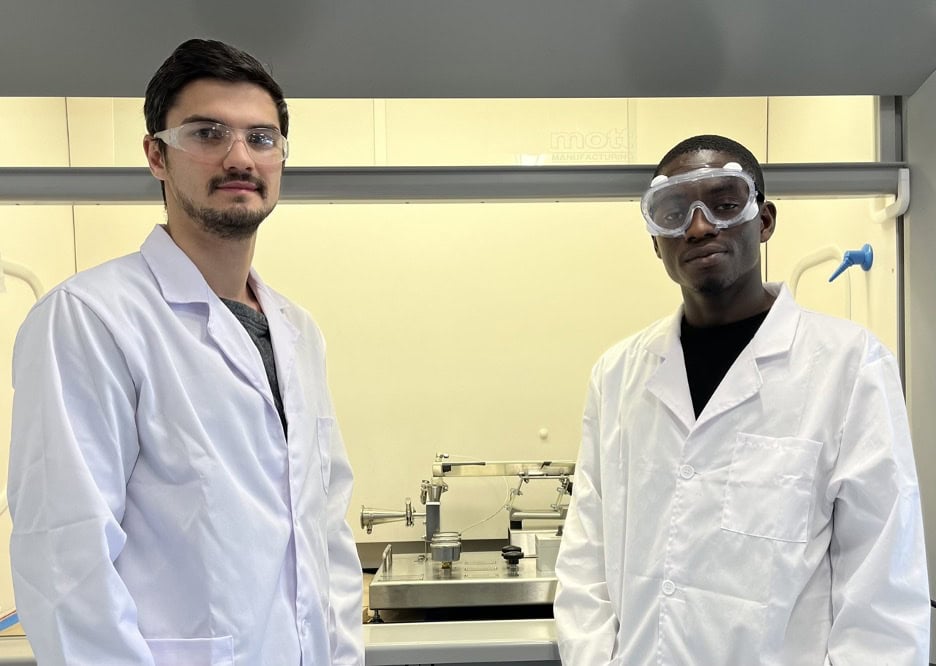
Morehead-Cain Global Fellow Fadilullahi Ayodeji Adeniyi ’26 (right), a lead author of the study, collaborated with doctoral student Vadim Shipitsyn on the research at the University of North Carolina at Chapel Hill. Global fellows pursue a fully funded year of undergraduate study and research at Carolina.
This story was originally published via the UNC Department of Applied Physical Sciences on May 4, 2026. Written by Dave DeFusco.
Morehead-Cain Global Fellow Fadilullahi Ayodeji Adeniyi ’26 and doctoral student Vadim Shipitsyn in the Department of Applied Physical Sciences at the University of North Carolina at Chapel Hill have found a simpler, cleaner way to prepare one of the most important parts of a battery. The scientists used a method called jet milling, which blows tiny particles together at very high speeds.
At the center of their work is a study, “A Guide from Laboratory Jet Milling as an Enabling Step in Sustainable All-Dry Manufacturing of Battery Materials,” published in Energy Storage Manufacturing Science. The research focuses on a small but powerful step in battery production that could make a big environmental difference.
Lithium-ion batteries power much of modern life, from smartphones and laptops to electric cars and even large data centers. But making these batteries, especially their cathodes—the part that stores and releases energy—is resource-intensive. Traditional methods rely heavily on water-based processes that consume vast amounts of water and energy.
“Conventional manufacturing can require enormous volumes of water and multiple drying steps, which adds both cost and environmental impact,” said Morehead-Cain Global Fellow Fadilullahi Ayodeji Adeniyi ’26, a lead author of the paper and a chemical engineering student at the University of Lagos in Lagos, Nigeria. “We wanted to explore a cleaner way to do this.”
That cleaner way is called “all-dry manufacturing.” As the name suggests, it removes water from the process almost entirely. But going dry introduces a new challenge: how to properly break down and prepare the tiny particles that make up battery materials.
This is where jet milling comes in. Jet milling is a technique that uses high-speed streams of gas, like compressed air or nitrogen, to smash particles together at high speed. These collisions break apart clumps of material into smaller, more uniform pieces without adding chemicals or generating much heat.
“Think of it like a controlled storm inside a chamber,” Vadim said. “Particles are caught in a fast-moving spiral of gas, colliding with each other again and again until they reach the right size.”
The team focused on a common battery material known as NMC532, a blend of nickel, manganese, and cobalt. After being heated at high temperatures, this material tends to form clusters of particles stuck together. For batteries to work efficiently, those clusters need to be separated into individual particles about 3 micrometers wide, or roughly 30 times smaller than the width of a human hair.
Using a laboratory-scale jet mill, the researchers carefully studied how different settings affect the outcome. They found that higher gas pressure—around 120 pounds per square inch—and controlled feeding of the material into the machine produced the best results.
“At the right conditions, we were able to break apart these clusters into clean, uniform particles without damaging their structure,” Fadilullahi said. “That’s critical for maintaining battery performance.”
After milling, the particles were briefly reheated to remove surface impurities and stabilize their structure. The result was a consistent, high-quality material ready for use in batteries. Beyond the technical details, the importance of the work lies in its potential impact, according to Assistant Professor Lin Ma of Caudill Laboratories.
“This research provides a practical roadmap for making battery materials in a more sustainable way,” said Lin, who led the study. “As demand for batteries continues to grow, we need manufacturing methods that reduce environmental strain while maintaining high performance.”
The implications are far-reaching. All-dry manufacturing could significantly cut water use, lower energy consumption and reduce waste in battery production. It may also lower costs, making clean energy technologies more accessible.
Fadilullahi said collaborating with Lin during his time at UNC–Chapel Hill has helped “transform purpose into action.”
“When I shared my long-term vision of helping solve energy poverty in Nigeria, Dr. Lin Ma’s words to me, ‘You have to do it,’ turned that dream into a personal responsibility—one I now carry with confidence,” the global fellow said. “He believed in my potential before he even knew me, welcomed me into his lab, and trusted me with meaningful research that has shaped my growth as an engineer and a researcher.”
More about Fadilullahi
Morehead-Cain Global Fellow Fadilullahi Ayodeji Adeniyi ’26 is a driven and multi-award-winning chemical engineering student at the University of Lagos, passionate about clean energy, data science, and sustainable development. A committed scholar, he earned the best WASSCE result in Lagos State Education District IV in 2020 and continues to pursue excellence in all areas of his academic and leadership journey. Fadilullahi led his team to win the 2024 NSChE hackathon with a pipeline leak detection app and secured first place in the NSE-ULES engineering quiz. As a Bridge Fellow in 2024 and dedicated chemistry tutor for public school students, he is invested in education equity and community advancement. He aspires to become both an engineer and educator, working to accelerate Nigeria’s transition to renewable energy.
More about the Morehead-Cain Global Fellows program
The Morehead-Cain Global Fellows program identifies, invests in, and empowers emerging leaders who seek to positively shape communities across the world. During their time at Carolina, global fellows engage in rigorous academics, immersive research, and meaningful cross-cultural exchange. The program includes funded travel within the United States, personal coaching from Morehead-Cain advisers, and yearlong leadership development designed to strengthen purpose, confidence, and impact. Global fellows return home with world-class research experience, an international network, and the skills to lead with clarity and purpose.