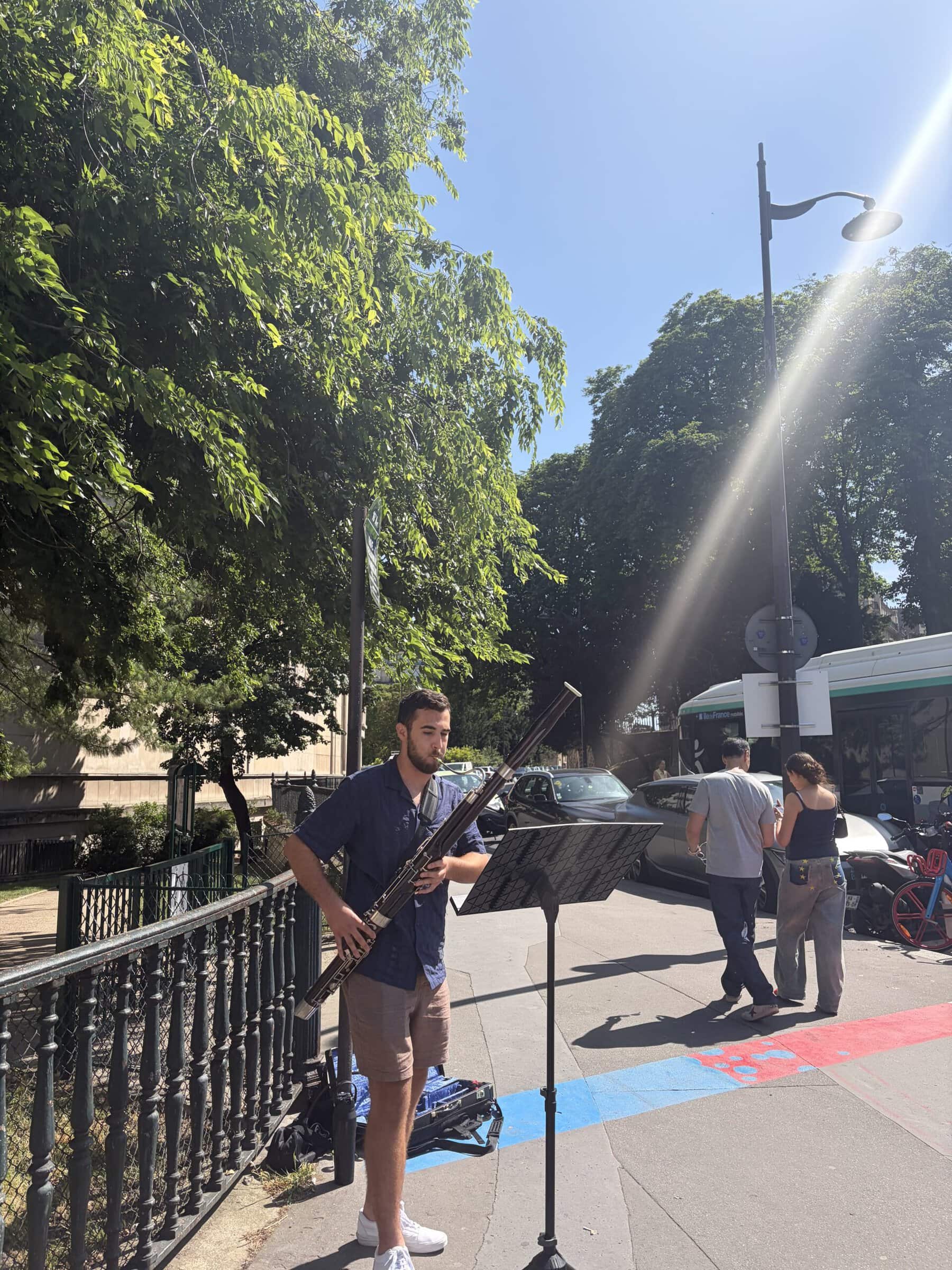
Jon Ayden Horne ’28 busks behind the Trocadéro in Paris, one of about a dozen performances he gave across Paris and Vienna as part of his research.
Jon Ayden Horne ’28 spent his Global Perspective summer studying how four composers’ lives influenced their music, and found some of his best research happened with a bassoon in his hands.
It was 5:30 p.m. at Notre-Dame Cathedral, and the late-afternoon sun was lighting up the Gothic facade when Jon Ayden Horne ’28 set up his stand and began to play his bassoon.
People stopped. Before long, thirty to forty of them had gathered around him, listening to the music and taking in the view. He played for half an hour before he had to move on.
“Those 30 minutes were magical,” Jon Ayden said, “and helped prove to myself that I can play at a level that receives recognition, and that the music of these composers is still recognized as well.”
It was one of about a dozen performances across Paris and Vienna, from Notre-Dame to a sidewalk behind the Trocadéro. For a biology major, those performances were more than street-corner entertainment. They were research in action. Busking let him experience each city’s music culture firsthand and feel what it’s like to perform where Debussy and Brahms once lived.
Jon Ayden designed an independent project to understand how the lives and surroundings of four composers shaped their music: Claude Debussy and Camille Saint-Saëns in Paris, and Johannes Brahms and Ludwig van Beethoven in Vienna. Knowing why a composer made certain choices, he explains, deepens the experience of playing and listening to the music.
Following the evidence
He expected architecture to be the throughline. He planned to focus on the imperial buildings Brahms watched rise, the Gothic structures around Debussy, and the Catholic churches where Beethoven performed.
“But as my research progressed, I found out that architecture had little influence on many of the composers I was studying,” Jon Ayden said. “I found that mostly nature, people, or unique experiences were the influencing factors behind many of the composers’ pieces.”
That discovery changed his approach. Instead of searching for a single defining influence, he began tracing how many smaller experiences added up to a composer’s musical choices.
He visited the composers’ graves, both popular stops for musicians. Debussy’s marker in Passy Cemetery is strikingly simple next to its neighbors. The Saint-Saëns family crypt in Montparnasse holds its own among the grandest graves nearby, and stars inside and out nod to the composer’s love of astronomy. Each site said something about how these artists saw themselves.
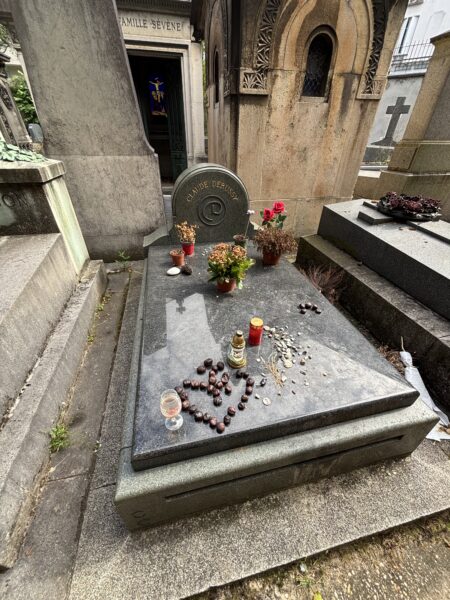
Visitors leave flowers, candles, stones, and chestnuts arranged in a heart on Claude Debussy’s grave in Paris’s Passy Cemetery, a simple marker set among grander tombs.
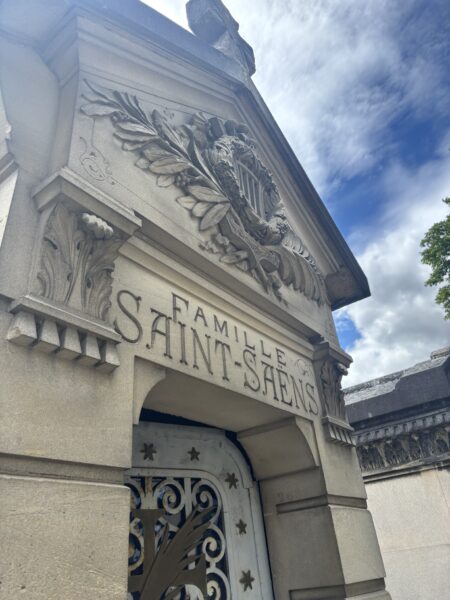
A carved lyre crowns the Saint-Saëns family crypt in Montparnasse Cemetery, where the stars on the door reflect the composer’s interest in astronomy.
In Vienna, he toured the Natural History Museum, built under Emperor Franz Joseph I during the building boom Brahms witnessed. He also walked Karlsplatz at night, where the illuminated St. Charles Church still dominates the square.
He consulted experts, including Rémi Copain of the Musée Debussy, and recorded snippets of his performances when it felt safe to set up his phone. By summer’s end, he had written a research paper on his findings and compiled recordings from both cities.
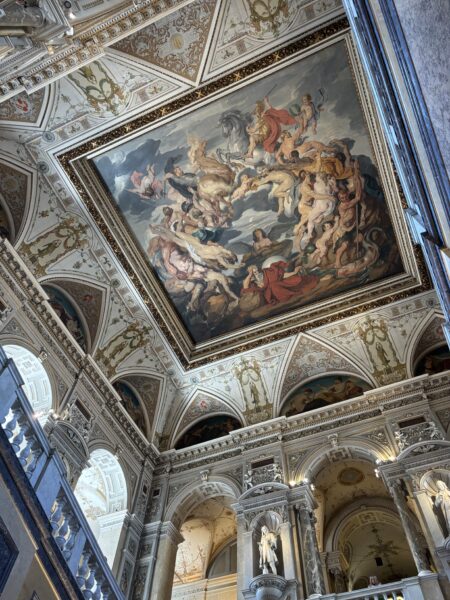
The ceiling above the grand staircase of Vienna’s Natural History Museum, one of the imperial landmarks built during Brahms’s years in the city.
Music for everyone
Jon Ayden was struck by how welcoming both communities were and how often ordinary people could help with his project.
“The biggest reason for this, and another surprise to me, was that there are public conservatories, music education schools, in each community that offer programming and music education to the public.”
That observation connects to his own plans. He hopes to keep performing throughout his life, especially in community music.
He was also surprised by his own staying power as burnout crept in, in cities full of distractions. “I was able to balance fun and work, and still complete my project,” he said.
Connecting music to medicine
On the surface, the project has little to do with his future as a biology major headed toward medicine.
“However, on a deeper level, it connects to the research that will follow me throughout my time in medical school and throughout my medical career,” he said. “This experience allows me to gain knowledge on how to formulate my own research, conduct it, and shift based on findings.”
Several skills carry over from musicology to medicine: designing independent research, recognizing when a hypothesis doesn’t match the evidence, and adjusting course accordingly.
The small and minute moments
Each time he played in the cities where this music was written, Jon Ayden was testing whether pieces that mattered 150 years ago still hold power today. The crowds that stopped to listen suggested they do.
“One need not the grandiose and large to appreciate truly living,” Jon Ayden said, “of which truly belongs to the small and minute moments that create each day.”
Now back in Chapel Hill, he’s on a path that leads toward hospitals more than concert halls, and toward disease pathways rather than Debussy. But that lesson may be the most valuable finding of his summer.