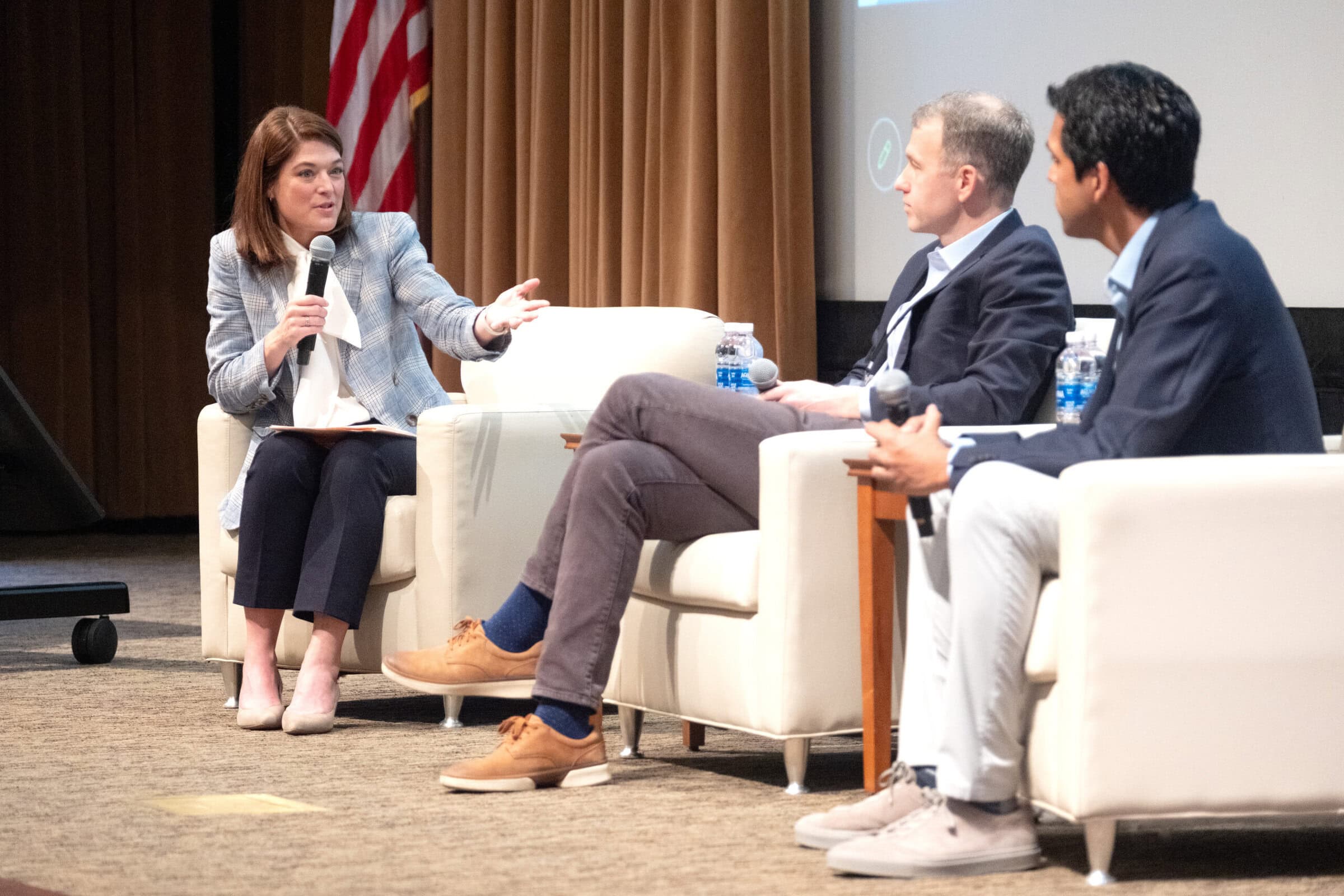
Marina Chase Carreker ’03 (left) participated in a panel entitled “Executive Dialogue: Perspectives from AI Industry Leaders” with Thompson Paine ’05 and Ronnie Chatterji. (Photo by Jon Gardiner/UNC-Chapel Hill)
Morehead-Cain Alumni helped lead the University of North Carolina at Chapel Hill’s first “AI for Public Good” conference on April 13, bringing together leaders from government, industry, and academia to explore how artificial intelligence can advance societal well-being.
Nearly 600 people attended the daylong event at the William and Ida Friday Center, where speakers focused on both the promise of AI and the challenges of deploying it responsibly.
The conference was co-chaired by Marina Chase Carreker ’03, founder of Galleon Strategies, and organized by Brad Ives ’86, senior advisor to the chancellor for strategy and planning at UNC–Chapel Hill.
Marina said the goal was to create space for practical, cross-sector conversations at a time when organizations are moving quickly to adopt AI tools.
“So much of how I approach my work today traces back to what I learned at Carolina,” she said. “Bringing this work back to Chapel Hill is incredibly meaningful to me.”
The keynote discussion featured Thompson Paine ’05, head of geopolitics at Anthropic, alongside OpenAI’s chief economist. Thompson, who studied political science and Asian studies at Carolina, now analyzes global AI trends and advises on their policy implications.
He said organizations developing AI have a responsibility to help others understand what’s coming.
“The qualities of problem-solving, curiosity, being entrepreneurial, seeing around corners are going to enable people to adapt to a world economy that will change quickly in their lifetime,” Thompson said. “UNC produces leaders uniquely well.”
Other Morehead-Cain Alumni participated as panelists and moderators, including Dan Folliard ’04, Derek Chiang ’00, and North Carolina State Treasurer Brad Briner ’99. Brad said AI is helping his office process large volumes of data and better identify financial risks facing municipalities.
Across sessions, speakers pointed to a common challenge: ensuring that rapid advances in AI are matched by thoughtful leadership and public trust.
For Thompson, that approach reflects lessons from his time at Carolina.
“UNC seeded a lot of curiosity in me and exposed me to things that I eventually found really interesting and part of my passion,” he said. “I developed confidence that it was not risky to pursue something that was uniquely interesting to me, even if everyone else wasn’t pursuing it.”
Marina said she hopes the conference will continue in the years ahead.
“My hope is that this conference is just the opening chapter of a long and fruitful dialogue about AI for the public good,” she said.