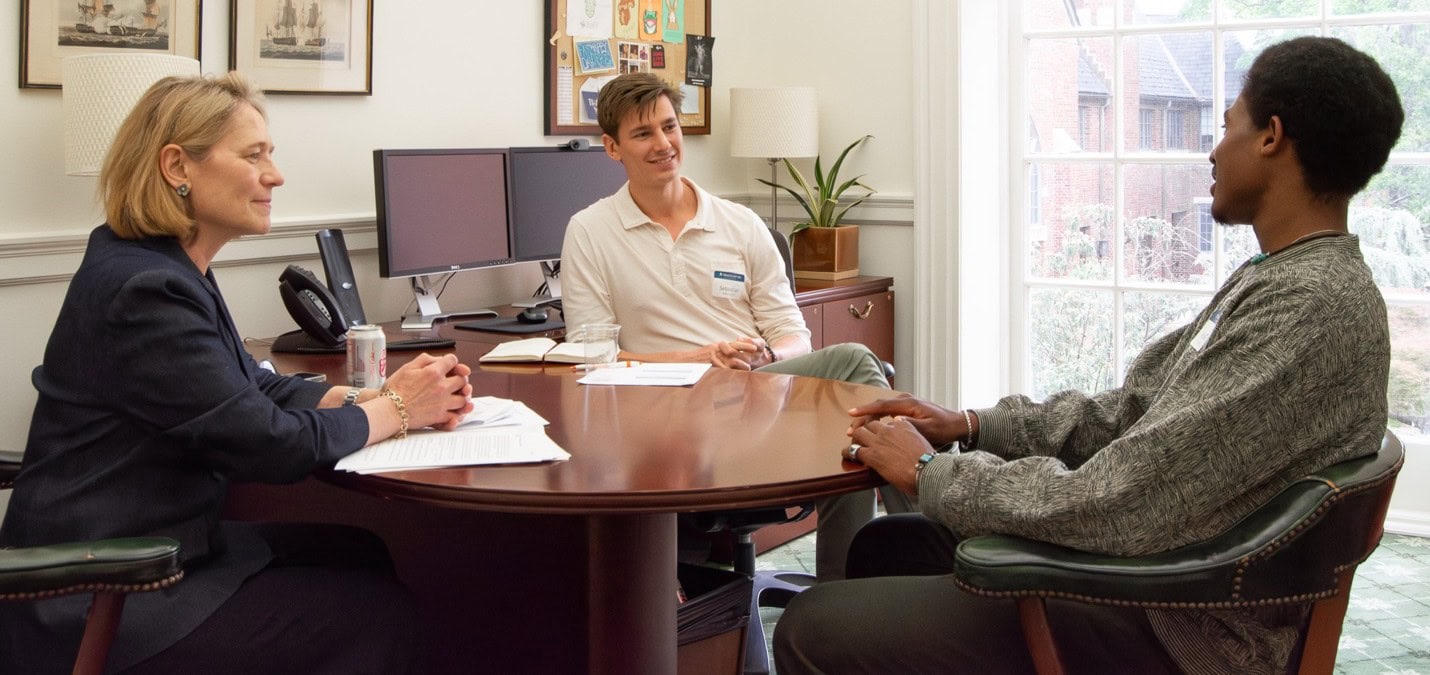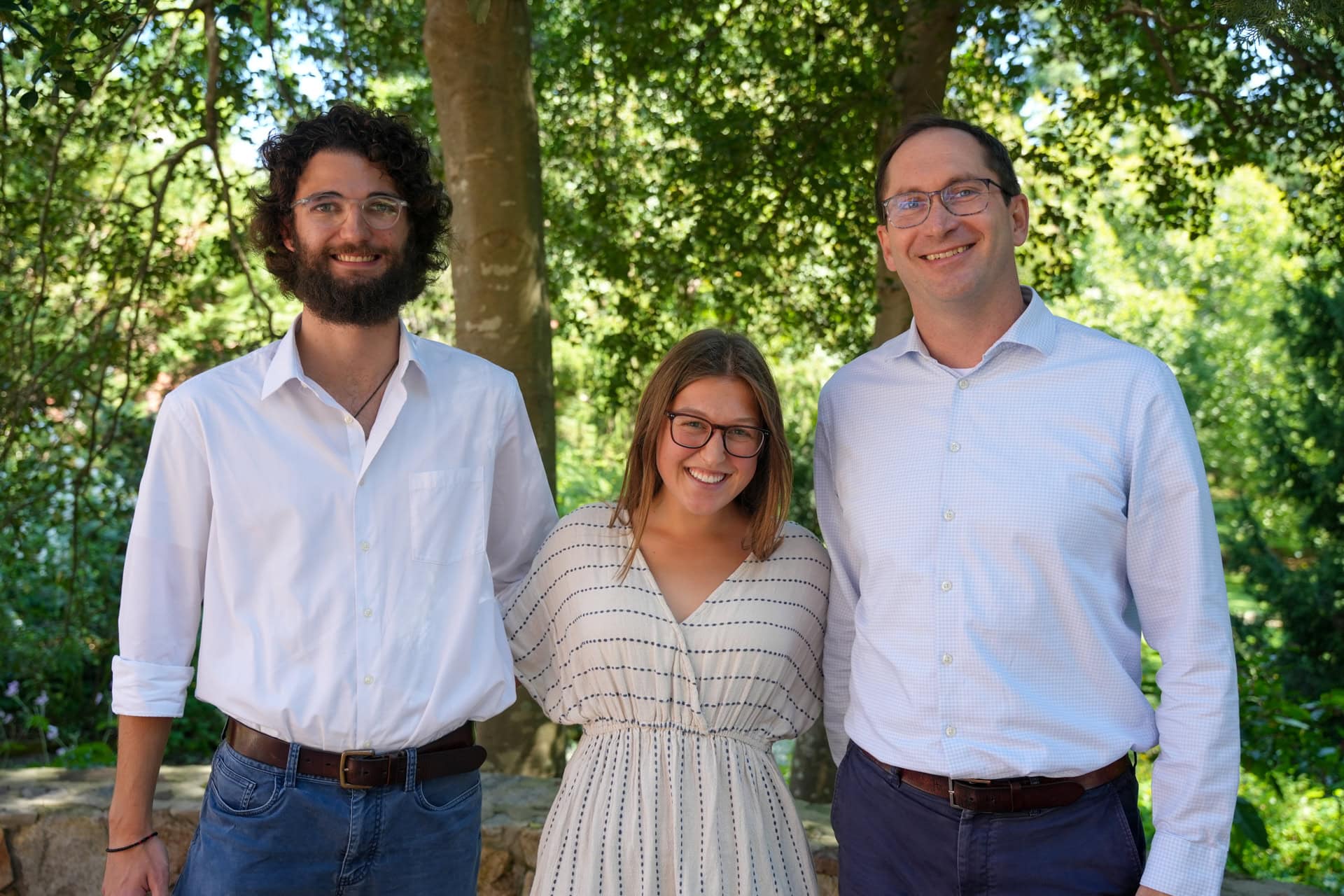
Isaac Watkins ’27, Catalyze host Ali Slack ’28, and Morehead-Cain President Chris Bradford
This is the first episode of “College as It Should Be,” a miniseries of the Catalyze podcast that features insights and stories from Morehead-Cain President Chris Bradford and current scholars and alumni.
On this episode, Ali Slack ’28 sits down with Chris and Isaac Watkins ’27 to talk about creating a “gym membership for your mind,” and what it takes to actually slow down and think in a world built to keep you scrolling, distracted, and disengaged.
Chris shares the Morehead-Cain Program’s philosophy in treating thinking as a discipline, not a mood. Isaac shares about how he built a personal reflection practice from deep in the woods, and what all scholars can do to be more intentional about their thought lives through reading, writing, and meditation.
Reading recommendations from Chris & Isaac
- A Swim in a Pond in the Rain by George Saunders—Chris’s recommendation; a book about reading, thinking, and writing that engages with classic Russian short stories
- The Desert Fathers: Sayings of the Early Christian Monks translated by Benedicta Ward—Isaac’s recommendation; a collection of sayings and encounters from monks and nuns over several centuries
- Nudge: Improving Decisions About Health, Wealth, and Happiness by Richard Thaler and Cass Sunstein—Isaac’s recommendation for thinking about how to prioritize time and build intentional habits
- “The Starship and the Cloister” by Niall Ferguson—An essay referenced by Chris; argues students need to put themselves into a cloister for a few hours each day while also engaging with modern technology
Music credits
The episode’s intro song is by scholar Scott Hallyburton ’22, guitarist of the band South of the Soul.
How to listen
On your mobile device, you can listen and subscribe to Catalyze on Apple Podcasts or Spotify. For any other podcast app, you can find the show using our RSS feed. You can let us know what you thought of the episode by finding us on social media @moreheadcain or you can email us at communications@moreheadcain.org.
Episode Transcription
(Ali)
Chris and Isaac, thank you for joining us.
(Chris)
Thanks for having us.
(Isaac)
Yeah, thanks.
(Ali)
To start off, what are both of y’all reading today?
(Isaac)
So, I’m reading two books right now. For fiction, I’m reading On the Road by Jack Kerouac. And then I’m reading this fun collection of letters from this twentieth-century monk called Sojourners by Matthew the Poor.
(Chris)
I’m reading a book called The Grasshopper. It’s actually a philosophical text, I think that’s as old as I am, by a philosopher named Bernard Suits. It argues that games are the fundamental purpose for human existence.
(Ali)
I’m currently reading Mansfield Park for a research project. And similarly, Isaac, I’m looking into Franciscan ethics, which is fascinating. So, today’s topic is creating a gym membership for your mind. Chris, what made you think of a gym as a metaphor for what scholars should be doing to make time for slow thinking?
(Chris)
Thank you for asking. I have spent much of the past few years wondering about what a college experience needs to look like in the 21st century. And it starts perhaps by asking, why do we choose to invest in university education at all as the Morehead-Cain Foundation? And the answer is presumably because we believe college is a place in which you learn how to think, right? It’s also a place in which you learn other things about how to socialize, how to engage with others, how to confront differences, how to learn how knowledge is constructed in different domains. But we could presumably have a foundation that just sent people on Outdoor Leadership trips for leadership learning through stretch. And we don’t do that, right? We choose to do that as part of a broader experience of college as it should be because we believe that college is a place that fosters the capacity for thinking, right? And thinking, as William Deresiewicz writes, is about concentrating on one thing long enough to be able to develop your own ideas about it. And we are trying to cultivate this work of thinking at a time in which there are many things that distract you from that work of concentrating on one thing long enough to develop your own idea about it.
And this is because you are going to college in a new kind of industrial and technological revolution. And the reason I called it a gym membership for your mind in my address to scholars last year was because I’m aware that I went to college after the first technological revolution that brought us all personal computers and the internet just before I started college. And the result is that I have spent a life pursuing largely office-based work in front of a computer.
My grandfather was a groundskeeper. He was a groundskeeper at a boarding school and then at a university. He never had to have a gym membership. The natural work of his day-to-day economic engagement kept his body fit and healthy into old age. But because I sit behind a computer, I also have to have a gym membership. I go to Orangetheory classes. And I fortunately did not grow up with the distractions of a smartphone, right? And so, I built practices of thinking and contemplation away from my computer that allowed me to develop the capacity to concentrate on one thing long enough to develop my own ideas about them.
And one of the things I think that is the great challenge of your generation is that you will both need a gym membership for your body. And you will need the equivalent of a gym membership for your mind, a cloistered space that you can go in which you do the hard work of reading and writing and thinking and intimate discussion that is not disintermediated by technology but allows you to concentrate on one thing long enough to develop your own idea about it.
(Ali)
I love that, and I know I’m a junior currently, and so I’ve seen that within this Program as something that I’ve grown in. I remember we were called to read Think Again by Adam Grant before Civic Collaboration, and it really challenged me before I went into a practical setting. And so, I know Isaac here is a senior and is someone who exemplified what you were talking about, this gym membership of the mind. So, Chris, can you share just why you think that Isaac illustrates this so well for our guests?
(Chris)
Well, before Isaac came here to Carolina, he decided to take a gap year, and he did a highly unusual thing on his gap year, which was he sort of had the full Thoreau’s Walden experience, right? We very memorably received typewritten letters from Isaac here at the Foundation in which he described his gap year experience because he was living in nature, reading books, and contemplating big questions about the world. And while he did many other things on his gap year as well, what I observed was that Isaac arrived in college with having built a practice of cloistered thinking that I think has caused him to grow into someone that we all admire for the way in which he steps away from technology and contemplates big, deep questions about life in the world. And so, Isaac, thank you for joining this podcast, and I look forward to learning from you how you do it in the noise of modern life.
(Isaac)
Thanks, Chris.
(Ali)
So, Isaac, let’s turn to you now. I’ve heard that you built a shack. Is that true? Where did that idea come from? And also, what exactly does that mean?
(Isaac)
That’s right. The shack is my preferred term. Others might say cabin, but I think that’s just trying to put lipstick on the pig, frankly. I suppose this all started in high school when I read Thoreau’s Walden and was enamored. I went into the woods because I wished to live deliberately to find the essential facts of life. And what’s a more noble endeavor than that? And so, I was on my gap year for a while, and I was like, okay, I got to figure out what I’m going to do next. And I kept thinking back to Thoreau, and I was like, okay, I need to try this. So, I came home, and my father and I drafted up plans about what I was going to build, and we spent six weeks building my shack in the woods. So, it was a shack, an outhouse, and then a very rustic outside kitchen, which was great.
(Ali)
What was the process of building something like that like?
(Isaac)
So, it was first like, one, how much money did I have? And two, how big did I want it to be? And I also tried to model it off of Thoreau’s guidelines in Walden. He’s very meticulous. I even, you know, had three chairs in my cabin, or my shack, just like him. One for self, one for company, or one for self, two for company, three for society. But I just could not build as big of a building as he had. And so, there’s pragmatic decisions, but settled on an eight-by-twelve-foot little rectangle building.
(Ali)
Would you mind sharing with us exactly what caused that need? Like you said that you read Thoreau and Walden Pond, but was there anything before that made you realize Thoreau had something, and there was something to this shack or this cabin?
(Isaac)
So, prior to this, on my gap year, I was in a rural village in Thailand for six months, and frankly, I was living in a shack there as well, and teaching and spending a lot of time hanging out with monks at the temple. And like, wow, there’s something to just stepping away from the world and thinking about these big problems that people have considered for thousands of years and to just read. Like, I realized I was so unread and wanted to sort of fix that before I came to Carolina.
(Ali)
Is there any way that you structure your life around spending time in this shack? Like, could you walk us through what life looks like as a very busy college student, but then also someone who is intentionally taking this time to think well?
(Isaac)
So, when I was in the shack, I would wake up when the sun rose because I didn’t have any technology. I had a watch, but I didn’t like to wear it. And so, when the birds started yapping, I would get up, make coffee. I would start my day with morning prayer and reading, some coffee on the little camp stove. And then it would take like two hours to cook breakfast because you forget that, you know, I can walk into my kitchen and turn on the sink and boom, hot water, soap, there’s a dishwasher. But you have to boil the water to wash your dishes. You have to, you know, treat your cast iron, dry everything out. We have bears. And so, I had to make sure to walk my dishwater far enough away to the hole I dug to make sure that the soap could decompose. And so, it’s just, everything takes so much time. But I was also reading at the time some works by some Buddhist monks about how everything has meaning and has value. Like, the whole universe is contained in an apple, because if you think about all the steps that led to this apple being grown, there’s particle dust from everything in it.
(Isaac)
And so, I tried to not be like, oh, it’s taken me two hours to wash my dishes and all I cooked was eggs, to, wow, wow, I’m getting to wash my dishes. How cool is that?
(Ali)
That’s a beautiful perspective change. I know I’m, as someone who’s grown up, and as I feel like you probably feel similarly, just with technology and in the age of efficiency, slowing down to do little things just like washing the dishes can be quite difficult. So, I’m curious, now that you are back at Carolina and a place that is moving quickly. Is there any way that you structure your days differently after spending time in the shack?
(Isaac)
I still love a good morning routine. My roommates like to make fun of me because I have a hand coffee grinder, and like even in the dorm I’d wake up early enough to like to have a long process of making coffee instead of just using like a K-Cup, just because I like the intentionality that physically goes into a process like that. And then it’s very easy when you have this sort of morning ritual, because I’m decaffeinated, I can’t think to add things onto it. And so, if you wake up early enough, you can get this long chain of things to do before the day starts that even regardless of what happens in my day, I’ve done this in the beginning. So, I still like to pray the morning office and to journal and to read, to read the news while I’m eating breakfast, go for a run, add all this chain together, and it kind of gives a good foundation to build the rest of the day upon.
(Ali)
It’s almost like you’re building a way of life before what we traditionally think of as life, as work and school begins. And I think that’s beautiful. So, I guess, what would you tell a scholar who hears all of this and is like, wow, Isaac, this sounds amazing, but I don’t really have time for this. I didn’t spend time in a shack. What would you say to them to encourage them that actually this is something that they might be able to implement?
(Isaac)
I think baby steps are the way to go about everything, right? Rome wasn’t built in a day. And there’s just small things you can do, like I’m going to wake up fifteen minutes early, or I’m going to wake up at the same time and just not get on my phone for fifteen minutes, to do whatever you think you need to do. I mean, I love journaling. I kind of think by writing things out. Not everyone loves journaling, and that’s okay, but if that’s something you can just try for a bit, or read something, anything that’s not required reading, just start with fifteen minutes and you might fall in love with it and want to expand and expand.
(Ali)
As a follow-up question, are journaling and reading things that you do because you love to do them or because they get at something deeper, which is perhaps like a love of learning or just a general curiosity?
(Isaac)
It’s a bit trite, but I think I’m obsessed with truth or whatever that means. And I find journaling is a way of sort of thinking about what I think about that. And also, to just reflect upon my day and my character. And then reading, I mean, I’m a religion and classics major. I like reading old things and I think there’s lots of value in what people have thought before. And so, I see reading as a way of, you know, there’s lots of things I need to know about the world that I can’t do because time is short. So, I can read what other people have done and think about this thing to shortcut. That’s beautiful.
(Ali)
I’m also a Greek minor, so we share this in common. Any last words of wisdom or little books that you would recommend our listeners read or check out?
(Isaac)
Ironically, or maybe not ironically, but surprisingly, a book that I think has really helped me and sort of thinking about how to prioritize my time is, I think it’s called Nudge. It’s like an economist book.
(Chris)
Richard Thaler?
(Isaac)
Yes, by Richard Thaler. Because it’s very easy to sort of trick yourself into doing things you want to do. I mean, the famous is like, let me lay out my running clothes the night before so when I wake up, that’s one less thing for me to have to do. I also like doing the inverse. I think it’s called sludge. It’s like making things intentionally harder for yourself. So, I mean, I hate my phone and my laptop, but I do have to use them. I can’t write essays by hand or probably shouldn’t, but I am—email is like a terrible thing, but I will intentionally not sign into my email. And, like, put my phone in a different room. Because even if I sign into my email, I have to do my little Duo push or put in my little numbers from my phone, which means I have to get up, go downstairs, get my phone, type in the password to my phone, type in the password to my authenticator—like, five, ten minutes, and I’m lazy. And so, it’s, like, a good way to force me not to look at my email instead of writing.
(Ali)
And I also like that because it’s returning technology back to what it was initially supposed to be, which is a tool. Rather than something that’s consuming all of our time. I feel very inspired by this conversation, so thank you so much for sharing all of this. Chris, did anything surprise you today about Isaac’s story?
(Chris)
No, I like the fact that you’ve really thought about your routine and like how you use your—how you use your time, what’s the nature of the routine that gets you into your thinking. At the end of the day, a gym membership for your mind is about a set of daily practices that get you thinking for yourself. And I think some people hear me talk about the importance of a gym membership for your mind, or they hear me talk about creating your own personal Walden, right? And they imagine that I must be some sort of Luddite, right? I actually think that there are lots of reasons that we all need to be engaging with modern technology. We all need to understand and have experience. working with the AI tools of the present moment, because they’re going to guide so much of our economy and so much of the interactions of our peers with each other and with the world. But I think that we need space to process those things. We need space to think about, to think for ourselves, and space to discuss the way in which we’re processing the world around us with other people with disintermediation from technology.
And I’m hopeful that every Morehead-Cain Scholar and every student at Carolina can find places to create that type of experience. The historian Niall Ferguson wrote an essay probably about a year and a half ago called The Starship and the Cloister, right? And he argues that students in colleges today really need to put themselves into a cloister like their own personal Walden for a few hours a day. Of work, engaging with great texts, recognizing that when you engage with a great text and you think about it and discuss it, you’re actually capturing the sum total of human knowledge for yourself. And that’s going to prepare you for the rest of your day in the starship and making the most of these technological tools for the grand challenges that you seek to address in our broader society. And I think that if you are only in the starship all day, you risk outsourcing your thinking, outsourcing the development of your own processing capacity, your own soul, right, to a scroll that will happily tell you what to think about everything, right? And by finding time that is both in the starship and in the cloister, by building that gym membership as a daily practice, I think that you will settle into a routine that will serve you well, not just as a college student, but will serve you well throughout your life.
(Ali)
I love that, Chris. And the idea of not losing your soul to the scroll is definitely something that’s going to stick with me. For our listeners, are there any questions, Chris, that you’d have, or Isaac, to reflect on just for fifteen minutes of the day?
(Isaac)
I’ve been thinking a lot, and Chris, you’re partially to blame for this, about what the university is for. And there’s lots that can be said about this. And searching for the truth is a fine answer, but there’s lots of embedded problems in that answer. For one, what is truth? How do we search for it? But what I’ve been thinking about is, what do we do with it when we have the truth? Especially when truth seems so personal now, or like it’s something we can possess for ourselves and not something that we reach for, for us as a community. And I don’t know, I’ve been thinking a lot about truth isn’t this thing that we reach. Truth is this thing that calls us to act. And that part of the university is learning what is so that we can think about what should be and kind of being called into action, right? It’s almost a sort of moral force as well. And so, what is the relationship between truth as this object of knowledge and the relationship of knowledge that calls us to do?
(Ali)
I love that. I see the classics focus.
(Chris)
Ali, you asked about some questions. And with where I am, I think in my life, there are two things that I like to think about at the end of each day. The first is I like to think about something that—an idea I engaged with today. What’s an idea I came across today that piqued my curiosity or made me feel a little bit uncomfortable? And how can I articulate that idea such that I might learn something more about it? The other thing that I spend time with each day is, what’s a human interaction I had today that maybe didn’t go the way I expected or leaves me asking some questions about the difference between my perspective and that other person’s perspective on a particular problem? As you can imagine, these things happen just in the context of working in an office. every single day and having to collaborate with other people. But I think that when—if we create space to reflect on both ideas and how we might learn about them, right, and people and what we might have learned from an engagement we had with them, it actually is building the core capacities we need for a lifelong leadership journey.
And for the development of our own character, right? I have a flawed and imperfect understanding of many ideas, right? Because there is a very large zone of things that I both don’t know and a large zone of things I don’t know I don’t know, right? And by identifying these little ideas and thinking about how I might chip away at them, it helps me shrink my I-don’t-know zone a little bit. Similarly, I have very imperfect relationships with any number of people who I collaborate with or rely on every day or feel that I don’t necessarily show up in the best way in every single circumstance. And by reflecting on those interactions and the engagement that someone else has in that space, I can consider how I might like to show up differently and experiment with other ideas about myself that I think will be fundamental to our future. Our future both requires us to engage with ideas and consider what’s the truth, as Isaac says, but it also requires us to engage with other people and build relationships and drive human systems to a better form than the form in which we find them today. And I think each of those things is an easy area upon which we could reflect each day.
(Ali)
I love that. Hearing from both of you, what I’m getting is that not only does this gym membership build your mind, but it also builds the capacity for empathy. And that’s something that’s beautiful about reading and thinking. So, in final and closing, any recommendations of readings or different books, podcasts, essays that our readers, that our listeners could be engaging with?
(Chris)
Well, Ali, you might know that for the last two years, I’ve sent all of the first-year students in the Morehead-Cain Program a book, which is George Saunders’ A Swim in a Pond in the Rain. It was a book that was recommended to me by Morehead-Cain Alumna Margaret Gardner ’88, and it’s a stunning book because it’s a book about the work of reading and thinking and writing by a great writer. But the way the book unfolds is by engaging with a series of classic Russian short stories. In many cases, short stories I had read before, but now was engaging with differently because I’m reading them at a different time in my life with that reading facilitated by a great writer. And so, I’ve encouraged all of our scholars to read this book because I think it’s a pathway into the work of thinking.
(Ali)
Beautiful. Isaac, do you have anything?
(Isaac)
Not to be too on the nose, but I would recommend reading, or at least skimming through and reading, some of the excerpts of The Desert Fathers. It’s a collection over a few centuries of these sayings and interactions and encounters from all sorts of monks and nuns. And seeing, even like, even if you’re not spiritually or religiously inclined, seeing how these people that separate themselves from the world and spend time studying and reading and praying sort of approach life and different problems that arise, it’s really powerful for thinking about interactions with other people and gaining empathy and thinking like—well, one example that comes to mind is that this young monk is walking down the road with another monk and he sees a bag of gold on the ground. And in a different edition, I don’t even think it’s a bag of gold, I think it’s a coin. And he’s like, picks it up and puts it in his pocket and he’s like, oh, I’m going to go put this in the offering plate for the monastery. What many people might say, okay, a fine thing, it’s on the road, who knows? Well, the older monk scolds him and says, what are you doing?
(Isaac)
What you did not put down, do not pick up. Which is just—I think both monks did something that we could see the value in, and there’s virtue in both things, but that was a reading of the situation that I would not have considered. And pondering over that has lots of implications about what do I think is right, what affects me, who has responsibility for a thing. And there’s hundreds of these stories.
(Chris)
I do hope you pick up litter, however, as you stroll through our beautiful public university campus.
(Ali)
Yes. Yes. Well, thank you so much for being here, Chris and Isaac. I’m feeling inspired to pick up a book, to set some intentional time and get a gym membership for my own mind.
(Chris)
Thank you for having us, Ali.
(Isaac)
Thanks.