Through Progress Conversations, Morehead-Cain Scholars step out of the momentum of college life and into something increasingly rare: time to reflect, ask important questions, and talk it through with someone who has walked the journey before them.
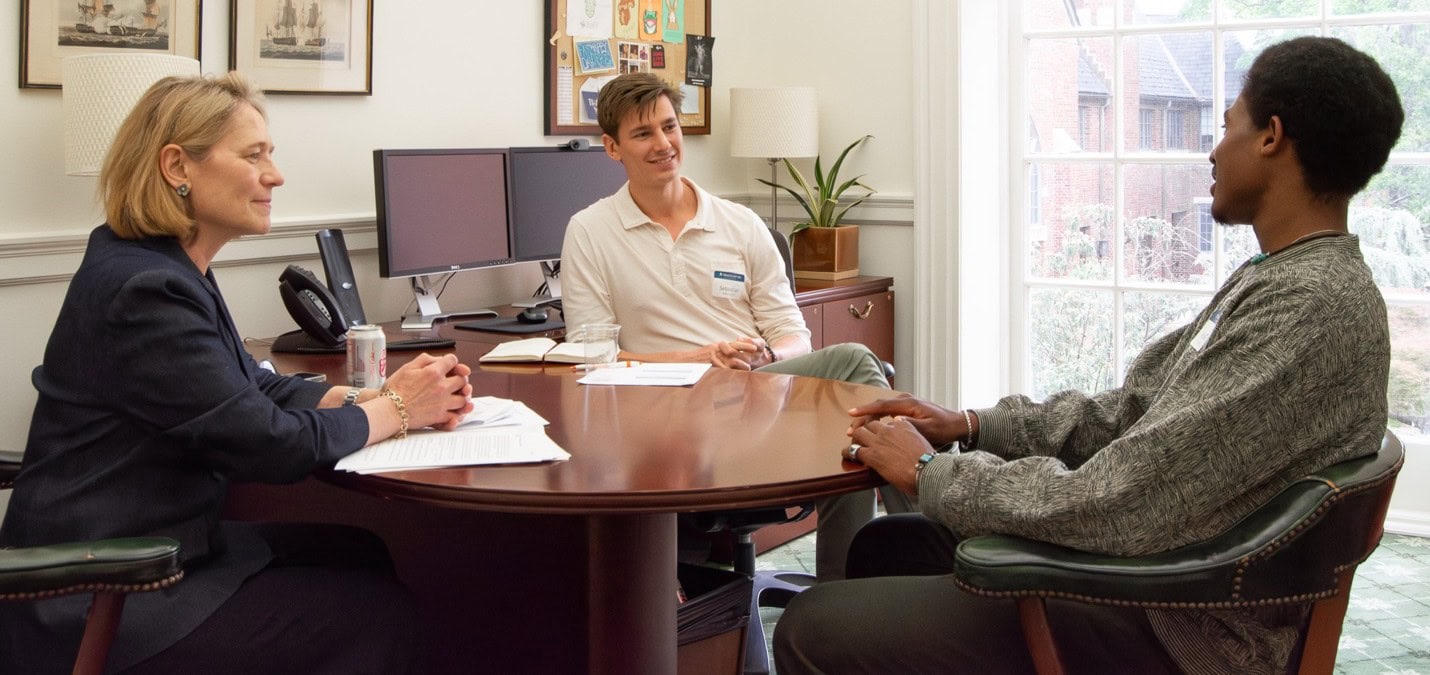
(From left) Susan Adler Alesina ’86, Sebastian Nabatoff ’19, and Kendall Ford ’28 at Progress Conversations on April 25, 2025. (Photo by Emma Coye ’26)
College has a way of keeping students in motion.
There is always another class to take, organization to join, opportunity to pursue, or decision to make. For high-achieving students, the drumbeat of forward momentum can feel like progress, even as it leaves little room to consider whether their pursuits are truly aligned to their interests and passions.
Progress Conversations invite Morehead-Cain Scholars to do something different: pause.
Introduced in 2024, the initiative pairs scholars with Morehead-Cain Alumni for structured conversations about what they are learning, where they are stretching, how they are spending their time, and what they want to pursue next.
The first conversations brought together thirty-four scholars and eleven alumni representing four decades of Morehead-Cain experience. The premise was simple but consequential: reflection becomes more powerful when it moves beyond an individual exercise and into conversation.
The conversations are not evaluations or networking sessions. Rather, they give scholars space to examine the choices they are making and become more intentional about what comes next.
The idea grew from an observation by Julie DeVoe, Morehead-Cain Vice President of Scholar Development, and the Scholar Advising team: transformative experiences do not necessarily produce learning on their own. Scholars need time to understand what those experiences have taught them.
“In general, our scholars and college students work at a pretty fast pace. They’re always ready to move on to the next fun or great experience and plan for the future,” DeVoe said. “But when you have big stretch experiences and leadership moments, it’s important to have time for reflection to actually draw out the wisdom of those experiences and make meaning.”
Progress Conversations create a deliberate pause in that momentum.
Preparing to think differently
The conversation begins before an alumnus asks the first question.
Scholars who elect to participate complete prework designed to slow down their thinking and help them arrive ready to engage.
In previous years’ prework, scholars have been asked to examine how they spent their time, reflect on their experiences working with teams and observing leadership, and identify goals for the year ahead. The fall 2026 prework asked scholars to go further by considering how they are living the Morehead-Cain Community Standards, identifying experiences that will stretch them, noticing the people and communities shaping them, and distinguishing between opportunities that are genuinely meaningful and those that may simply appear impressive.
Those questions return to something fundamental, DeVoe said, by not simply asking what scholars are doing, but why.
“Are these activities aligned with their values? Are they aligned with what’s important to them, the things that they want to learn and how they want to grow?” she said.
For Dani Simon ’26, who participated in Progress Conversations each time they were offered during his undergraduate years, the preparation made his choices about time and growth more visible.
Before one conversation, a time-audit exercise prompted Simon to look closely at his campus commitments. Seeing his time laid out helped him recognize that an activity he enjoyed was no longer where he was growing most.
“I was happy to notice that this wasn’t where I felt like I was growing the most,” Simon said. That clarity helped him redirect some of his time toward a leadership role that offered new challenges.

Dani Simon ’26 (pictured at the Morehead-Cain Latinx Alumni and Scholars meetup during the 2025 Alumni Forum) participated in Progress Conversations each time they were offered as an undergraduate, meeting with the same two alumni coaches over three years. (Photo by Leon Godwin)
A coach, not an answer key
Alumni receive preparation of their own.
The Alumni Coach Conversation Guide provides a framework and questions but deliberately stops short of offering a script. Coaches are encouraged to listen closely, use observation and inquiry, and allow the scholar to do most of the talking. That distinction matters.
Scholars can naturally look to someone with more experience and ask, in effect, What would you do? The instinct may be to answer. The coaching approach is often to ask another question.
What feels meaningful about this opportunity? What happens if you play this decision forward for a year? Is this something you truly want or something you think you should want?
Simon remembers entering his first Progress Conversation near the end of his sophomore year with an urgent question: What should he do to prepare for a successful career after Carolina? Consulting appeared to offer a safe, established path, even though he was not particularly excited by the work. Looking back, Simon realized he was hoping his alumni coaches, Jamie Rosenberg ’92 and Marina Chase Carreker ’03, would validate his instinct that he didn’t have to follow a traditional route.
Instead, they brought the conversation closer to the present.
Rosenberg and Carreker focused on the leadership experiences already in front of him, how he was showing up on campus, where he wanted to grow, and what he might do differently in the coming year.
“These types of conversations are not about prescribing a path or trying to follow in someone’s footsteps,” DeVoe said. “It’s about the scholar really listening to what they want, what their goals are, and figuring that out for themselves.”
For alumni coaches, that approach can require a shift in mindset, too.
“It’s hard at first to fight the instinct to give advice,” said Carreker, who has participated in every round of Progress Conversations. “We’re very used to having young people come to us in search of advice, and then we give advice. The exercise is to help the scholars do some introspective thinking about what they probably already know, but haven’t taken the time to work through.”
Their own experiences still enter the conversation, but often in a different way. Rather than recounting a sequence of career moves, alumni can draw on what they have learned from the turns their lives have taken.
For DeVoe, the distinction is central to the larger work of scholar development.
“Learning to make decisions is one of the most important things we encourage scholars to practice,” she said. “It takes practice to learn what to listen to from the outside world and what to listen to from yourself.”
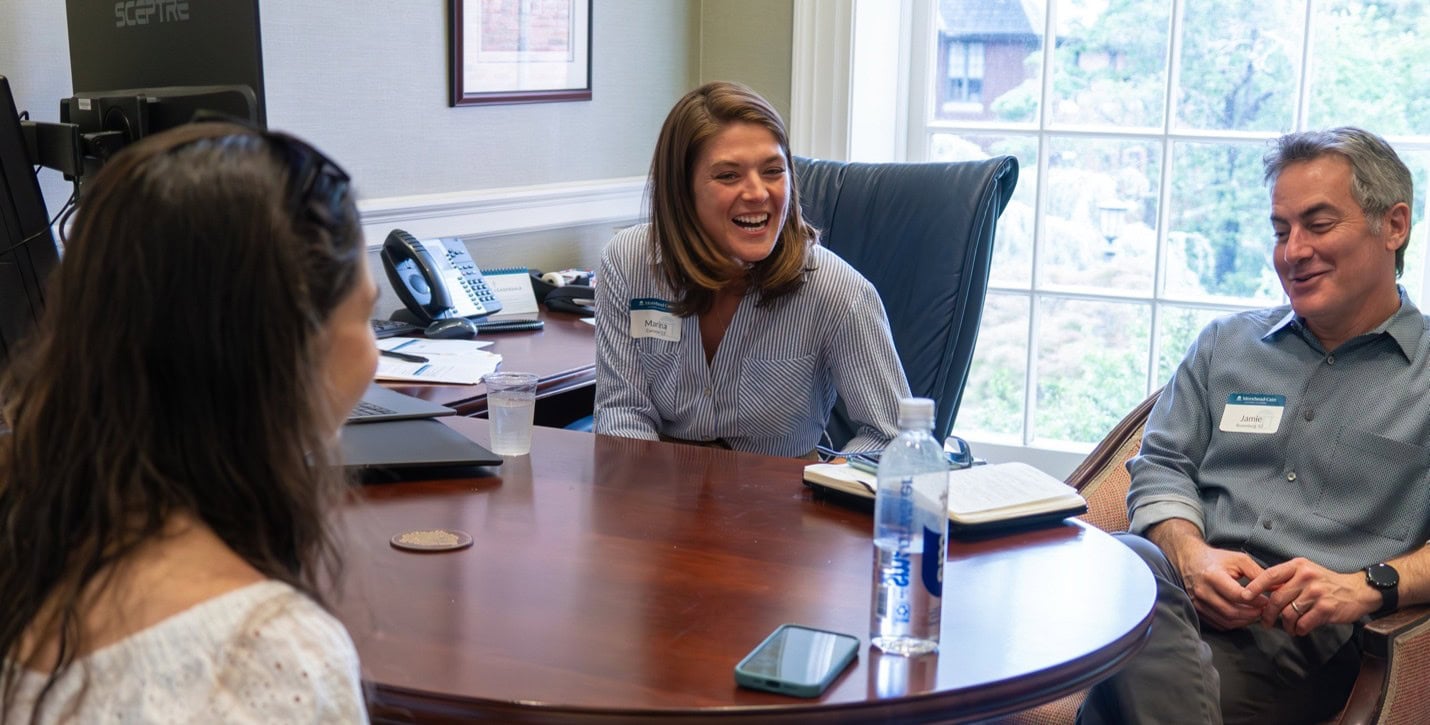
Marina Chase Carreker ’03 (center) and Jamie Rosenberg ’92 (right) at Progress Conversations on April 24, 2025.
Learning from the conversations themselves
Progress Conversations were designed to be a reflective opportunity for scholars, but the programmatic learning does not end there.
After each session, Morehead-Cain surveys scholars and alumni about what worked, what they noticed, and whether the conversations gave scholars greater clarity about their goals and sense of purpose.
Their feedback has helped shape what Progress Conversations have become.
Early feedback also helped the Foundation identify when those conversations could be most useful. One such moment is the beginning of sophomore year.
By then, decisions about academics, career exploration, summer experiences, and other commitments can begin to feel more consequential. In fall 2026, Progress Conversations were offered exclusively to sophomore scholars and newly-arrived global fellows.
“The beginning of sophomore year is often a tough spot,” said DeVoe. “It’s a time when scholars feel the pressure ratchets up, and a lot of decisions are being made. It can feel like all the decisions need to be made at once.”
Returning alumni coaches can also see how a scholar’s thinking changes over time.
Simon’s repeated conversations with Rosenberg and Carreker gave him the opportunity to return to the same questions and see evidence of his own growth. One recurring topic was delegation.
“It was really helpful to have two people who are very good leaders pick out that, ‘Yeah, you have a delegation problem,’” Simon said. “And then a year later, we’d pick it up, and a year later, we’d pick it up again.”
By his final Progress Conversation, Simon could point to a leadership experience in which he had learned to give other students greater ownership and began to see delegation not simply as distributing work but as a way to invest in other people’s development.
“Constantly getting to follow up on the same threads and aspects of leadership was incredibly helpful,” he said.
Carreker sees that continuity from the other side of the table.
“It’s been really rewarding year over year to see changes in the scholars,” she said, particularly when those changes reflect areas Morehead-Cain and scholars have been intentionally working to develop. “It’s very encouraging to get to see that firsthand.”
But scholars are not the only ones who leave the conversations reflecting.
Alumni coaches have consistently told the Foundation that they take something from the experience, too: the joy of connecting with scholars, questions worth considering in their own lives, and relationships with fellow alumni they might not otherwise have had the opportunity to know.
Several alumni have even told DeVoe that the experience made them want a Progress Conversation of their own.
“How often do we stop in our lives to really take stock of where we are, ask hard questions, and then work through that with a trusted person who serves as a sounding board?” she said.
The conversations have also created a unique opportunity for connection across generations of Morehead-Cain Alumni. In fall 2026, eighteen alumni coaches represented class years spanning every decade from the 1970s through the 2010s.
“We’ve heard it from alumni in the past, and we heard it again this time,” DeVoe said. “They’re really amazed at how much they get out of Progress Conversations and how much they enjoy the experience working with an intergenerational group of alumni.”
Carreker said in addition to the joy of connecting with fellow alumni, the setting feels different from other alumni gatherings because they are not convening primarily around their own experiences or professional interests.
“With the Progress Conversations, everything is structured in service of the scholars,” she said. “You get together with alumni, some of whom you know and some of whom you don’t, and work on a project together that impacts scholars and serves the Foundation’s mission.”
That shared work, she said, “gives it a different feel, and one that’s truly rewarding.”
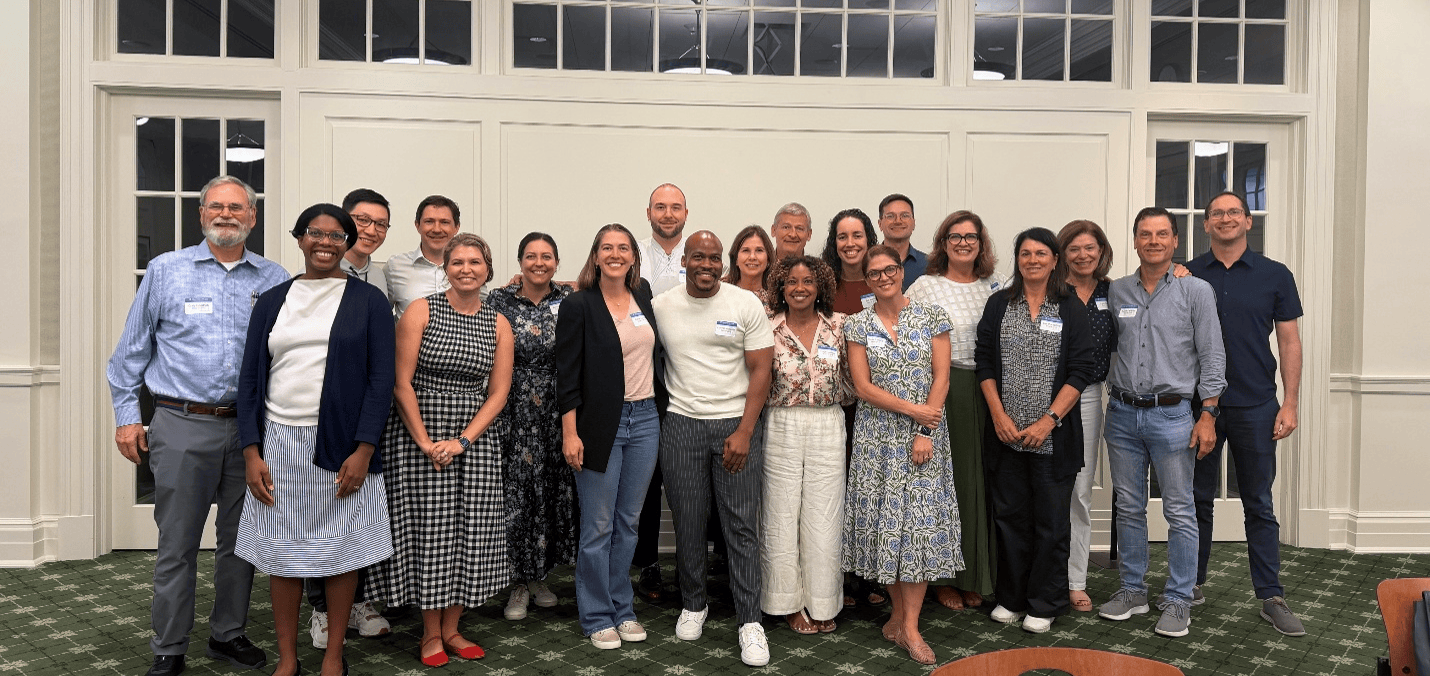
Alumni coaches and Morehead-Cain Staff at Progress Conversations on September 19, 2026.
Progress without a predetermined path
Morehead-Cain’s Community Standards describe leadership as a lifelong journey, grounded not only in titles but in everyday actions and behaviors. They call scholars toward self-awareness and reflection, intellectual stretch, responsibility, and investment in community.
Progress Conversations put those aspirations into practice by creating space for scholars to examine their experiences, make sense of what they are learning, and decide what they want to carry forward.
That kind of reflection is already familiar to scholars: Morehead-Cain Scholar Advisors ask thoughtful questions, listen closely, and help scholars make sense of their own experiences. But alumni bring another perspective to that work, not as replacements for advisors but as members of the Morehead-Cain community who have navigated their own choices, detours, and turning points.
The Foundation provides structure, preparation, and questions. Morehead-Cain Alumni bring perspective shaped by experience. The scholar decides what to do with it.
For Simon, his conversations have carried beyond Carolina. His career path looks different from the one he was contemplating when he entered his first Progress Conversation. Rather than optimizing his first job around a particular title, he ultimately looked for work where he could learn from strong leaders and problem-solvers while taking on meaningful ownership and responsibility.
He has also carried forward the habit of reflection and feedback. In the first months of his new job, he intentionally built regular feedback conversations with his manager into his work routine, including a short weekly check-in about what is working, what is not, and where he can improve.
There is no single outcome a Progress Conversation is meant to produce. A scholar may leave with a concrete next step, a better question, a clearer sense of what matters, or the permission to let something go.
Progress, after all, is not always about moving faster. Sometimes it is pausing long enough to hear yourself think