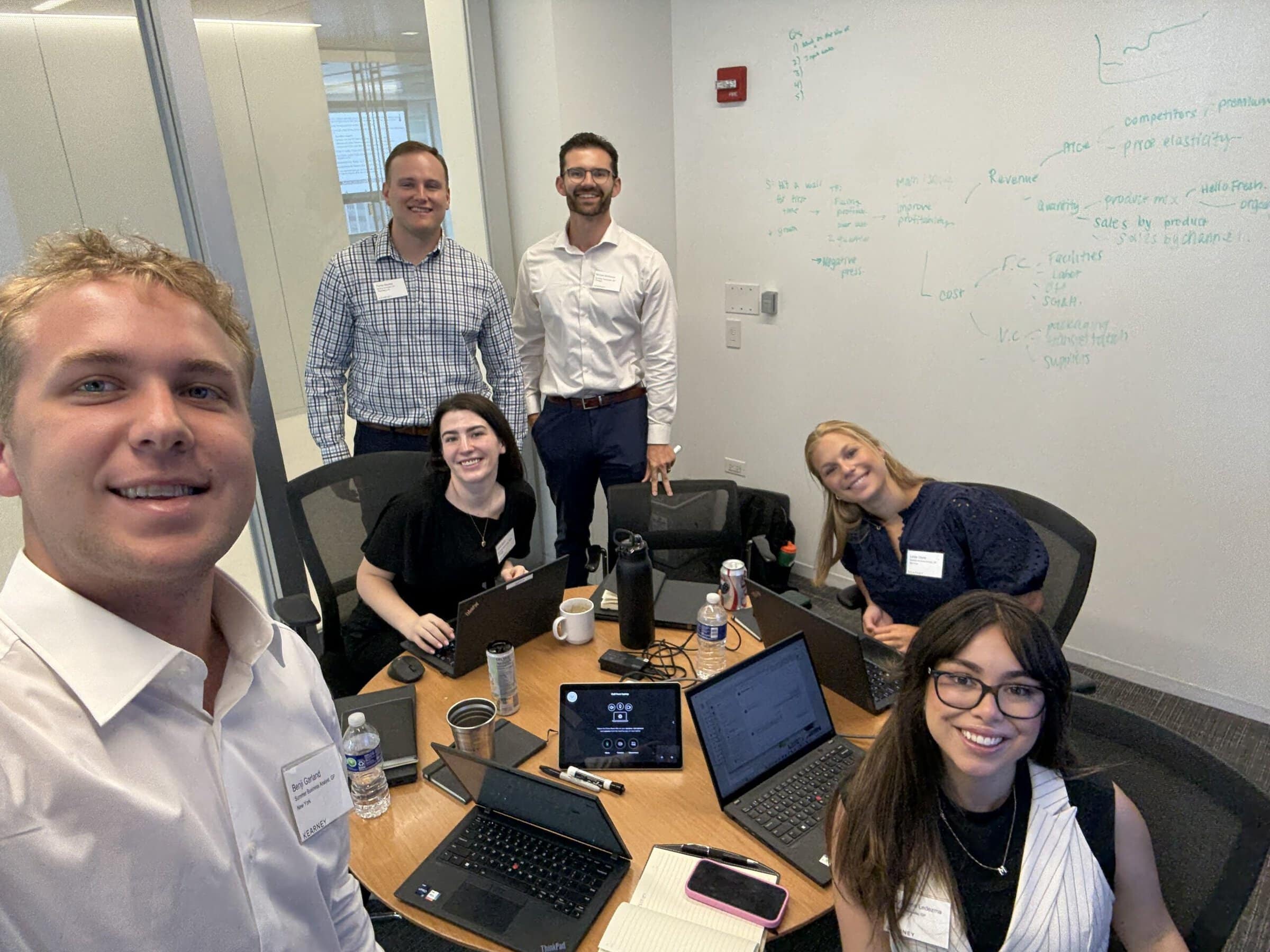
Benji Garland ’27 works with fellow interns on a mini-engagement during training week in Chicago.
Benji Garland ’27 spent his Professional Experience summer at Kearney working on a first-of-its-kind telecommunications deal, and learned that the hardest part of systems work is explaining it to people.
Benji Garland ’27 had never considered all the subtle, unsung aspects of his life powered by network infrastructure.
Then the partner on the IT workstream described the impact of fiber networks: where they travel, what happens when they connect, and what breaks when they go out. Suddenly, Benji was looking at his phone differently. His laptop. The systems running hospitals and airports and everything else that depends on invisible cables carrying light through glass.
“I immediately became invested in the project,” Benji said.
He was in New York City for his Professional Experience summer, working at Kearney, a global management consulting firm, on a telecommunications engagement unlike anything the U.S. TelCo market had seen before. Every two weeks, he traveled to Chicago for full-team colocations. The rest of the time, he worked from a desk in the Empire State Building with a view that reminded him daily of the importance of good infrastructure. Even when you can’t see it.
Four companies, one system, unlimited complexity
The engagement was a first-of-its-kind telecommunications transaction: simultaneously integrate two regional fiber operators while transforming the combined entity for a wholesale agreement with T-Mobile.
Benji worked in the IT workstream, designing an IT system stack that could serve every aspect of the business, supporting employee, customer, and business needs as the deal progressed from pre-close planning to post-close implementation.
His specific focus: migrating every company onto the same HR and payroll platform.
“I conducted client interviews to map current system functions and vendor interviews to assess platform capabilities,” Benji said. “I ultimately shaped Kearney’s official recommendation on which HR and payroll system should be used and the migration timeline.”
He also worked across the workstream, contributing to case study research, system analysis, and presentations.
It was technical work. System architecture. Migration planning. The kind of project that sounds like it’s all about technology.
Except it wasn’t.
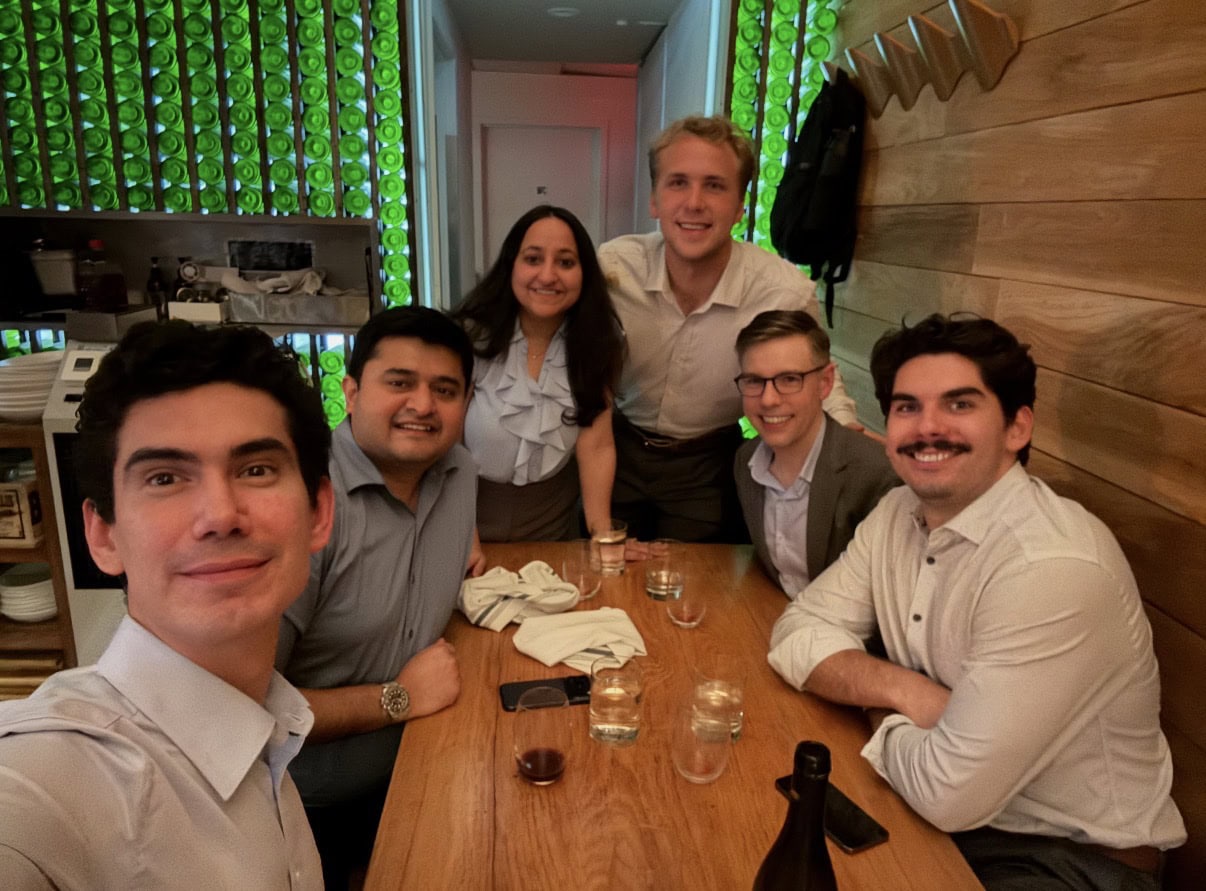
Members of Benji’s IT workstream, including associates, a manager, and the workstream partner, gather for dinner during a team colocation in Chicago.
The human side of system design
What surprised Benji most was how people-focused and creative the work ended up being.
“Much of the work needed was in assessing how certain system changes would impact technicians, other employees, or customers of each company,” he said. “When delivering recommendations, it was less about all of the technical assessments we conducted and more about delivering a story of how each decision would make an impact on the ground.”
Choose the wrong HR platform, and payroll breaks for more than a thousand employees across four companies. Mess up the migration timeline, and field technicians can’t access the information they need to repair fiber lines. Make system changes without considering customer-facing impacts, and service calls go unanswered.
Every technical decision had human consequences. And explaining those consequences required storytelling, not just data analysis.
“This summer taught me that in consulting, the best business insights require equally strong creativity to explain the impact effectively for whoever is involved,” Benji said.
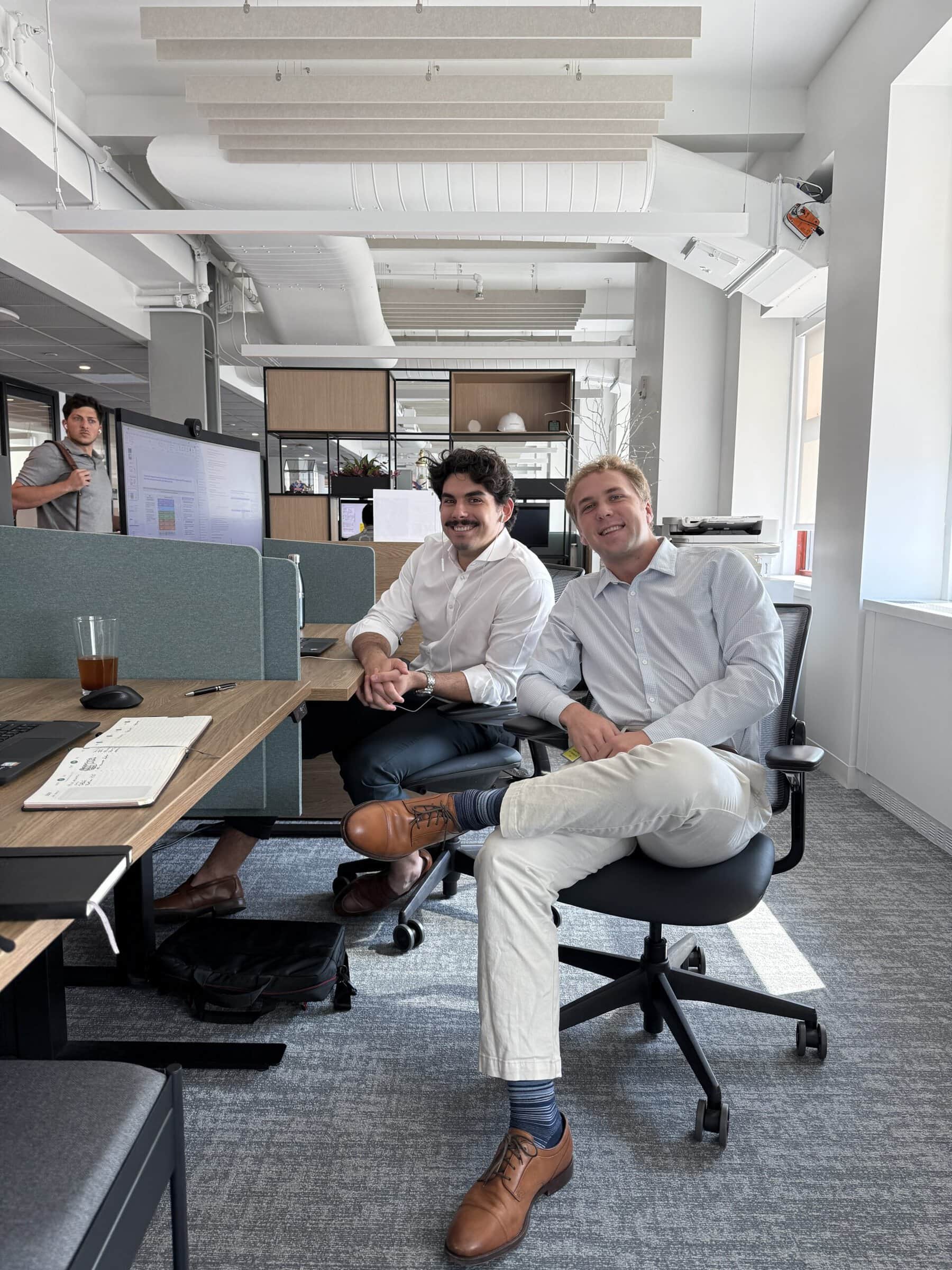
Benji Garland ’27 works with John, an MBA intern on his engagement, in Kearney’s New York City office at the Empire State Building.
When the scope shifts monthly
The engagement was retainer-based, which meant the scope of work could shift consistently, unlike other projects where you define deliverables upfront and execute them over time.
“This required me to constantly shift my focus to make sure I was actually working on something that served the immediate needs of the client rather than focusing solely on what was put in front of me,” Benji said.
It was a lesson in agility: listening to what the client actually needs right now and recognizing when priorities change.
Working across the IT workstream, not just on his HR and payroll migration project but contributing to other system migrations and client needs, taught Benji to think like a consultant. He learned to be versatile, responsive, and focused on solving the problem in front of you today while keeping the bigger picture in mind.
Beyond the technical
Benji’s summer wasn’t just spent at his desk in the Empire State Building. The project team including senior leaders went out for dinner while the engagement team colocated in Chicago. Summer interns repackaged leftover food from nearby restaurants to deliver to Publicolor in New York City. He worked alongside other interns on a mini-engagement during training week.
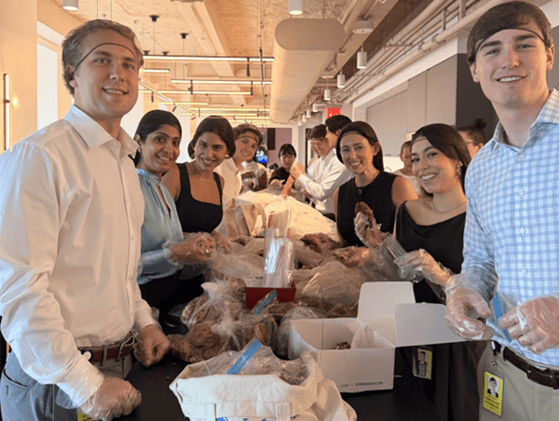
Benji Garland ’27 and fellow summer interns repackage leftover food from nearby restaurants for delivery to Publicolor in New York City.
And through it all, he learned what consulting actually is: not just technical expertise, but the ability to translate analysis into digestible, usable, and people-centered solutions for the client.
“I have loved working in the Communications, Media, and Technology practice at Kearney,” Benji said, “and I can’t wait to return to the practice full-time after my senior year. This experience confirmed that my creativity and business interest can come together nicely in a consulting career that is exciting, serves my strengths, and is consistently delivering learning opportunities.”

The view from Benji’s desk at Kearney’s office in the Empire State Building, overlooking New York City at dusk.