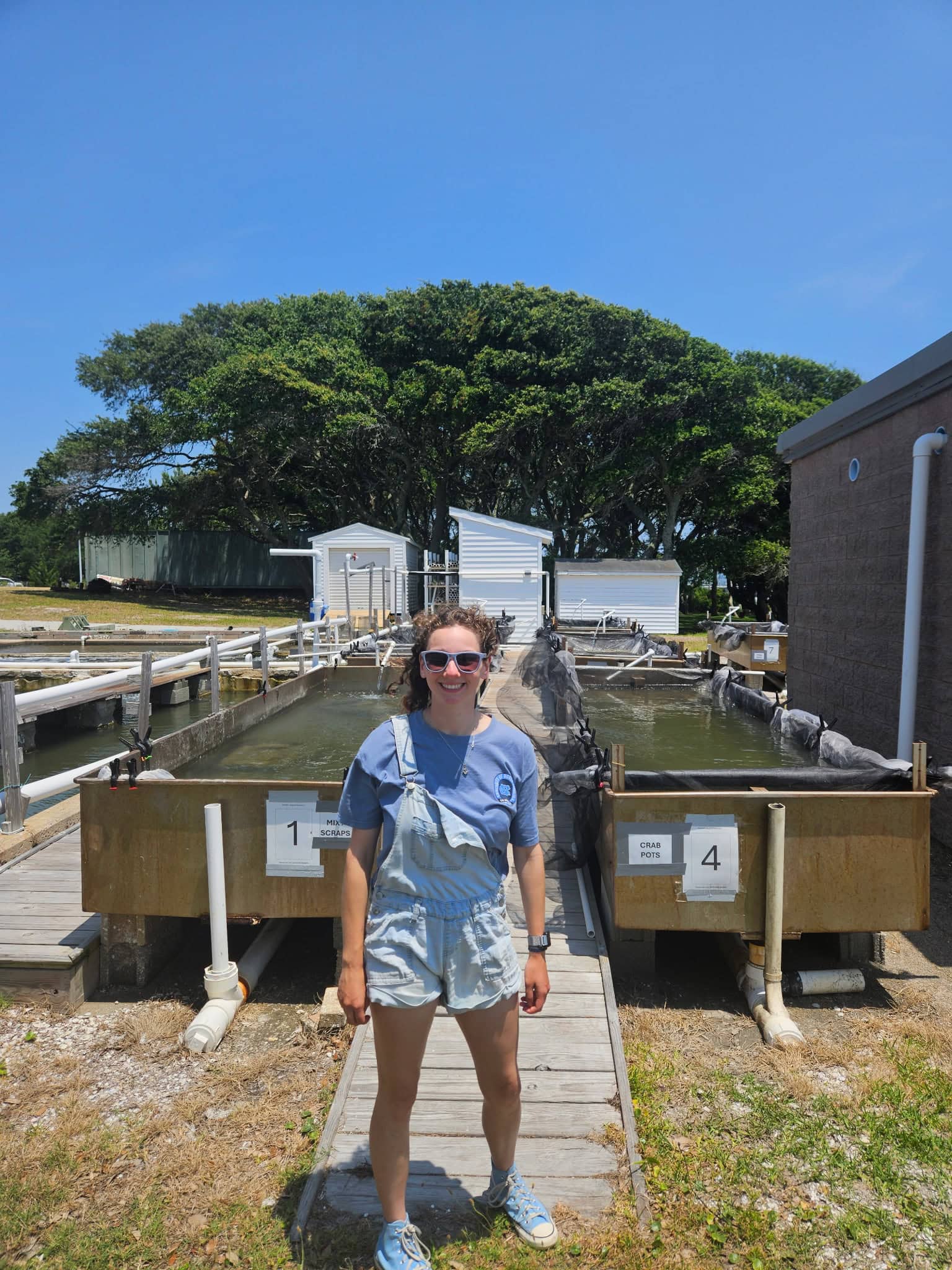
Alexandra Newmark ’27 in front of seagrass tanks as part of a seagrass meadow restoration project.
Alexandra Newmark ’27 spent her Professional Experience summer at the UNC Institute of Marine Sciences in Morehead City, North Carolina, and came home with a new minor and career path.
Shivers were wracking her body. The northern wind was brutal, and the water was colder than anything Alexandra Newmark ’27 had imagined when she signed up to survey a seagrass meadow.
“I’m from the mountains, so I thought that I would be fine with the frigid water and strong northern wind,” Alexandra said. “But snorkeling to find evidence of stingrays meant I was soaked to my bones and shivering.”
She stayed in the water anyway.
Because along with the stingrays she was looking for (part of ongoing research into habitat utilization), she found hermit crabs, sand dollars, numerous small fish, and even a sea urchin.
For a math major spending her summer at the UNC Institute of Marine Sciences in Morehead City, North Carolina, that freezing survey was the moment she realized something important: she’d found a field she wanted to pursue.
Alexandra worked in the Fodrie Estuarine Ecology Lab, where researchers study how coastal ecosystems function and how human activities affect them. She assisted with multiple research projects: seagrass meadow restoration, the impacts of living shorelines on predatory fish movement, and the effects of fragmentation on seagrass meadows.
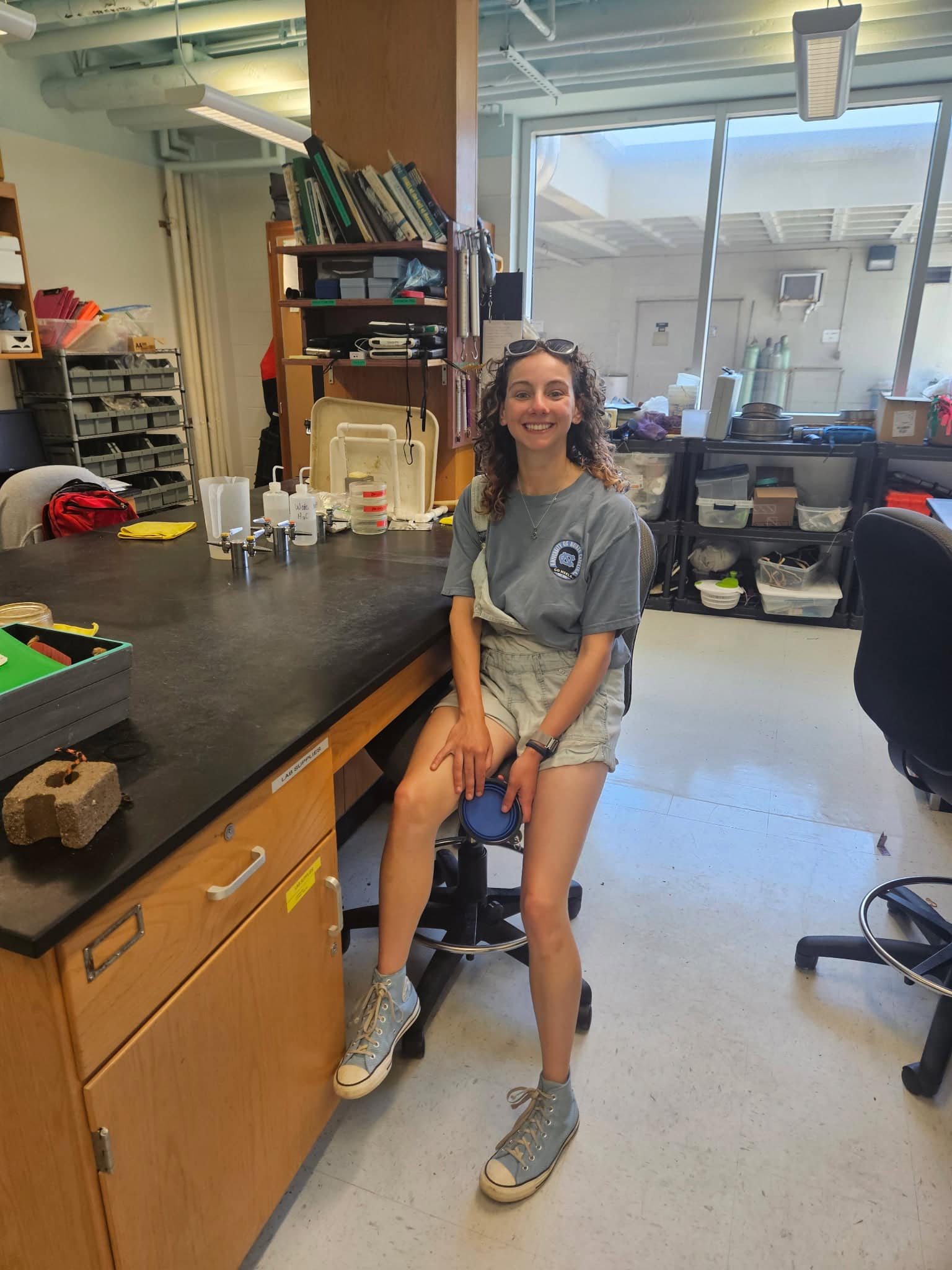
Alexandra in the Fodrie Estuarine Ecology Lab.
The work was hands-on and varied.
She helped collect more than 2.3 million seagrass seeds for an ongoing restoration project. She deployed 574 artificial seagrass units to explore how fragmentation affects meadow ecosystems. She surveyed stingray pits to understand how these predators use internal edges as a hunting strategy. She processed seagrass cores. She learned to operate a conductivity, temperature, and depth instrument.
“In my role as a lab technician, I assisted in the deployment of experiments in the field, research projects, and restoration efforts,” Alexandra said.
But what she really learned was how marine scientists actually study the world.
The variety of discovery
What surprised Alexandra most wasn’t the cold water or the long hours. It was the sheer variety of methods a single lab uses to answer questions.
“We conducted research through drone imaging, night surveys, acoustic tracking of fish, seagrass core analysis, and the deployment of artificial seagrass,” she said. “These methods serve to answer a variety of research questions, revealing more information about estuarine ecological systems in the natural world.”
Each technique opened a different window into understanding how coastal ecosystems work: how fish move through habitats, how seagrass meadows recover, or don’t, and how creatures interact with their environment in ways that aren’t visible from the surface.
For someone who came into the summer with very little background in marine ecology, and who knew next to nothing about fieldwork and running experiments, this variety became the education itself.
“This summer taught me about the vast effort, rigor, and detail needed to effectively learn about the world around us,” Alexandra said.
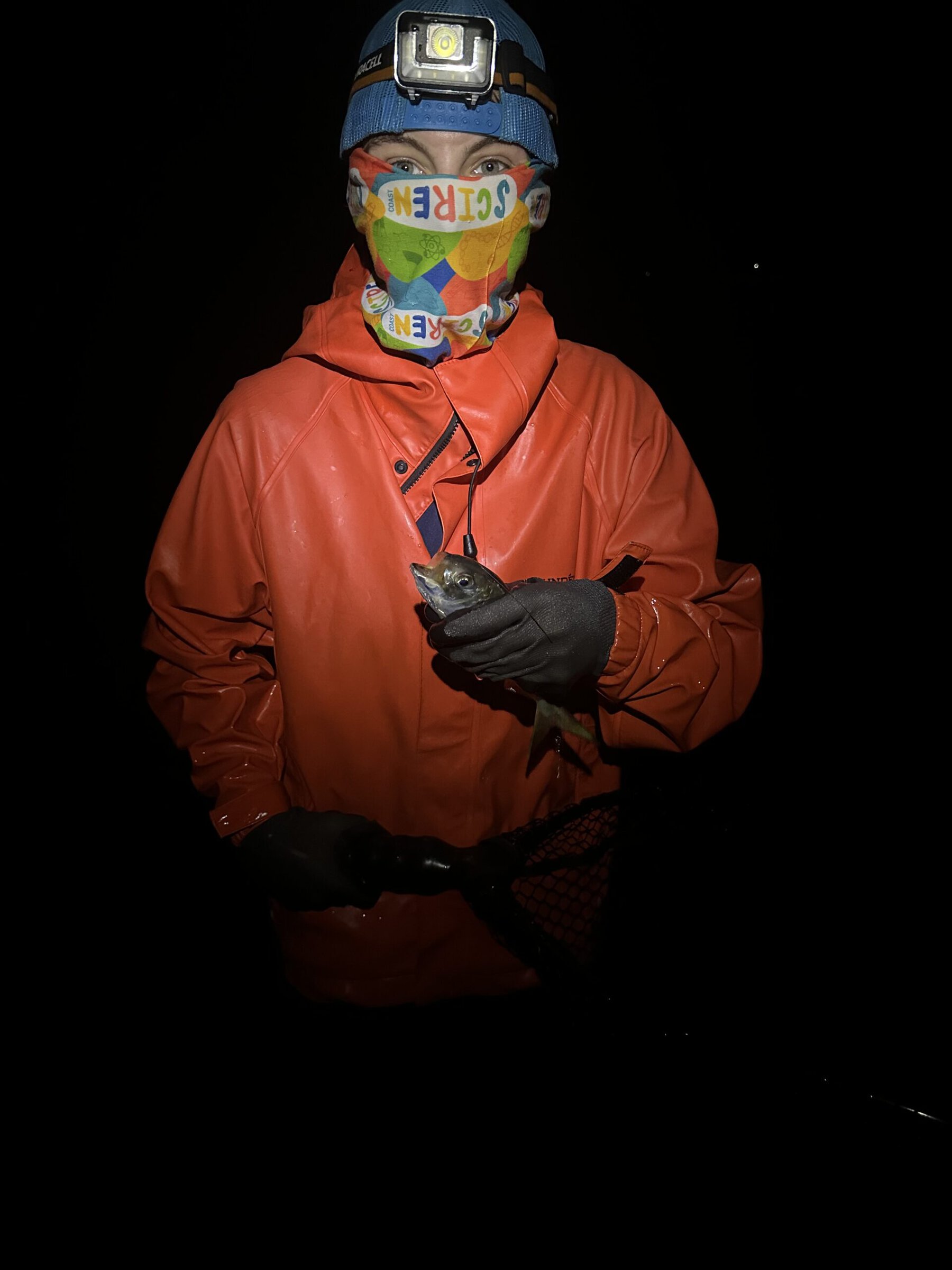
Alexandra during a night survey, when the team caught fish to explore how living shorelines impact fish movement.
When a math major changes course
The rigor appealed to her mathematician’s mind. The fieldwork, even freezing fieldwork, thrilled her. The questions marine scientists ask turned out to matter to her in ways she hadn’t anticipated.
So she changed direction.
“This summer completely changed my career trajectory,” Alexandra said. “I added a marine science minor and am now exploring graduate programs in the field.”
For a student from the mountains who thought she’d be fine in cold water, the summer turned out to hold more discoveries than just stingrays and sea urchins.
North Carolina’s longest-running shark survey
The UNC Institute of Marine Sciences operates the longest-running continuous shark survey in the United States. During her summer, Alexandra assisted with data collection and helped tag shark populations off the North Carolina coast, part of decades of research tracking these apex predators.
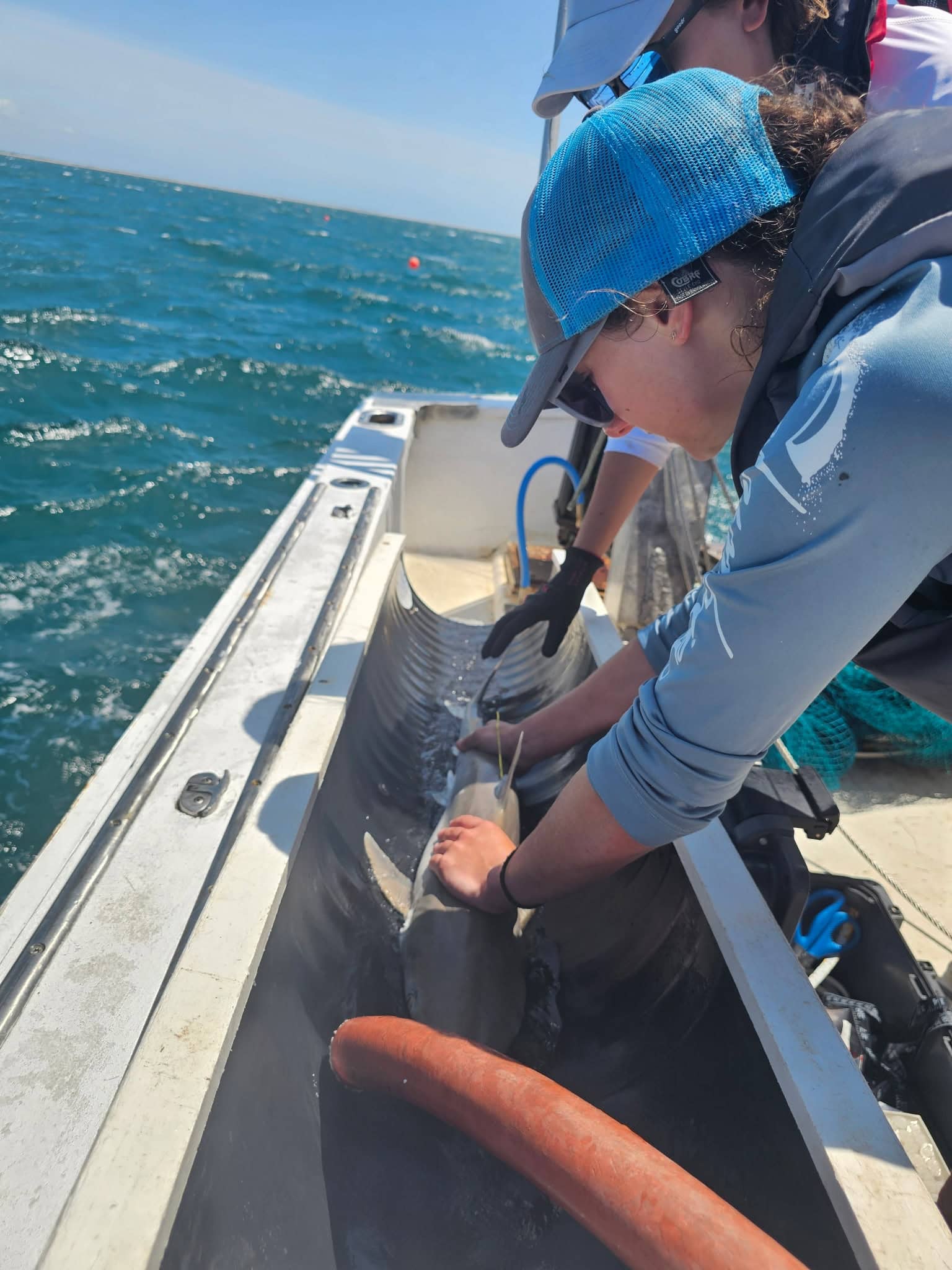
Alexandra and colleague Holly Doerr assisting with data collection and tagging shark populations off the coast of North Carolina.
It’s the kind of work that requires patience, precision, and a willingness to get uncomfortable: to stay in cold water when your lips are turning blue, to keep looking when you haven’t found what you’re looking for, to trust that the data you’re collecting matters, even when you’re just one person processing cores, surveying meadows, or counting fish on a night survey.
For Alexandra, that trust paid off.
“Sometimes the best thing you can do for yourself is to take the risk and explore the unknown,” she said.
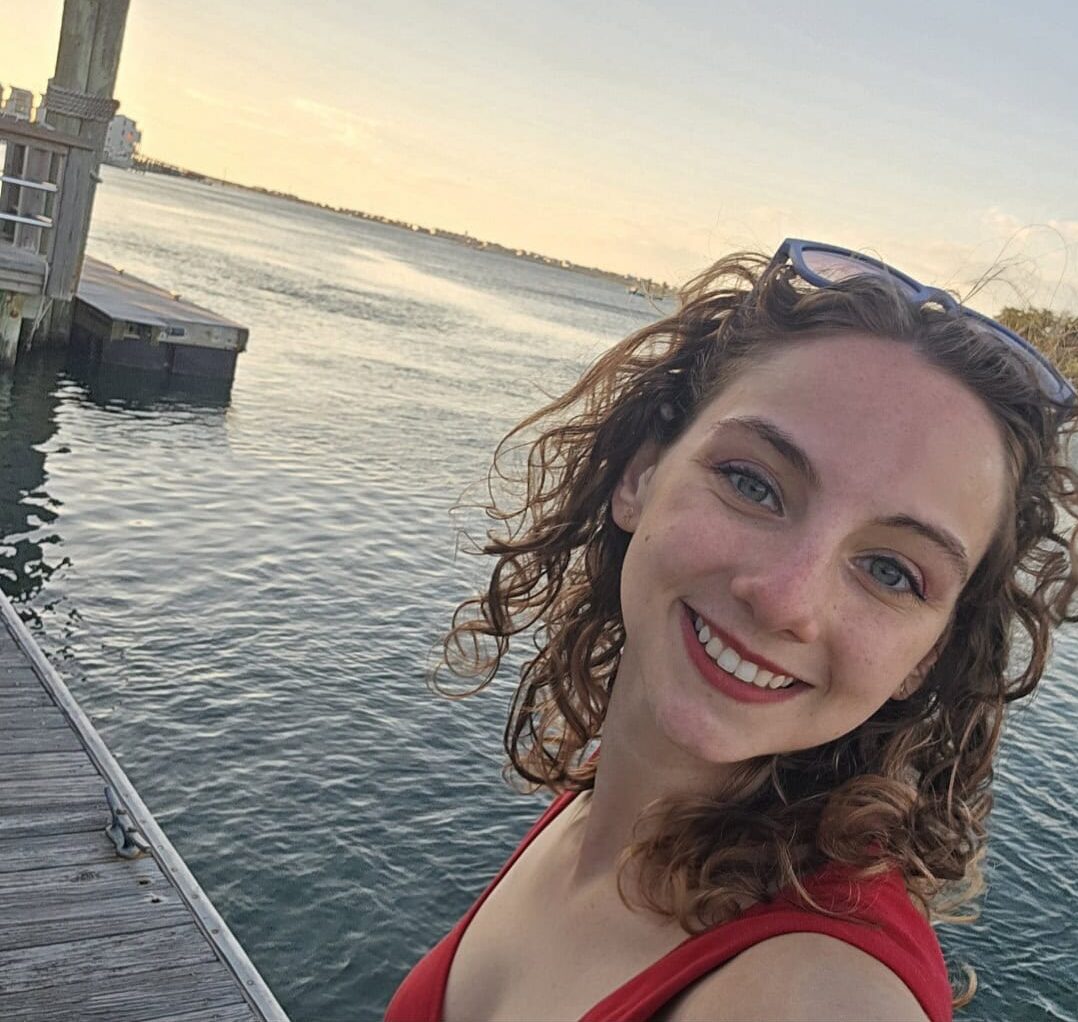
Catching the sunset in Morehead City, North Carolina.