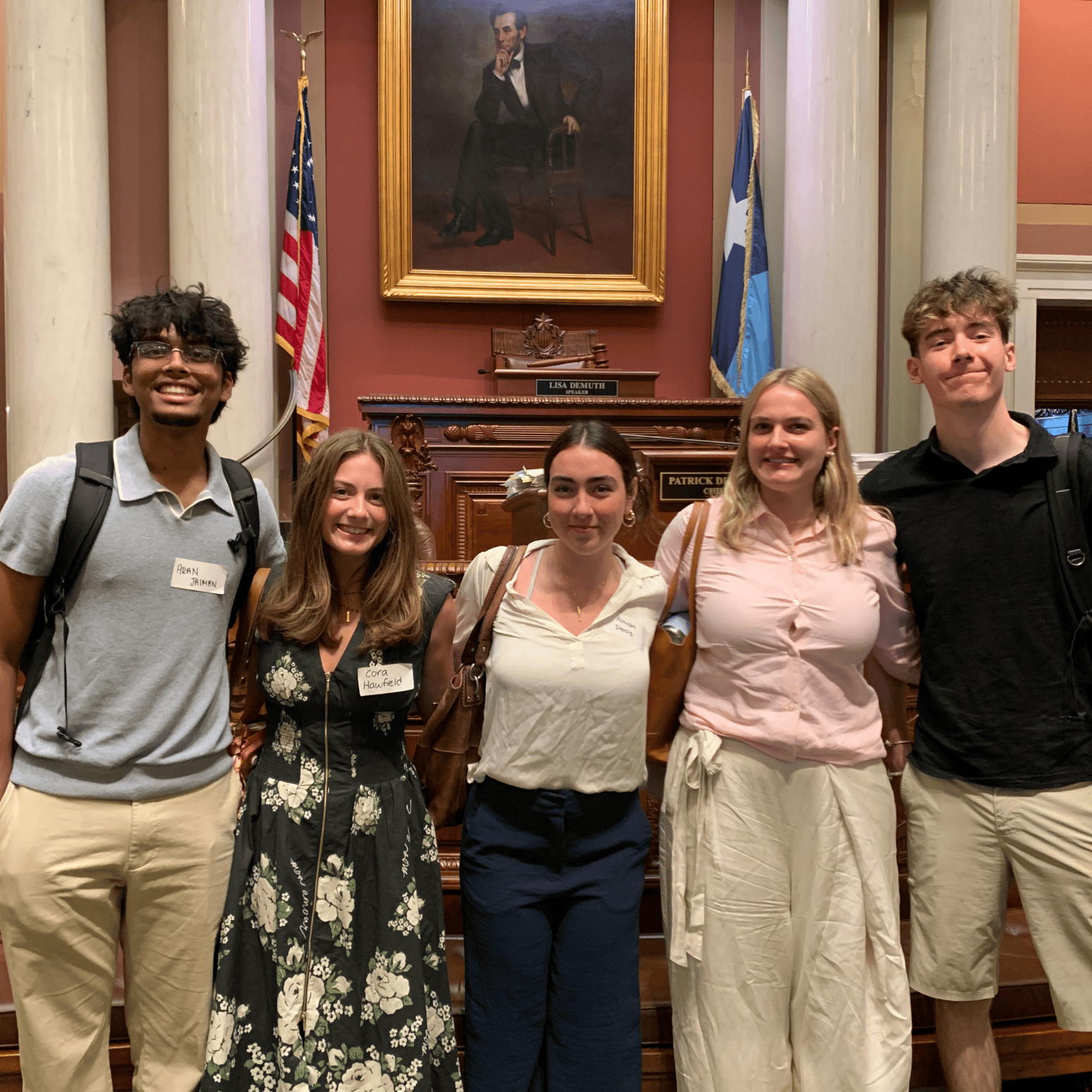
Civic Collaboration Team Minneapolis: Aran Jaiman ’29, Cora Hawfield ’29, Rowan Denis ’29, Caroline Dylewski ’29, and Logan Bly ’29
Morehead-Cain Scholars mapped a summer of community mobilization in the Twin Cities, turning thirty-five interviews into a resource-sharing tool and a curriculum for Minnesota Interfaith Power and Light.
She had every reason to stay home. But when a team of Morehead-Cain Scholars sat down with her to ask why she’d gotten involved in her community’s response effort anyway, she didn’t hesitate.
She couldn’t bear to see her neighbors isolated—unable to get food, unsure how to reach the people around them—she told them, as if there were no other option.
That conversation was one of thirty-five the scholars conducted this summer through Civic Collaboration, the second summer of the Morehead-Cain Summer Enrichment Program, which places teams of scholars inside organizations tackling real community challenges across North America.
Understanding how a community supports itself
The five-person team—Logan Bly ’29, Rowan Denis ’29, Aran Jaiman ’29, Caroline Dylewski ’29, and Cora Hawfield ’29—spent eight weeks with Minnesota Interfaith Power and Light (MNIPL), hosted by Buff Grace ’91.
Earlier this year, a period of disruption among immigrant communities in the Twin Cities left some communities uncertain about how to get help and stay connected to their neighbors.
MNIPL wanted to understand how communities had organized in response: who stepped up, how people found one another, and how help and information moved from house to house.
The findings would ultimately feed into the organization’s broader climate resilience planning, which prepares communities to support one another through any disruption, natural or otherwise, according to Buff, who said partnering with Morehead-Cain through the Civic Collaboration program gave MNIPL the capacity to “dig into the nuance of motivation and activation” that takes place during emergencies.
“We know from experience and the research that strong relationships are the foundation of the resilience hubs we are creating, and here in our city we just saw those strong relationships in action,” he said. “The scholars provided us not only with the people power to interview dozens, but they could see our city from outside and better extrapolate principles we need to replicate for climate change-driven weather emergencies.”
Working across every level of the response—congregation leaders, nonprofit staff, organizers, and neighbors who simply showed up for one another—the team pulled recurring themes from their interviews and translated them into concrete steps for MNIPL’s Resilience Hub curriculum, which prepares congregations to respond during future disruptions.
Despite the range of people they spoke with, the same three-part pattern surfaced again and again, Cora said: know your neighbors, know your role, and make entry points accessible.
“It was so beautiful to hear people across all different walks of life describe building community,” the scholar said. “As we did more and more interviews, a common recipe for connection became apparent, despite everyone’s unique passions, occupations, and geographic locations in Minnesota.”
Connecting neighbors through tech
Aran turned the team’s research into a public-facing tool: a web app that maps aid and shelter resources across the Twin Cities, letting residents filter by their specific needs and get directions to the help they need.
The scholar said that even though the project focus was outside his expertise, he was able to use his skills in tech to serve the community.
“Being pushed outside my comfort zone turned out to be the best part; it let me bring something only I could bring,” he said. “I heard a problem in our interviews and built an app to solve it.”
The summer culminated in a community dinner where the team presented their findings directly to the neighbors and organizers who had shaped their research.
“I love seeing my colleagues’ eyes get wide when they see the quality of the Civic Collaboration teams,” Buff said. “This summer’s team again went above and beyond, creating a tool we had not even imagined that improves our outreach and elevates our reputation in this sector of our work.”
The team’s work was also featured by CBS Minnesota.
A lesson that travels beyond Minneapolis
The experience left the team convinced that community response is what catches people when larger systems fall short, and that it’s a need that can surface anywhere, not just in a city recovering from a specific crisis.
“It’s easy, in an individualistic culture, to stay heads-down in your own life, but this summer was a reminder of how much depends on people simply deciding to show up for one another,” Aran said.