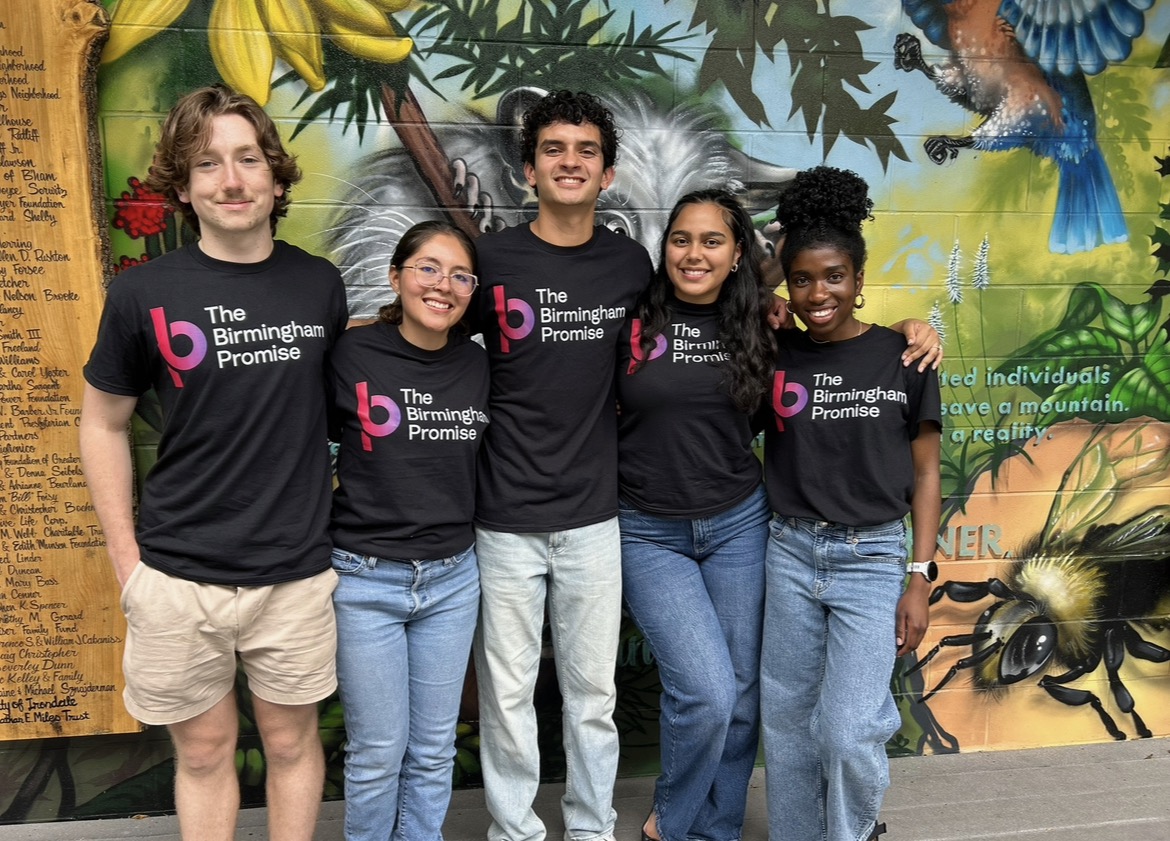
Civic Collaboration Team Birmingham: Eddie Perrin ’29, Catalina Aldana-Archila ’28, Devak Coltrane ’29, Scarlett Bermudez ’29, and Princess Adeyi ’29
Morehead-Cain Scholars spent the summer in Birmingham, Alabama, interviewing scholarship recipients, nonprofit staff, and program leaders to help Birmingham Promise build stronger pathways from college to career
On the last day of her Civic Collaboration summer, Catalina Aldana-Archila ’28 felt the nerves rising as she and her teammates waited for the room to fill.
The presentation was ready. What she hadn’t planned for was who else walked in.
Her rowing coaches from Lake Purdy, mentors she’d found through a Lovelace Fund for Discovery project, had shown up to watch. Two communities she’d built in Birmingham over the course of a single summer came together in one room.
“Even though my support system was far away, I didn’t feel alone,” Catalina said. The scholar spent the summer in Birmingham, Alabama, working alongside four other scholars to strengthen support systems for local students.
Understanding what students need
Catalina and teammates Devak Coltrane ’29, Scarlett Bermudez ’29, Eddie Perrin ’29, and Princess Adeyi ’29 worked with Birmingham Promise through Civic Collaboration, the second summer of the Morehead-Cain Summer Enrichment Program, which places teams of scholars inside organizations tackling real community challenges across North America.
Birmingham Promise provides youth development programming and a scholarship that allows Birmingham city high school graduates to attend Alabama’s public universities tuition-free.
The challenge the team was asked to take on: once scholars reach college, how does the organization ensure they come out the other side with meaningful employment?
As college students at the University of North Carolina at Chapel Hill, the Morehead-Cain Scholars were close to the experiences of Birmingham Promise scholars, yet also carried a helpful outside perspective, according to Mia Toole, the organization’s chief of staff.
“They were able to address this question from so many perspectives and delivered thoughtful insights that were valuable to our team,” Mia said.
What the interviews revealed
To find answers, the team interviewed Birmingham Promise scholars, staff members, local nonprofits, and other scholarship programs, including Morehead-Cain, looking for patterns across the landscape.
What they found wasn’t a gap in programming. It was a gap in community.
Scholars were receiving financial support, but the connections to peers, mentors, and opportunities weren’t reliably there. As the team moved into the middle of the summer, they realized that what scholarship programs really needed are non-transactional relationships with their scholars, ones grounded in more than the financial benefits they provide, Devak said.
“Birmingham Promise already had what it needed, but we realized we just need to look within to the community of Birmingham Promise, and Birmingham as a whole, to support students,” he said.
From that finding, the team designed two prototypes: the Birmingham Promise Network (BPN), a community platform inspired by the Morehead-Cain Network, and the Birmingham Promise Podcast, a storytelling platform designed to sustain that community long after any single cohort moves on.
The BPN “will be a game changer” in the ways that students and alumni connect with one another and to opportunity, Mia said, while the podcast will serve as a fresh platform to share scholar stories.
“The first time the team showed me these prototypes, it was so refreshing because I couldn’t have put into words that this is something we needed, but it so clearly was,” she said. “Student experience is compelling to other students, and I think it has the potential to unlock opportunities for even more students in Birmingham City Schools.”
A lesson that crossed disciplines
Catalina is a chemistry major with her sights set on medicine. The work of Birmingham Promise sits far from organic chemistry or clinical rotations, but that distance was part of what made it valuable.
As an advocate for education equity and access to higher education, the scholar said it was meaningful to see the infrastructure, relationships, and intentional design required to turn a financial award into a genuine launch pad.
“My experience working for Birmingham Promise gave me not only confidence in the skills I can contribute to a team but also meaningful and longstanding connections,” Catalina said. “From the custodian at our workplace who would call us her work children to the mayor who showed genuine interest not only in our job but also in us, Birmingham showed me what great cities are made of.”