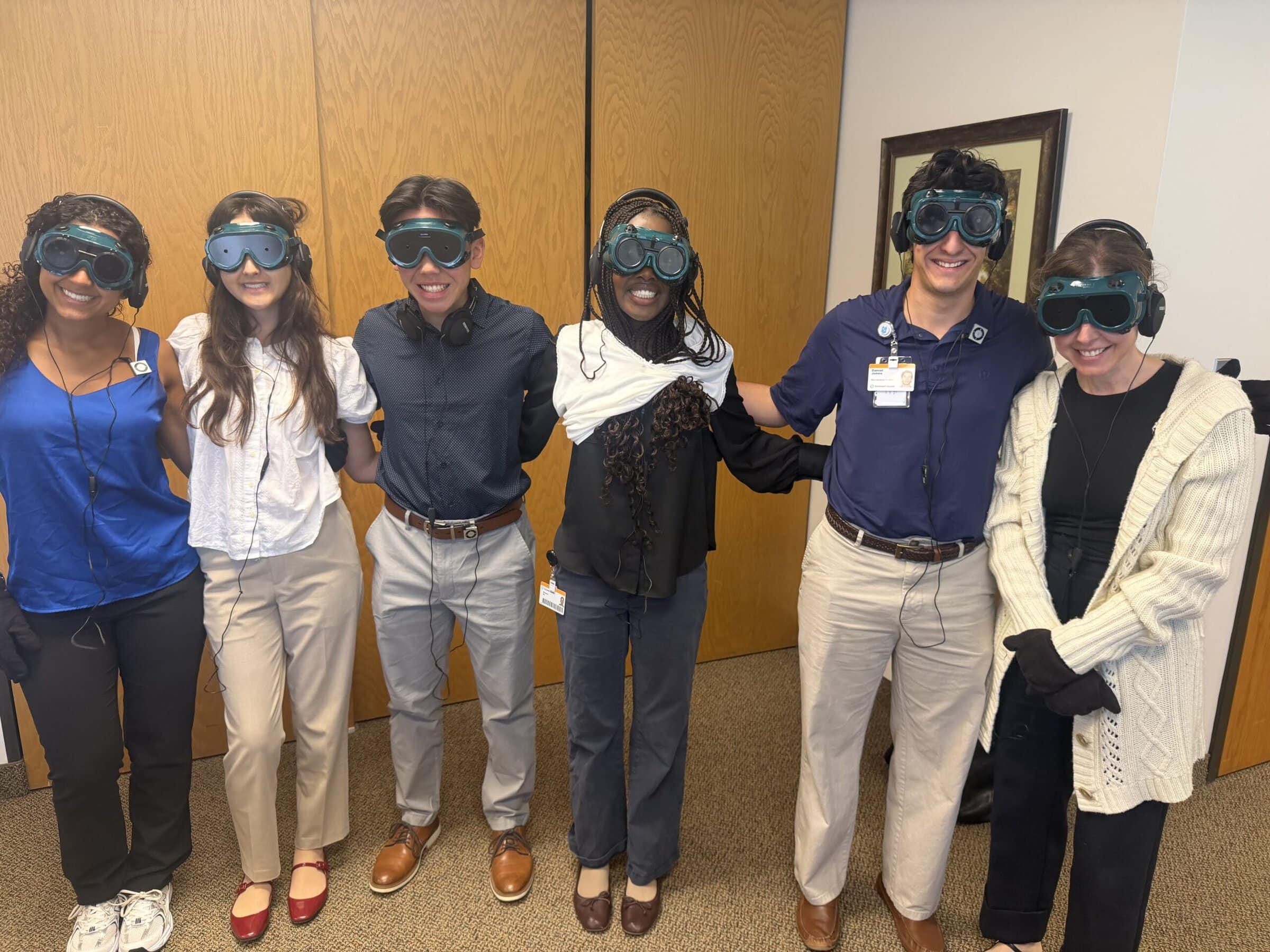
A team of Morehead-Cain Scholars explore dementia care at an institute in Grand Rapids, learning firsthand about the tools and approaches used to better understand cognitive health.
They’d just finished touring a dementia care facility and meeting its leaders when they stepped into the day activity space, where older adults spend time while their family caregivers get a few hours to work, rest, or handle their own lives. The team scattered to meet people, but Rayana Ba ’29 lingered for a second, working up the nerve to talk to someone. She sat beside a woman who was quietly coloring, and when she heard her say something in Spanish, she answered with the rustiest language skills she had left.
The woman’s face lit up. She asked where Rayana was from and how she’d learned the language, and Rayana pieced together verbs she hadn’t touched in years, getting them wrong just often enough to keep the conversation alive. When she finally ran out of words, she waved over her teammate, Ryan Lacey ’29, whose fluency carried it the rest of the way.
“Watching her laugh and come alive, I was so glad she got to feel understood, even for a few minutes,” Rayana said.
That moment captured what the team spent the summer working to fix through Civic Collaboration, the second summer of the Morehead-Cain Summer Enrichment Program, which places teams of scholars inside organizations tackling real community challenges across North America.
A diagnosis that comes too late
Rayana and Ryan spent the summer in Grand Rapids, Michigan, with teammates Daniel Jones ’29, Emilie Garrabrant ’29, and Cameron Lee ’29, working with Corewell Health, Michigan’s largest integrated health system.
In Grand Rapids, dementia diagnosis is often delayed; patients can wait more than a year to see a specialist, and many primary care clinics lack routine cognitive screening and clear referral pathways to identify concerns early, according to Rayana.
“The gaps disproportionately affect communities facing language barriers, limited insurance, or distrust of the healthcare system,” she said.
Designing a clinic that meets people where they are
The team conducted more than fifty stakeholder interviews across clinical, community, and research settings to understand why dementia is diagnosed so late and who is most affected.
Rayana was surprised by how much she loved interviewing, and how naturally it came to her.
“So often we were speaking with stakeholders who were eager to be asked and genuinely glad this issue was finally getting attention, which made many conversations feel less like research and more like connection,” she said.
From their findings, the team designed COMPASS (Community Outreach Mobile Program for Aging Support Services), a mobile memory screening clinic that brings cognitive screening and care navigation to underserved older adults where they already gather: at churches, senior centers, and community events hosted by trusted partners.
The team built clear referral pathways connecting every screening to follow-up care and embedded the program within Corewell Health’s existing infrastructure so it could sustain and scale beyond the summer. They also proposed four system-level changes: dementia care pathways built into Epic, Corewell’s electronic health record; expanded Spanish-language screening; a centralized resource hub for patients; and a dedicated Dementia Care Navigator role.
At the end of the summer, the team presented the full proposal to Corewell Health leadership and asked them to fund the pilot.
Emilie said that even though she’d never spent so much time in a hospital or speaking with leaders across the healthcare ecosystem, that she was able to bridge her personal and academic interests to the team’s mission.
“As I continued to work, I found so many similarities to my passion for poverty alleviation and human capital development,” she said.
This summer, Emilie and Amy Gao (UNC–Chapel Hill ’29) launched the Bukedea Learning Lab, a community-based, game-centered educational space for primary school children in the Bukedea District of northeastern Uganda through a Projects for Peace grant.
A shift in how she thinks about a good life
Before this summer, Rayana hadn’t spent much time thinking about cognitive decline, she said. Her belief in equity and dignity had always extended to everyone, but the work made her think specifically about what it means to live well for a whole life, not just up to a certain age.
She’s now considering adding a data science minor alongside her public policy and sociology majors, to keep exploring how research and well-designed systems can improve people’s lives.
“It’s made me question the instinct to keep pushing toward some future goal at the cost of the present, and think instead about how to make life good for as long as I’m living it,” she said.