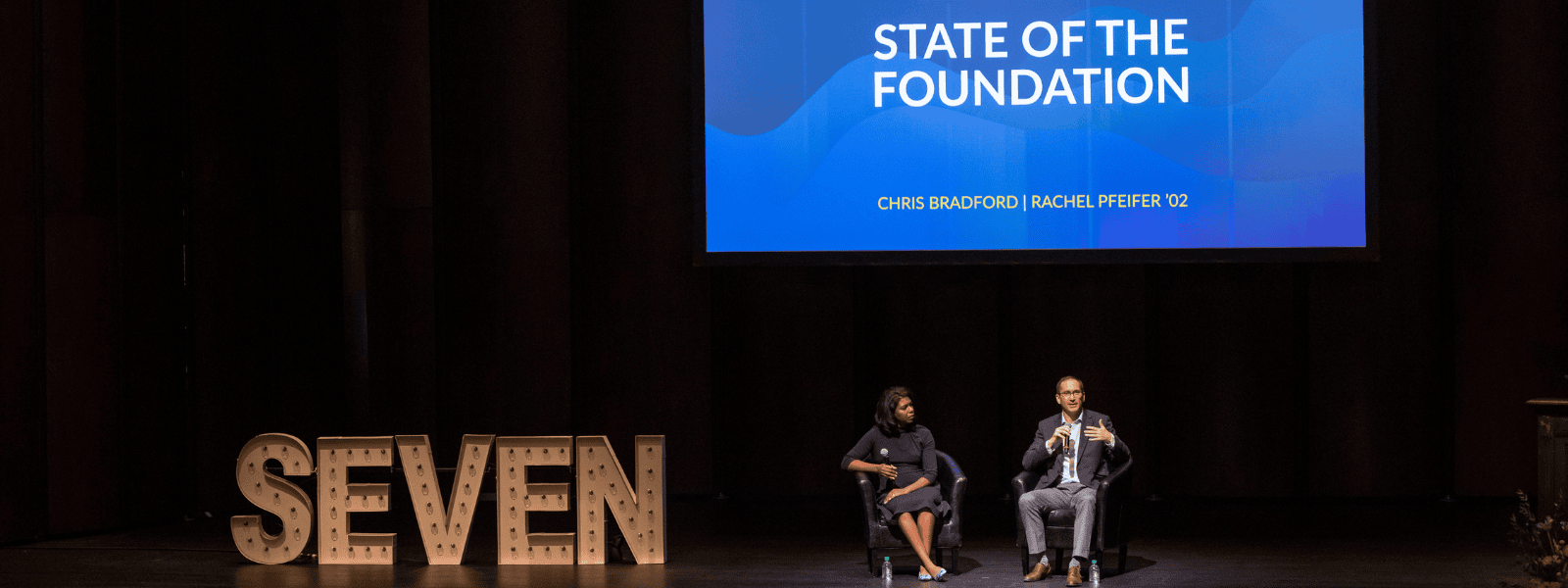
 Morehead-Cain Chief Program Officer Rachel Pfeifer ’01 and President Chris Bradford delivering the “State of the Foundation” address at the Alumni Forum in Chapel Hill on October 19, 2025. (Photo by Leon Godwin)
Happy New Year! In this episode, Morehead-Cain President Chris Bradford joins host Oni Terrado ’27 of the Scholar Media Team to reflect on an extraordinary year for the Program.
Chris shares highlights from the 2025 Alumni Forum and the launch of the Morehead-Cain Global Fellows program, which brought twelve exceptional leaders from five countries to Carolina. The president discusses how the Foundation is balancing innovation with tradition as the Program reaches its largest size ever, the arrival of former trustee Rachel Pfeifer ’02 as chief program officer, the challenge of counterprogramming pre-professional pressures, and his vision for “college as it should be.”
This year also marked major moments of community gathering: nearly 100 Black alumni and scholars celebrating 50 years of Black excellence, the reunion of the first class of women Morehead-Cains, and the 55th anniversary of the British Programme in London.
Music credits
The episode’s intro song is by scholar Scott Hallyburton ’22, guitarist of the band South of the Soul.
How to listen
On your mobile device, you can listen and subscribe to Catalyze on Apple Podcasts or Spotify. For any other podcast app, you can find the show using our RSS feed. You can let us know what you thought of the episode by finding us on social media @moreheadcain or you can email us at communications@moreheadcain.org.
Episode transcription
(Oni)
Chris, thank you for being here.
(Chris)
Thank you for having me, Oni. It’s always great to spend time with you.
(Oni)
We’re recording about one month since the 2025 Alumni Forum. What were some highlights for
you, and what moments or themes stood out?
(Chris)
I thought the Alumni Forum was amazing, and what struck me most was just the profound sense of belonging that permeated the Forum as a result of the shared experience and shared love for this place, of Carolina. Some of the peaks for me would be things like the extraordinary SEVEN Talks or sitting in on a panel on the rule of law that included alumni who are federal judges, who are civil rights attorneys, and a staffer for the Judiciary Committee. The depth and range and character of this community were palpable throughout the whole weekend.
(Oni)
You opened your talk at the Forum by honoring Til Jolly from the class of 1983, who passed away earlier this year. Can you share why you chose to remember him at that moment?
(Chris)
Oni, in November, on November 21, it will be the eightieth anniversary of the establishment of the Morehead Foundation, which became the Morehead-Cain Foundation. And the founding belief that guided the establishment of this Foundation was that leaders shape thriving communities. When Til passed away in April, I heard from alumni from all different backgrounds with a wide range of majors and professional journeys who wrote to me about the impact that Til had on them. It struck me that he’s something of a model Morehead. He saved lives as an ER doctor. He led nationwide review bodies. He worked in government, Department of Homeland Security, shaping the national strategy for pandemic influenza. He built EMCentric as an entrepreneur. But what I heard about was how he was never too busy to say hello, never too busy to take a call from a scholar, never too busy to coach youth basketball. And his life reminds me of what it means to live with purpose. There are many Til Jollys in this community. And the question is, how do we all marshal our talents for the betterment of our community, for the betterment of our country, for the betterment of the world, with the vigor and the character of Til Jolly?
(Oni)
Thank you for sharing that. It’s so humbling to hear about his life and leadership. This was also the first Forum without former vice president Megan Mazzocchi, who retired in January after forty years of service on staff. What was that transition like for the Foundation?
(Chris)
Well, Megan’s wisdom, her care, her fierce devotion to Morehead-Cain defined this program for generations. She spent forty years on the staff of Morehead-Cain. Her fingerprints are everywhere. She set up her transition so very well. She was such an amazing partner and mentor for me in the time that we had the opportunity to overlap. We get to build on the Foundation that she laid every single day. One of the things that I loved about the Forum—you asked about highlights earlier—it was the opportunity to celebrate Megan’s legacy and to surprise her. As you may know, she was honored as a Morehead-Cain scholar and graduate of the class of 2025 by our board chair, Tim Sullivan. She also received notification and celebration as a member of the Order of the Long Leaf Pine for her contributions to North Carolina, an honor that was bestowed on her by Chuck Lovelace and Brad Briner, the current state treasurer from the class of 1999. I was just so happy to see everyone in this community celebrate Megan in that way over the course of the weekend.
(Oni)
Speaking of the team, you announced at the Forum that Rachel Pfeifer from the class of 2002 joined as chief program officer. What does that addition mean for the Foundation?
(Chris)
I have learned so much from working with Rachel in my role as president, and that goes to the first day that I arrived here. As you may know, Rachel spent two terms as a trustee. She knows this community deeply, and to have someone of her talent, her curiosity, and her ambition joining our team and wanting to lend her hand to what we’re seeking to build in this next phase of Morehead-Cain’s history is just an extraordinary privilege for all of us on staff, and I think for all of the scholars at Morehead-Cain. Right now, she’s leading our work and thinking about leadership development and scholar programming. And more broadly, she’s a connection to our history and our culture. I’m thrilled that we’ve been able to bring alumni like Rachel Pfeifer, Julie Werry, Melanie Godinez-Cedillo, Jesse Soloff, Franky Jones, Ben Ousley Naseman to the staff because they ensure that as we innovate, as we expand, as we bring new ideas from elsewhere, we remain anchored in the culture and the experience that shaped all of you and gives rise to the sense of belonging that you find at something like the Alumni Forum.
(Oni)
Let’s talk about one of the biggest innovations this year. In August, we introduced a dozen Morehead-Cain Global Fellows into the program for the inaugural class representing countries such as Brazil, India, Nigeria, and more. What was the inspiration behind this fellowship?
(Chris)
Oni, our mission at Morehead-Cain is to identify, invest in, and empower a community of dynamic, purpose-driven leaders. We think a lot about each of those verbs. What does it mean to identify future leaders? Where are future leaders?
We know that the world’s most extraordinary young leaders are disproportionately funneled into the great public universities of their country. Those leaders who get access to study in a place like the United States or the opportunity to apply to Carolina out of high school are students who have had access to international curricula. They’re disproportionately in the top 1 percent of the global wealth distribution, or they lucked out and had the opportunity to go to a scholarship school that serves that population. And so, we thought, what if we could take the lessons we learned from Sophomore Selection to go identify extraordinary scholar leaders at great public universities elsewhere in the world and invite them to spend one year at Carolina as Morehead-Cain Global Fellows? And we decided to focus on South India. We decided to focus on Turkey, the home of UNC’s Nobel Prize–winning chemistry faculty member, Aziz Sancar. We decided to focus on Nigeria, a country that’s the home of the great Joseph Chike Edozien, who chaired the Nutrition Department at UNC for decades and passed away last year at the age of ninety-nine.
We went to these geopolitically important countries. We went to their very top universities. We were able to introduce Carolina, introduce Morehead-Cain, and ask their faculty and staff and talent aggregating organizations: where are the student leaders who they think are going to shape the world? In the same way that we found you, and in your case, through an affiliate, Boys and Girls Club, in the case of other scholars, through their schools, we had the opportunity, after 1,144 nominations, to interview at a finalist weekend thirty-two of these candidates and invite twelve of them to Carolina. And they are awesome, and they’re enriching your experience, and they’re enriching the experience of every student here every day. But they’re also being invested in by this Foundation and propelled on their journey to shape thriving communities.
(Oni)
I just want to say I appreciate that you included them into our community because they are just wonderful friends of mine. Could you share more about the global fellows?
(Chris)
Sure. We have twelve global fellows. They study in four different countries. They hail from five different countries: Azerbaijan, Brazil, Nigeria, Turkey, and India. They are extraordinary leaders who, when you meet, as many people met at the Forum, they say, “Oh, these people are Morehead-Cain Scholars.” They carry themselves in the way and with the character of Morehead-Cain scholars every single day. One of the things I’ve been so excited about is the way in which these fellows have leapt at the opportunity to be fully invested into life at Carolina. Rotdalmwa Dimka, for example, is a scholar from Nigeria. She is a biochemistry student at the University of Jos. She has the opportunity to do groundbreaking research in Dr. Netz Arroyo’s lab at UNC. She’s also in an African dance group. Madeu Neto from Brazil is currently doing a—he’s in a play this week that opens at PlayMakers. Atharv Joshi, who was the speaker of the student legislature at IIT Madras, the number one ranked university in India, he’s now here at Carolina, and he’s part of the Carolina Diplomacy Fellows. I could speak about any of them as I could speak about so many of you.
What I am so inspired by is hearing back not only from our scholars about conversations they’ve had with the fellows that have helped them see the world differently, but also hearing back from faculty members about what our fellows are adding to the classroom or what they’re adding to clubs across campus. And if I project out into the future, imagine being a scholar here five or ten years from now, right? If you have the opportunity to reach out to these fellows all over the world who are now in leadership roles across their countries’ societies and the way that that can enrich your learning when they transition from being members of our scholar community to being members of our alumni community. One last thing I’ll say, they’re here for one year. The grand challenge that they have is they will return home for a final year of study at their home university, and they need to take the networks and lessons they’ve learned here to make their university a better place for all students to live, to work, to study, to lead. And I’m really excited to imagine these little seeds from Carolina and the opportunities that exist in this extraordinary place being planted all over the world.
(Oni)
They’re absolutely a bright light to this community. When designing the Morehead-Cain Global Fellowship, what priorities guided your decision-making process? I’m also curious, what made the timing right? Why now?
(Chris)
We are thinking every day about what it means to prepare young people like you for leadership in a globalized world, in a digital—in the twenty-first century. And one of the questions that we have been asking is, how do we prepare you for global engagement effectively on a campus that we celebrate for its proud commitment to the state of North Carolina and its 82 percent North Carolinian student body. We felt that there is an opportunity to strengthen the international reach, the global engagement of this campus, to strengthen your ability to connect to diverse global perspectives, and there’s an opportunity to do this at a world-class level that is difficult for other universities to replicate. So, the timing felt right to start this. Our general view is if we think we can pilot something at a world-class level, why wait? What we didn’t know at the time was that the opportunities for global students to study in the US would become much more limited as a result of actions to reduce access to student visas. I just want to celebrate the way in which the university has championed this initiative. We have received the support of our representatives, our senators, Valerie Foushee and Thom Tillis, in working with consulates across the world to ensure that our global fellows, all twelve who we selected, were able to get a visa to study here.
I’m just so excited for the impact that they have on campus.
(Oni)
How do you know the Global Fellows program has been successful? I’m a person with my background in data. So, what would you say your metrics are?
(Chris)
I would say we don’t know yet if the program is successful. I think the leading indicators that we want to look for are, do the global fellows hit the ground running on campus, get integrated into student life, take advantage of the liberal arts curriculum and the breadth of the curriculum that is offered here at Carolina. All of those things are great. We survey the global fellows regularly to understand the quality of their experience. It’s also important to us to hear from you as scholars how the global fellows are shaping or enriching your experience. It’s important to us to hear from faculty about the impact of global fellows on their classrooms and on their experience. And ultimately, we expect that the program will evolve in various ways as a result of things we learn from those engagements. We’re going to grow this patiently and in response to our capacity to sustain and grow and ensure a world-class experience for every global fellow that is the equivalent of the experience of a Morehead-Cain scholar. I think that’s hard to do, but it is absolutely worth trying. And ultimately, the measure will be many years down the road in the impact that our global fellows are having in their communities and their societies and in the ways in which they are fully integrated as part of our alumni community.
(Oni)
That’s a perfect segue into talking about the Forum and integrating them into our community. I spoke with so many inspiring alumni, and one through line of my conversation was questioning the balance of innovation with the Foundation’s legacy and tradition. I heard alumni express the excitement about this growth, but also some concern about connection. How do you think about balancing this?
(Chris)
I’d first say that in the grand scheme of American college experiences, we remain a very small program. While we are the largest we have ever been in terms of the number of scholars, we still have less than one hundred scholars per class, and we are a remarkably intimate program. I think the beauty of the American college system, and of Carolina specifically, is that you can deliver depth and breadth. We don’t have to choose between excellence and growth in the ways in which you might in other environments. Growth isn’t happening for growth’s sake. It’s happening because there are more extraordinary people at the top of the funnel, the top of our selection funnel from across the state, across this country, and around the world who are worthy of our investment because we believe that with our investment, they can move on to meaningfully shaping our society and building our world for the better. Our responsibility is to meet that growth and demand with excellence in execution. We have a team that takes excellence very, very seriously. And I’m thrilled with the quality of execution of Morehead-Cain Global Fellows, of Sophomore Selection, of our Impact Educators, or of some of the new initiatives that we’ve invested in for the scholar experience.
I’m also excited about the ways in which we’ve created new programs to connect alumni, whether it’s Alumni Journeys or they’re coming to campus to engage directly with scholars as part of Progress Conversations. Everything that we do, we do because it’s in service of our mission. We do it because it enables us to better identify, to invest in, or to empower a community of dynamic, purpose-driven leaders who will shape flourishing societies around the world.
(Oni)
As the founder of a school in Africa, it’s no surprise that your business entrepreneurial background informs your role at Morehead-Cain. You just spoke about demand. I’ve heard you talk about innovation as a responsibility, not an aspiration. What’s your approach to change, especially when it can be uncomfortable? Why has it been important for you to center evolution in advancing the Foundation’s work?
(Chris)
Oni, I love that question, and I loved that you said the word “discomfort,” because one of the things that drew me to Morehead-Cain is this is a program that has, for generations, embraced that all great learning comes through discomfort. That’s why you were sent off in the wilderness in Outdoor Leadership. We strive to create a four-year experience for you in which you experience escalating complexity and discomfort throughout as you continue to grow and learn and understand yourself and the impact that you want to have better. We have to imagine the program in the same way. The program needs to keep learning. The program needs to keep evolving such that it can deliver a college experience for every one of our scholars that is truly transformational and responsive to the modern moment in which we find ourselves. And we have immense privilege. With that privilege comes great responsibility. We are working at a time in which my peers in higher education are playing defense. They are reacting and responding to a rapidly evolving landscape, a landscape that’s evolving due to regulatory changes, due to the evolution and rapid evolution of artificial intelligence, etc.
While they’re playing defense, we at the Foundation have the opportunity to play offense. We have the opportunity to be proactive in defining, imagining, and piloting opportunities that could meaningfully transform the college experience. Global fellows and the speed with which we were able to design that and pull that off is an example of our embracing an innovation opportunity that could have transformational impact on the Morehead-Cain community, on your learning, but also on the university with which we partner every day, Carolina, a place that we all love. So, we want to continue to experiment with things, to try things that can create the best talent identification, the best leadership development experiences in higher education. We will stop doing things that aren’t working. We’ll double, triple down on the things that are. I love being part of a team that embraces that responsibility with joy and recognition of the really unique role that we play as Morehead-Cain in the broader higher education and Carolina ecosystem.
(Oni)
You talked about having great responsibility, and now we have the largest program it’s ever been with 356 scholars and global fellows. What does that growth mean for the Foundation’s capacity and resources?
(Chris)
What I think it means, first and foremost, as we have grown over the last ten years, we’ve grown the number of scholars almost by half. And what does that mean? It means, first of all, we have an amazing team that can maintain quality and commitment to excellence as we grow. I am awed by the quality of the people we get to work with every day in building and advancing this work at Morehead-Cain. It also means that we have an extraordinary alumni community that is deeply invested in the future of this Foundation and in the future of this program. That growth has been powered by alumni. It has been powered by their contributions. It has been empowered by their seeking to pay forward into the future the investment that they received from the estates of John Motley Morehead III and Gordon and Mary Cain. I am thrilled to be part of a community in which alumni are that invested and that committed to ensuring that the opportunities that they had are advanced and strengthened and that we respond to the moment and offer to more extraordinary young leaders every single year.
(Oni)
You just spoke about how wonderful the alumni are, and I will say that they are truly the heart and soul. I’ve heard from my peers about the Progress Conversations, the Morehead-Cain Mentoring Program. After meeting so many alumni, it’s just been inspiring to reach out to our network for guidance. Can you share about how Progress Conversations came to be?
(Chris)
Yes. One of the things that we observed is that our scholars thrive and take very seriously the feedback that they receive from alumni. I’m always aware that sometimes when one of our advisors or I sit with a scholar and we say, “Well, have you thought about this?” or, “How have you come to understand that about yourself?” or, “Are you sure?” I think sometimes your natural response is, “Well, they’re paid to say that.” I think when you hear the same things from an alum who has been in your shoes and who has gone on to live a life of meaning and impact, and they’re asking you some of these questions about decisions and choices that you’re making, what we observe is that you take those really seriously. We also observed that our alums love engaging with scholars. And so, we thought we would create a new coaching opportunity called Progress Conversations. We started very small. We invited a small group of alumni to engage—two alumni with a scholar around a reflection that each scholar had written that captured some of their thinking, their plans, their goals, and their growth over the past year—and armed those alumni with the opportunity to ask questions that helped scholars think about how they wanted to make choices for the future.
What we saw was that those scholars deeply valued the experience. They rated it 9.3 out of 10. Our alumni loved the experience. They rated it over 9 out of 10 as well. But more importantly, we saw scholars make different choices than they would have made as a result of the opportunity that they had to sit across the table from some alumni who inquired about who they were and why they were making the choices that they were making. And so, we hope to grow this type of opportunity. It’s something that we can uniquely develop. I think all of us who have had the opportunity to step into challenging leadership roles have benefited from coaching and mentorship and apprenticeship over the course of our lives. We want to make sure that you have the opportunity to receive those types of things also. We have the mentoring program. We have Progress Conversations. These not only weave our intergenerational community, but also hopefully provide powerful leadership learning moments for each of you.
(Oni)
This really goes into that statement you made as “college as it should be.” I feel like the Progress Conversation, as I’ve done one myself, really helped me, and I was one of the students who said it changed my trajectory and my decisions that I have made thus far. With that, we continued initiatives like the Dialogue and Discourse program and Food for Thought, a breakfast conversation series. What’s the thinking about having these initiatives, and how do they fit into the Morehead-Cain’s leadership development program or model “college as it should be”?
(Chris)
We have an obligation to prepare leaders for a pluralistic society. As part of that, it’s important to us that in an era in which you grew up surrounded by social media, which I think prizes stark black-and-white perspectives, that you’re able to engage with the rich complexity of the world, that you’re able to build the capacity to not only declare and defend but also to ask and to listen. And so, we want you to engage with and learn from others with different backgrounds, different experiences, different perspectives, because through your life, you’re going to lead others with different backgrounds, different experiences, with different perspectives. And you will make policies and make decisions that affect people who are different from yourself. Over the course of my life, I’ve learned that my inquiry into others’ perspectives has helped me gain a deeper understanding of my own thinking, and I think it’s essential to your leadership learning. So, we will continue to evolve these programs, Dialogue and Discourse, Food for Thought. But a commitment to supporting your leadership learning is at the core of everything that we do, and this is no exception. And I’ve had so much fun sitting in and learning from so many of the Food for Thought speakers who’ve come through this campus. And they’ve helped me think about my own role and my own decisions as a citizen of Chapel Hill and of the country and of the world differently as a result of their perspectives.
(Oni)
During your State of the Foundation address at the Forum, someone in the audience asked about an area in which Morehead-Cain had failed. You said, “We haven’t adequately counter-programmed the pre-professional pressures of modern college life.” Since identifying that gap, other than the initiatives you’ve talked about, what other plans do you take to address it?
This is something that I truly find myself thinking about when I lie in bed at night. I’m very aware that the pressures that swirl around you as a college student in the 2020s are just very different than the ones that swirled around me or didn’t swirl around me as a college student in the 1990s. Our scholars arrive here with perfect LinkedIn profiles. I mean, almost every scholar has a 4.0 GPA. They have these personal brands that they’ve created about the way in which they’re going to change the world. And they’ve curated this LinkedIn profile since they were the age of fourteen. And there is a sense in this moment that the role of college is to prepare you for the labor market, to help you transition into your first job. I think the pressure to optimize your career outcomes undermines the exploration that is core to the university experience. I hear scholars talking about, “Well, I’m not sure I can do X or do Y because I need to continue to advance on my goal to changing the world in some way that anchored their application to Morehead-Cain in the first place.”
It’s okay to change your mind. It’s okay to explore new things, and we want you to do that. We need to do a better job of creating permission for our scholars to notice the world around them, to discover new curiosities, to take intellectual risks. If we do so, I think we will prepare you not just for the job you will have after college, but we’ll prepare you for the jobs you will have over the course of your life, many of which will be in industries or in roles that do not exist today. We have to be preparing you for that future. And so Rachel’s leading work right now on how we articulate our leadership development model in a way that makes that clear to you, that gives you that permission for broad exploration as a part of discovering who you are, but also strengthening your capacity to step into an uncertain future and to lead others through that future.
(Oni)
You spoke a lot about discomfort, “college as it should be,” and really challenging ourselves. Is there anything else that you want to add that fits into the aspiration of how we should be navigating college?
(Chris)
I think I’m going to break this into two parts. The first is maybe how do I think about “college as it should be”? I think “college as it should be” is rigorous study and research paired with broad exploration. I think it’s about an intergenerational community that supports leadership learning in which you learn from those who’ve come before you and those who’ve come before you are energized and learn to see the world differently through their engagements with you. I think it’s about recognizing the necessity of serving the public and serving the world, which is one of the reasons that I love being at a great public research university with the ninth largest research budget in the country and faculty who love to work with undergrads. So, you have all of these experiences of college, and then they’re wrapped up in a program that ensures escalating challenge, escalating complexity over those four years, that’s always challenging you to keep learning and keep growing through discomfort and through that broad exploration. And that is an exciting thing for us to be a part of. But you asked what’s missing or what else fits. The thing that I think is essential that I want to make sure that we’re always taking the time to do in this community is gratitude.
Every finalist for Morehead-Cain celebrates an educator who shaped their life and leadership learning in high school as an Impact Educator. Every senior who graduates at Morehead-Cain invites a faculty member at UNC who’s shaped their life and learning here to our Faculty Appreciation Luncheon. It is my favorite day of the year. I hope that as we are engaging in scholarship, as we are working in the community, we are also recognizing that each of us is the product of so many people, seen and unseen, who have invested their time and energy into helping us become the greatest and most fullest version of our self. Walking through this campus and walking through this world with a deep sense of gratitude and the ability to express that gratitude feels essential to me.
(Oni)
I love that you mentioned that the Faculty Appreciation Luncheon is your favorite day of the year. You spoke about why that’s important for also scholars to recognize that gratitude. Is there someone or a specific reason why it matters to you so much?
(Chris)
Two things. The first is that I’ve been a teacher, and I know as a teacher that there are few things that fill your bucket, as Julie Werry would say, like hearing from a former student about the impact your time or a lesson has had on their life. And one of the things that I have seen come out of the Faculty Appreciation Luncheon is not only the joy of giving and of celebrating that our scholars exude when they invite faculty members to that luncheon, but also the way in which faculty members who attend that luncheon write to us about how hearing the impact that their peers at Carolina have on scholars—peers in different departments, peers who have different passions and interests—that that has made them fall in love with Carolina all over again. And that’s how I feel at the Faculty Appreciation Luncheon also. As one faculty member said to me, “The spirit and legacy of Ruel Tyson, who was a great faculty member that you and I have never met, passed away some years ago—they realize his legacy at Carolina lives on every day through that lunch.”
(Oni)
You mentioned Impact Educators. Can you tell me about that?
We’ve supported and celebrated more than 1,200 high school teachers since 2023 through the Impact Educator Initiative. It is awesome. This year, I think, 457 Impact Educators from forty states and twenty-two countries received a certificate and a letter telling them about a young person who they had taught, who had shared with us about their leadership legacy on their lives. And we know how much this means to those teachers. We send them certificates, we congratulate them. Some North Carolina teachers have the opportunity to apply for small grants for professional development modeled on our Loveless Fund for Discovery. But there’s a broader opportunity here, which is that we are aware that guidance offices that existed when many of us were students no longer exist or have been dramatically pared down in many schools across the country. They are a victim of public education budget cuts. And one of the questions we have to ask ourselves is who will identify extraordinary young leaders and send them our way in the future? And I think it’s going to be educators like these Impact Educators. And so, our getting to know them, our building relationships with them, I think will ultimately also serve our mission in helping us identify the Morehead-Cain scholars of tomorrow.
It was great. We were able to have a group of those Impact Educators, I think ten or twelve, attend the Alumni Forum. They had the most amazing experience sitting in on SEVEN Talks and hearing from some of our community members in various sessions and panels over the course of the day.
(Oni)
I know this is a podcast, but no one can see just how much you’re lighting up about connection and community gatherings. We had nearly one hundred Black alumni and scholars gather in Chapel Hill to mark fifty years of Black excellence in the program. Members of the first class of women Morehead-Cains reunited, and we celebrated the fifty-fifth anniversary of the British Programme in London, and we held Alumni Journeys in London and Santa Fe. What role do these gatherings play in strengthening community?
(Chris)
Well, I think each of these opportunities not only fosters reconnection but also intergenerational connection. They have the opportunity of reconnecting our alumni who participate with the mission of Morehead-Cain, with this extraordinary university, Carolina, and also with current scholars and peers who they might not have met before. They create opportunities for mentorship and support of new scholars and people like you who are currently in the program. And the legacy of some of these gatherings is something that we feel every time we walk into the Foundation. You asked earlier about highlights of the Alumni Forum. One of the great highlights on the first day of the Alumni Forum was the unveiling of a new portrait. It’s a portrait of Harvey Kennedy and Karen Stevenson, the first Black alumni, Black male and Black female alumni of the Morehead-Cain program, that now sits in the Dixon Room just outside this office where we are recording this podcast. It is a beautiful portrait. It is a portrait that emerged from the celebration of fifty years of Black excellence and Black alumni at Morehead-Cain earlier this year and was commissioned by the Black Alumni to help all of us recognize the legacy that we live into in Harvey and Karen and so many whose footsteps we follow at Morehead-Cain every day. That is a living example in our space of the legacy of these types of gatherings and the opportunity that they present all of us.
(Oni)
The alumni just help all the time with legacy. That you mentioned, this is the fifth consecutive year that 55 percent of alumni gave a gift to the program. That is a remarkable sustained commitment. What does that support enable?
(Chris)
Well, let me say first just how remarkable that commitment is. We have alumni participation that would be the envy of any college or university in this country or anywhere in the world. To have over half of your alumni make a gift to the program each year is just extraordinary, and it is a reminder of the depth of gratitude and the commitment to paying it forward that so many of our alumni feel all over the world. It makes everything possible. I told you earlier that it’s allowed us to expand the number of scholars. It’s also allowed us to strengthen our programming. It’s allowed us to pilot new opportunities that can help power the future of this program and help strengthen the university that we love, like our Sophomore Selection, like our global fellows, like our Impact Educators program. All of this is a function of alumni support, alumni investment. And so many elements of your growth are a function of alumni investment in the form of a conversation, when you pick up the phone and call someone you found on the Morehead-Cain Network or a coaching conversation or a collision that just happens to happen when someone comes back into this space while visiting campus and says hello to and has a conversation with a scholar.
I cannot be more proud or humbled to be associated with such an amazing group of people. I take very seriously our shared commitment to Morehead-Cain’s mission to identify, invest in, and empower a community of dynamic, purpose-driven leaders.
(Oni)
I wish everyone was sitting with us to just see how much you are excited and just so proud about this program. We’re looking ahead at 2026. What are you most excited about, and where will the Foundation focus its energy?
(Chris)
We’re going to continue to focus on excellence. We’re going to seek to continue to expand the number of scholars in response to the extraordinary applicant pool that we draw at the top of our selection funnel. We’re going to continue to innovate, particularly in the area of leadership development as we seek to support you in growing into yourself and your leadership voice beyond this place. And we’re going to build on the successes and the failures of programs we’ve tried and try to refine those things as we continue to get better. And so, it will be another exciting and dynamic year. It will be powered by an extraordinary staff, a group of alumni who are deeply committed from across the world and across generations, and a group of scholars who inspire us every day to do our work to the best of our ability.
(Oni)
Speaking more on alumni, at the Forum, Karen Stevenson from the class of ’79 called on alumni to not look for heroes to enact the change they wish to see in the world. She said, “We are the ones we’ve been waiting for. No one is coming. It’s just us.” Powerful words from a chief magistrate judge and the first Black female Morehead-Cain graduate. How are you taking those words to heart in your role? What about personally?
(Chris)
There were a lot of amazing things said at the Forum, and there have been a couple of ideas that have really been resonating in my head ever since. One was Robin Cory’s statement in a SEVEN Talk that citizenship is not a status. Citizenship is a practice. I’ve been wondering, how do I practice citizenship every day in my role? How do I practice citizenship every day in my personal life? How do I give myself in ways that strengthen this community and strengthen the world? And then Karen’s comment, which is just so powerful. “There’s no one coming. There’s no one coming. We are the ones we’ve been waiting for,” reminds me of the urgency with which we should move as we continue to strengthen this program and as we continue to innovate on behalf of this University, to create a model for what college should be in the uncertain world that we live in every single day. It is a great challenge, and it’s one for which, as I said earlier, we need to play offense. There’s no one else coming.
(Oni)
Chris, thank you so much for joining us today and for sharing your insights and vision for Morehead-Cain’s future. Is there anything else you’d like to share with our listeners?
(Chris)
I just want to say most of the people who are listening to this podcast, Oni, will probably be alumni. I hope those alumni will continue to raise their hands to support the program and engage with our scholars in any number of ways. Reach out to and connect with a scholar, attend a regional event. Write me a note if you’d like to participate in Progress Conversations. Support financially if you’re able to. This community makes everything that we do possible, and I am so grateful for everyone’s support.
(Oni)
Chris, thanks again.
(Chris)
Thank you, Oni.