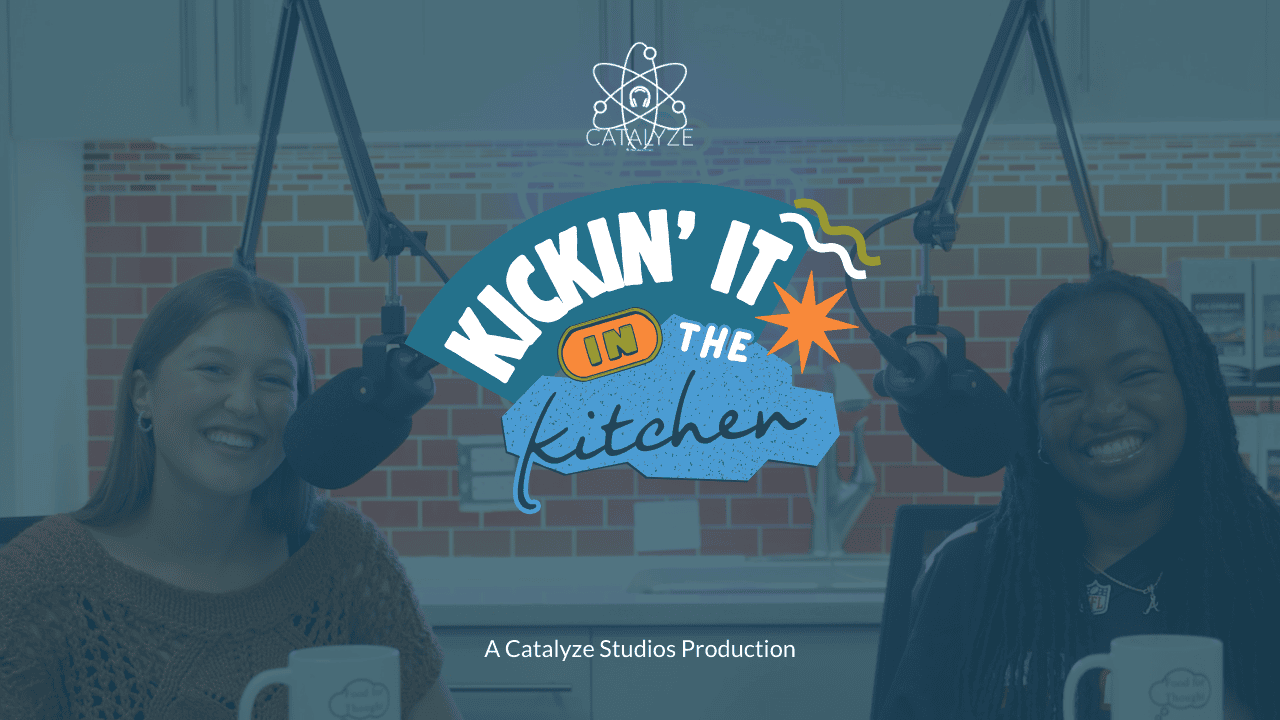
Catalyze host Ali Slack ’28, on left, with Kori Billingslea ’29 in the Scholar Kitchen at the Morehead-Cain Foundation in Chapel Hill.
Welcome to Kickin’ It in the Kitchen, a miniseries by the Catalyze podcast that explores the transformative summers of the Morehead-Cain Program. In the Outdoor Leadership summer, scholars spend several weeks in the North American wilderness on a leadership course that tests their limits and inspires self-discovery.
In this episode, host Ali Slack ’28 from the Scholar Media Team sits down with first-year Kori Billingslea ’29 to reflect on her Outdoor Leadership experience in Wyoming. Fresh from the trail and adjusting to college life, Kori shares what it was like to spend a month unplugged from technology, pushing through physical and mental challenges, and discovering unexpected strengths in the backcountry.
From breaking camp at dawn to navigating group dynamics under pressure, Kori shares about stepping outside your comfort zone and the lessons that follow you long after you’ve left the wilderness.
Listen to the episode. Watch the episode on YouTube.

Music credits
The episode’s intro song is by scholar Scott Hallyburton ’22, guitarist of the band South of the Soul.
How to listen
On your mobile device, you can listen and subscribe to Catalyze on Apple Podcasts or Spotify. For any other podcast app, you can find the show using our RSS feed. You can let us know what you thought of the episode by finding us on social media @moreheadcain or you can email us at communications@moreheadcain.org.
Episode transcription
(Ali)
Welcome to Kickin’ It in the Kitchen, a series from the Catalyze podcast. I’m your host, Ali Slack, from the class of 2028. This series explores the how, why, and what behind the Morehead-Cain Summer Enrichment Program. Over the course of four years, scholars progress through four summers: the Outdoor Leadership, Civic Collaboration, Global Perspective, and Professional Experience. These metamorphic summers are designed to help scholars develop their leadership, grow their self-awareness, and expand their understanding of the world. In this episode, we speak with Kori Billingslea from the class of 2029 about her Outdoor Leadership summer. In Outdoor Leadership, scholars spend several weeks in North America on a leadership course that tests their limits and inspires self-discovery.
Kori, thanks so much for being here today.
(Kori)
Thank you for inviting me.
(Ali)
What are we having?
(Kori)
Today I’m having a Sprite.
(Ali)
I’m having a Fresca. So to start, how’s your semester been? I know that the jump between high school and college can sometimes be a big one.
(Kori)
Yeah, it’s been pretty good. In the beginning, I had seventeen and a half credits, and I quickly learned that that was not the way to start my college experience. So after talking with Montez in advising, he was really helpful. He also helped me with any type of major change that I was feeling. So it’s been pretty good. I’ve gotten to meet a lot of new people and get to know my professors, and so I’ve had a really good time.
(Ali)
Yeah, that’s fantastic. I know I had a similar experience my freshman year. So just for our viewers, is there anything that they might not know about you?
(Kori)
That’s a great question.
(Ali)
I know, it’s a big one.
(Kori)
I’ve moved around a lot. I am from Atlanta, Georgia, but I also lived in Montgomery, Alabama; Greensboro, North Carolina; and I currently live in Seattle, Washington.
(Ali)
Shut up. That’s so cool. Any reason for the move?
(Kori)
My dad works in education, so he wants to become a head of school. And so anytime he gets a new job, it has taken us to a different part of the country.
(Ali)
That’s fantastic. Okay, so moving on to the Outdoor Leadership. So what was your initial reaction to that, like when you learned about it?
(Kori)
I am not a camper at all. So it was definitely a summer that I was not necessarily looking forward to, but I knew— I was open for the challenge. I am an appreciator of nature, and I acknowledged that I was going to be around mountains and animals, and I am a big— yeah, astronomy fan. So I was excited to see the stars. And so I was like, okay, I can look for the positive in this. And obviously I was going to have to be out of my comfort zone. And I was with good people, so that definitely helped. But definitely initial impressions: I was a little nervous, especially— I was with NOLS, and they very much stated in the beginning, “This is not a beginner course.” And I’m like, well, I’m a beginner. So I didn’t know how it was going to work out for me. Yeah.
(Ali)
Wait, what summer did you do?
(Kori)
I was in Wyoming in the Wind River Range.
(Ali)
Me too. I was in the Absaroka Mountains.
(Kori)
Okay, fantastic. And we were there for twenty-five days, and that was a very intimidating experience. That was my first time in the state of Wyoming and the first time that I’ve been in nature to that extent. So it was definitely a lot of adjustment— a long adjustment period. That first week was pretty rough. And Wyoming— the climate was very interesting. And the town Lander, where we were staying, had very different weather than what it actually was out in the mountains, which is something I wasn’t expecting. And that took some getting used to.
(Ali)
Speaking of not expecting, how did your family and friends feel about it when you were telling them? Because I feel like that can be a hard thing to explain— what you’re doing.
(Kori)
Well, my mom was not excited whatsoever. Some schools require junior backpacking trips and stuff like that, and I moved to Seattle right before my junior year. And so I— or far enough before my junior year where I didn’t have to do said trip. And then I had to come and do this. So she was not very excited. She did not want me out in the woods at all. But she also realized that Morehead was a great program, and so she was like, “Nothing bad is going to happen to you. It’ll be okay.” And then my friends were all really shocked at the twenty-five-day aspect. They were like, “That’s a really long time.” I was like, “Yeah, I agree.” But I think that was the most jarring thing for people was the length of time.
(Ali)
I agree, that was the jarring part for me too.
Yeah, I know.
(Ali)
The time frame is just insane. I know for me, I did a little bit of training, super low key, but did you even prepare physically or mentally before it?
(Kori)
Mentally, I low-key was just thinking, I’m just going to have to get there. It was hard to put myself in that mind space. The closer I got to it, the more I was like, whoa, I’m actually about to do— it was just trying to keep a positive mindset in that part. Then physically, I broke in my boots a little bit. Me and my family went on a hike a week before I ended up going out. Seattle’s a good spot for that too.
It was a great— a lot. I got to see an alpine lake, which was pretty cool. The hike itself took an hour and a half, I think. There was a little bit of uphill, but no backpacking, no stakes needed. It wasn’t too intense of a hike, but it definitely is still very different from actual backpacking. And I go to the gym pretty often, so I wasn’t too worried about the physical aspect, and I kept going to the gym, but I really didn’t know what to expect. So I really didn’t know how to prepare a ton. I still never actually wore a backpack— backpack— until I arrived at NOLS.
(Ali)
Yeah, I was in the same boat. One of my friends had hiked with a thirty-pound backpack, and I was like, oh no, am I ready for this? But then I feel like NOLS does a really good job of preparing you, which is great.
So did you have any favorite moments of the trip? Getting into the good stuff.
(Kori)
Yes, I did have some favorite moments. My first favorite moment, which is also mixed with not being a favorite moment— on the fifth day of our trip, we climbed our first mountain. And so I think the highest we went to was around 11,000 feet in elevation.
(Ali)
Oh gosh.
(Kori)
I think that whole day we— and we climbed around 2,000 to 3,000 feet of elevation. So going up, it was pretty rough, but it was one of the learning curves for us. We learned how to go uphill at our own pace, and I was with an all-girl group, and it was just really good vibes. We were talking and singing and just trying to distract ourselves from what we were doing. And we came up with “Baddie Mountain Babes.” That was the name that we called ourselves.
(Ali)
I love that.
(Kori)
And anytime that we were— or just needed a pick-me-up, we would yell, “Baddies!” and then people respond— talk to them. And so that was just a really fun thing that kept us going. And then once we reached the top of the mountain, it was super rewarding, but then also we couldn’t stay up very long, and we realized we had to go down.
We had a bit of a little downhill moment— literally. Emotionally, we were going through it.
I love this ride. The downhill was really steep, and I was struggling with it personally, but my group did a great job of keeping me in it. And then once we were going downhill for a while— once we finally got towards the end, we were in a ton of deadfall was near, and we were just going back and forth, back and forth. It was rough, but we came up with a chant and just kept going, and we were down that mountain in no time. So it made us a little delirious, but it was really fun in the end. And that “Baddie Mountain Babes” was something that kept through the rest of the trip.
(Ali)
And probably— I mean, into the school year. How could you live something down like that?
(Kori)
Exactly. I mention “Baddie Mountain Babe” often. Anytime I go through something hard— was it “Baddie Mountain Babe”? Another favorite moment: we played a couple of games, and I think those were definitely good ways to lift people’s spirits and just us getting to know each other. There was this one really weird game that we played called “Bunny Bunny.”
Yeah, you know?
(Ali)
Yeah, I know.
(Kori)
It was— it’s a strange game, but essentially you’re trying to psych people out, and once the person in the middle is supposed to go, “Bunny, bunny, bunny, bunny,” and then people next to you are going, “Tiki, tiki, tiki.” It’s just a weird NOLS game, and it was just so outlandish, and people were getting really, really into it. We only played it one time, but it was really funny, and I think that was one of the more exciting games that we played.
(Ali)
Yeah, and I feel like the cool thing about both of those things is even though I guess there was some hardship in it, you got to really bond with your cohort. And that’s something that I know for me and my group— it was really comforting going in and knowing, hey, I have these super awesome memories with these super awesome people, and then I get to do the next four years with them. Which is great. You got those Baddie Mountain Babes for the next four.
(Kori)
I have those Baddie Mountain Babes. And everyone was a Baddie Mountain Babe. It was so true. It was great. Yeah.
(Ali)
So something that I did on my OL is I kept a journal just because I wanted to go back basically for the lore. You know what I mean? So did you do anything like that? Anyone in your group do something like that?
(Kori)
I did. I did pick up a journal. That was the one promise that I kept to myself— that I was going to journal every day, because I feel like documenting something— like venting, something like this— was very important to me. So I wrote— my notebook was actually small, so I couldn’t write as much as I wanted to, but I wrote at least one page of notes every single day, just of how my day went, how— emotions, venting, emotional stuff. And a lot of my friends kept a journal too. That was a very popular thing. Our instructors gave us journaling time occasionally. So good. And sometimes, if we just wanted to decompress, we would all sit together and write in our journals. So that was pretty important for everybody. And one of the things that helped me— one of my friends recommended writing letters to my parents. It would make me sad but also relieved, because it was killing me not being able to talk to them. And I was experiencing so many different things, and I couldn’t tell them what was going on. So it was nice even just pretending that I could tell them what was going on.
And the journaling just kept me sane. I was going through a lot of emotions. And my journal— if my journal could talk— it got all the emotions that I was feeling. So it was definitely a very helpful part of the trip.
(Ali)
Honestly, for me, because I had a similar experience— I didn’t write letters to my parents, but I kept my journal for them. And it was helpful because it made the transition to college great, because carrying journaling into college is something that I do all the time now. And it also helped me learn, how do I communicate with my parents when they’re not there?
So just walk me through what a typical day on your OL looks like.
(Kori)
Of course. So typically we are waking up— I’d say, and it definitely depends on what you’re doing. If you’re cooking, you’re waking up earlier than everybody. But we would have cooks in the kitchen at the latest six o’clock, and then everybody else can make their way toward the kitchen in their respective time. But cooks are going to be cooking breakfast for everyone in their cook group. And then other people do morning routines— brushing teeth, skin care if you have the time. That was some of the luxuries we could have out there. Just people talking, trying to warm up. It would be freezing in the morning, so just doing anything to get ready for the day. And then I’d say we’d probably be done around eight to nine, depending on how long the hike is.
(Ali)
And what would a breakfast look like? What would you eat?
(Kori)
Oh, breakfast. I feel like people came up with a lot of good things. Pancakes were one of my favorites.
(Ali)
Okay, eating well.
(Kori)
Yeah. I actually ate a lot better than I thought I was going to on that trip. There was one day— Grace. Grace was in my cook group, and she made gluten-free pancakes for us, and that was low-key one of my favorite breakfasts on the trip. Shout-out, Grace. Because it was raining that morning, and I was sad, and those pancakes made me feel better. But hash browns, summer sausage, and powdered eggs were a go-to breakfast scramble— definitely something that could get tiring after a point, but that one was definitely a go-to. On my birthday morning, we were able to make seven-minute rolls, which was really great.
(Ali)
That’s so good.
(Kori)
That was great. The seven-minute rolls were— that was in our third-year ration period. But as we were longer in, we were able to cook more stuff. But definitely hash browns were the pretty basic go-to. Once we met as a group in our morning meeting, we would go over the hike for the day— who’s leading in what order.
We also had DLs, which were our designated leaders. And whoever was DL for that day would basically break it down to the group— their hiking group— what we’re doing, when are we going to leave. And they were basically the delegator for that day, and they worked closely with the instructor to tell us what we were going to do. So a lot with looking at the map. And then once you go off on your hike, people would talk, play games— that’s really a lot of the time where we got to know each other. Anything to distract from the weight on our back.
The beauty, too.
We would have— the beauty, too. Packs-off breaks were always a nice time to eat food, snack up.
(Ali)
Go-to snack? Can you see what I care about?
(Kori)
I do see what you care about. We’re kickin’ it in the kitchen! It’s appropriate. I was a really big fan of Cinnamon Toast Crunch. I used to eat it a lot as a child, and this Wyoming trip was the first time I had eaten it in a really long time, and it was genuinely getting me through. Nobody told us how hungry we were going to be. My instructor told me that we were burning at minimum 1,000 calories per day, and then on days where we’re hiking up mountains, it’s around 3,000. And so I wanted to eat all the time.
And so Cinnamon Toast Crunch was my go-to for the first re-ration, but then they didn’t give it to us again. And so that was heartbreaking. And I was basically on Cheddar Whales after that.
(Ali)
Those are good though.
(Kori)
They were pretty good. They’re pretty good. And they also gave us Bobo Bars, which were a limited commodity— we only got two per ration period. But they were the best thing ever. I really loved the oatmeal raisin ones. And every time I go to the grocery store, I look for the Bobo Bar, and I have not found it. NOLS is clearly hiding them somewhere.
What else did we do? Oh, after our hike, we would find our campsite. Whoever gets there first has to scout the grounds and look for: where can we set up camp, where can we set up kitchen, is there water close by, what can we do? And so once that group is there and they’re done and everybody knows where we’re going to be, we set up camp, start cooking dinner, and we basically have our chill time after that. And then we’ll have evening meeting, which is where the instructors will go through— and we had a whole acronym for what we were supposed to do and now I can’t even remember— but we would just go over the day, talk about what is tomorrow. We also had these times where somebody would speak up and share a story if they wanted to.
(Ali)
I love that.
Those parts were pretty sweet. Another time where we got to learn a lot about each other. This is times where people would make jokes. We would have appreciation time.
That’s so sweet.
And so we would say, “Oh, I appreciate so-and-so for doing this today.” And it was just a great time to decompress. And then that’s when the stars would start to come out, the bugs would go away. And then halfway through the trip we started having campfires, and that made evening meeting even nicer.
(Ali)
The vibes.
(Kori)
Yes, the vibes. After evening meeting, depending on if it’s dark out or not, our instructors wanted us to sleep pretty early. And most of the time you’re tired from the day, so it’s pretty easy. So it was— some people will go back to their tent, others will stay up for a little bit, play games if there’s the time.
(Ali)
Which crowd were you in?
(Kori)
Which crowd?
(Ali)
Yeah, were you in like, go to bed early?
(Kori)
It definitely depended on the night. And it also depended on my tent group. I had some tent groups that would stay out later, and so sometimes I would go to bed early just so I could have the tent to myself for a little bit. And then other times, if everybody was like, “Oh, let’s stay up,” then I would do that. There was one night— it was actually Baddie Mountain night— we had a layover day the next day, so we all stayed out later after evening meeting, and we were all just sharing stories with each other and getting to know each other, and it was all of us sitting in a circle, and it was really sweet. And then we all went to the tents at the same time. So that was nice.
It’s making me miss my OL. It took me back.
(Ali)
So I guess on a different note, did you have any regrets? Anything that you wish you would have done or hadn’t done on your OL? It’s okay if there’s not one. It’s a great question.
(Kori)
I— like, I do have a regret actually. I wish that I listened to NOLS more or I asked more questions in terms of food. So I didn’t really understand how the re-ration worked when they first explained it to us. But my birthday was on the trip, and so my parents did give me letters, and I put that in the re-ration so it would come closer to my birthday and I wouldn’t have to hold it the whole time. But for some reason, I didn’t think, hey, I can do that with food. And so I didn’t have any personal snacks besides the ones that I brought with me in the beginning. And so I was rationing those out. But if I knew that I could have kept adding— keep adding food— I would have done that. And considering how hungry I was— I’m also a picky eater. I don’t like chocolate. I don’t like peanuts. And there was so much of that on the trip because this was protein and sugar, and it just was hard to eat sometimes. And I had to just work with what I had. So I would definitely— if I was doing something like that again— add way more food so I can just soften the blow.
(Ali)
Exactly. You all heard it here. Add the food if you get the opportunity.
(Kori)
Add food.
(Ali)
Okay, so I remember one of my favorite parts about— was just getting to unplug for the first time in my life, which is crazy to think about. We’ve had technology for so long. But how did you feel just taking a step back before going into college? Just— technology super heavy.
(Kori)
I was actually really excited to be away from my phone. And while I was out there, it really wasn’t something that I thought about too often. I don’t think I’m addicted to my phone, but I definitely am a user. I use technology quite a bit. It’s hard to avoid. And so I think that separation was good for me. I definitely felt like my head was clearer on the trip, just not having any type of screen time at all. And also it just allowed me to sit with boredom or think of other ways to entertain myself. I learned how to play certain games, and I think it was just good for me. So I was pretty excited, and I was obviously with other people who were also not on their phones. So it was nice to really get to know each other in that sense.
(Ali)
Exactly. I feel like having a little bit of boredom allowed me to really get to know people. And then it also unlocked one of my new favorite hobbies, which is poetry. So I just think it’s cool. It’s some time for some creative expression.
So I guess for a closing word, what advice do you have for people who are either about to do their Outdoor Leadership summer— and also, what lessons do you want people who did do their Outdoor Leadership summer just to learn and hear from?
(Kori)
Advice for people who are about to do it: I would say you’re going to have to— especially if you’re not a camper. If you are a camper, I think you’ll love it. And also, don’t think too deep into packing. I’d say bring the bare minimum. A lot of my stuff— I was like, “Oh, I need all these things.” Your back is also going to be hurting.
(Ali)
So true.
(Kori)
Do not overpack at all. Say what they say to bring. And if you’re with NOLS, they will help you sort out your stuff too. But if you are a person that hates packing or backpacking or just any type of being outdoors, it’s— you might not see it in the moment, but you will see afterwards the stuff that you gained from it. And there might be certain things that you don’t feel like learning how to do, but those are skills that will help you eventually. And there is a reason why Morehead is sending you there. And so I think definitely acknowledge your feelings and emotions— your feelings and emotions are valid— but don’t let them hinder you. I learned how to do a lot of stuff on my OL that I would not have done in any other capacity.
I camped for as long as I did, and I never would have done that without the push from OL. And now I feel like I could go outdoors and know what to do and feel comfortable. Just embrace— it will be hard while you’re doing it. And even if you don’t see it while you’re doing it, I promise you will see the benefits afterwards.
I don’t know— oh yeah. Just enjoy the people that you’re doing it with. I’d say the people I was with— shout-out to my entire OL group. I love you guys so much. You will feel the separation anxiety once it’s time to go home. You get really, really, really close to those people. I recommend staying in touch as much as you can after your OL. We went out to— at Que Chula. Shout-out Que Chula. I love Que Chula. But that connection is just important, and I think you’re going to get closer to those people than you realize. So really lean on the people that you’re with. Trust yourself. It’s okay to cry. It happens. My group was emotional. It’s okay. It’s part of what bonds you. So just be okay with being uncomfortable.
You may not see it while you’re there, but there is a brighter side on the end of the tunnel. It’s also possible to have fun. I am not— I don’t love hiking and stuff, but I still had a ton of fun. And again, that’s what to do with your group. I’m really happy that Morehead makes it, like, an all-Morehead group now, because I couldn’t imagine doing something like this and then not seeing the people afterwards. So really just go at it with as positive of a mindset as you can.
(Ali)
I love that. Thank you so much, Kori.
(Kori)
Of course.
(Ali)
Your words were so wise and wonderful.
(Kori)
Thank you. Thank you for having me. Thank you.
(Ali)
Thank you for listening to Kickin’ It in the Kitchen, a series by the Catalyze podcast. I’m your host, Ali Slack from the class of 2028, and that was Kori Billingsley from the class of 2029. You can learn more about the Morehead-Cain Summer Enrichment Program on our website at moreheadcain.org. This episode was recorded on video at the Morehead-Cain Foundation at the University of North Carolina, Chapel Hill. You can watch all of the Kickin’ It in the Kitchen videos on our YouTube channel @moreheadcain. And if you prefer to listen, find Catalyze wherever you get your— you thought of this episode by emailing us at communications@moreheadcain.org or by finding us on social media @moreheadcain. Thanks for listening.