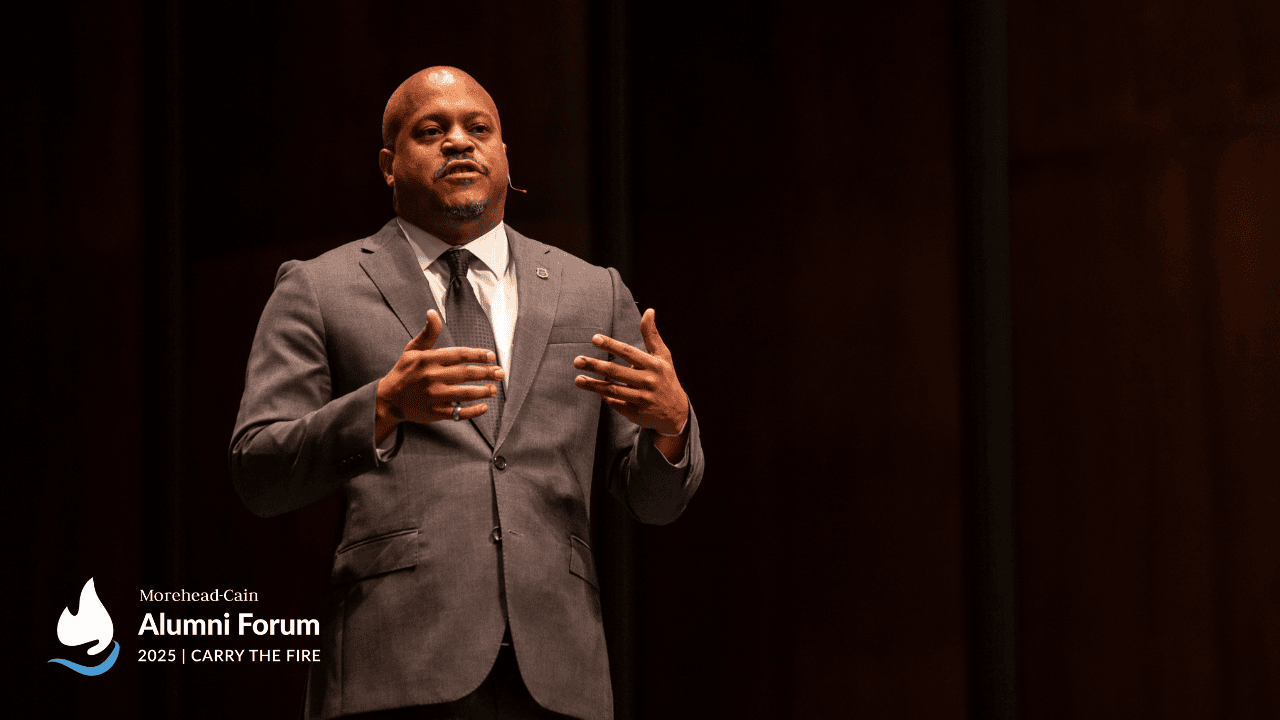
Scott Heath ’96 (photo by Leon Godwin)
Scott Heath ’96 delivered a SEVEN Talk at the 2025 Alumni Forum in Chapel Hill on October 18. Scott is a visiting professor of Africana studies at the University of Pittsburgh.
About SEVEN Talks
Every class of Morehead-Cain Scholars connects with seven others: the three classes ahead, its own, and the three that follow. The idea of SEVEN is to strengthen connections across generations of Morehead-Cains.
The Alumni Forum embodies this spirit through SEVEN Talks—seven alumni and scholars on Saturday, and seven more on Sunday—each sharing seven minutes of wisdom with the Morehead-Cain community.

How to listen
On your mobile device, you can listen and subscribe to Catalyze on Apple Podcasts or Spotify. For any other podcast app, you can find the show using our RSS feed. You can let us know what you thought of the episode by finding us on social media @moreheadcain or you can email us at communications@moreheadcain.org.
Episode transcription
I let my tape rock till my tape popped. I let my tape rock till my tape popped.
I’m a professor in the Department of Africana Studies at the University of Pittsburgh. That’s the new ACC. I do my best to represent us. I’m trained as a literary critic and cultural theorist. I approach literature and music and sound, and film, through a Black studies lens with a focus on hip-hop. All the things that are happening to us culturally and institutionally in this country right now caused me to reflect on how I got to this place as a scholar and why I do what I do.
I come from a family of educators. My mother is a high school teacher. My father is a middle school principal. My sister is a health educator. Half my parents’ friends are teachers or administrators. Half my friends are teachers or administrators. We used to say, “He got it honest, so in the blood.”
My work is motivated by love and memory and sometimes grief. To explain Black studies, I have to explain my daddy’s components that I let my tape rock till my tape popped.
You know a home audio system? A component set was a prized possession and a labor of love. At its foundation was a receiver. This is a machine in the middle that receives sound signals from all the other machines that are plugged into it. The centerpiece, traditionally, of a component set was a turntable, the player, which was used to play vinyl records and was made more or less useful depending on the quality of your record collection. The sound of those records gets plugged into the receiver and amplified by your speaker system—again, more or less useful depending on the quality of the machinery.
A component set would grow sometimes, adding on at the rate of technological advancement. My father’s component set included, along with the turntable, of course, an eight-track tape player. I’m taking some of you back, and some of you have no idea what I’m talking about. This eight-track player was eventually superseded by a cassette tape deck, first with one player and then with two players side by side. Next came the CD player to supersede that tape player.
Supposedly, I received my first CD player as a Christmas present from my parents. I say supposedly because I received the CD player along with three CDs. One was the best of Luther Vandross—you’ll see what I mean—Jody Watley, and then one rap CD by a singing group called Wreckx-n-Effect that did a song called “Rump Shaker.” I say I supposedly received this as a Christmas present because that CD player was immediately plugged into my father’s component set. So it was like our CD player, right? With Luther Vandross. I love Luther today, but they knew what they were doing.
Each of these developments was a special occasion that merited a small celebration of sorts. When my father added something to his component set, he would call up his friends—my uncles, Uncle Donald Ray and Chubb and Cheek and my godfather George—and he’d say, “Hey, you got to come over to the house. I got to show you something.” They’d come over to the house, maybe with a bottle of Canadian whiskey under an arm, to see what the new surprise was going to be.
For a while, they would look at the component set and look at the new shiny thing that’s attached to it. Just look for a little while, stand back. After looking for a while, they want to test it out, check out the sound. I’m looking from the other room, peeking around the door, thinking my father and his friends were technological geniuses.
Yeah, CDs were valuable at the time. One of the worst things that could happen to you was your CD collection being stolen or something like that. I don’t think it’s that crucial anymore. CD players were supplanted by MP3 players, and now MP3 players have been supplanted by streaming services, and all of it is corporatized.
But the thing about a real component set is you don’t toss the older pieces when you get a new machine. It just adds on. It adds on. It just grows. You have a CD player now, but you might prefer that vinyl record sound from time to time. Even though somebody said, “When are you going to throw that old thing out?” You don’t. Each piece in it indicates an era of expression and genius and memory.
I miss the cassette moment most, and I miss my big cousin, Donnie, and what he taught me. The cassette tape was special because it allowed us to listen but also to conveniently record new sound. While our daddies had whole component sets, Donnie and I each had a little boom box, a portable radio with one cassette player embedded in it.
When us cousins got together—rather, when our parents got together, when we were supposed to be fast asleep—we’d get in the back room, and you know how you do it: you press pause, and then you press play and record at the same time. And you wait, and you wait. And we’d listen to the late-night radio shows. I’m speaking to a mixed crowd here, so let me explain. Sometimes late-night radio shows were broadcast live from some location—the skating rink or the National Guard armory or wherever the party was taking place. And we’d listen, imagining—we’d never been to these places, but we’d imagine what was going on. And it was easy because you could hear the audience in the background cheering while the DJ spoke and played music.
And then when the song that you were waiting for arrived or a song you’d never heard but it was very interesting, you would release the pause, listen to the song, hoping not to get in trouble, and then you’d press pause again right at the end. This is how we began to build a mixtape. Remember those?
Little did we know, Donnie and I, that we were engaging in an archival practice, a research agenda. It always felt like we were smuggling something as we collected these sounds. And then what do you do? You want to disseminate that sound, disseminate what you recorded. So what do you do? You take one boom box, juxtapose it chest to chest against the other boom box. You press play on one, press record and play on the other, and then you would go silent because this is a very special process that could not be interrupted by one of our mothers walking in and saying, “What are you boys doing awake?” We might even leave the room and guard the door. There’s something going on here. We’re working on a project. And face-to-face, we would fill another blank cassette with sound.
I let my tape rock until my tape popped.
Black studies is an academic field that springs from a tradition of student protests coupled with community demand for departments and courses honoring Black life and culture. These studies sometimes include approaches to actual sound, like music, as in my work, but they always include approaches to sounding moments of cultural expression that we all make and have.
This sound and sounding has always met with resistance, though, especially today. There’s a segment of the population whose greatest fear is Black people’s capacity to read and remember things. So Black studies is actually a project built around literacy, right? Especially as literacy in this country has also—it’s often operated as a measure for citizenship and for humanity. And music requires a certain literacy as well.
Every Black music has been despised and villainized at some point. The spirituals, the blues, jazz, rock and roll, R&B, soul, funk, and of course, hip-hop have all been outlawed in some manner before being accepted as American music. Hip-hop is unlike other Black musical genres in that it is asked to say something. You don’t just listen to the beat, actually. You hear a rap song, and a smart audience will ask, “Yeah, but what is she saying, though? What is he saying, though? I hear the rhymes, but what are they saying?”
People in the eighties and nineties were not afraid of hip-hop because of what rappers were saying. They were afraid of the idea that these young Black people were saying anything at all, because the saying is the humanizing thing.
I let my tape rock till my tape popped.
University of North Carolina, the finest public institution on the planet, the original ACC, was established in 1789. George Moses Horton, the so-called slave poet, author of the first book of literature published in the state of North Carolina, The Hope of Liberty, in 1829—now, George Moses Horton notwithstanding, the North Carolina General Assembly wrote laws in 1818 and then doubled down in 1830, prohibiting anyone from teaching enslaved people to read and write. A year later, another bill made it illegal for any person of color, enslaved or free, to preach or exhort in public where enslaved people were gathered, like church. In other words, they were forbidden from speaking out loud. White people were fined up to two hundred dollars or imprisoned for teaching an enslaved person to read and write. Free Black people were whipped up to thirty-nine times for teaching.
I come from a family of teachers.
My family is getting smaller. Often when someone dies, they go from being a person to being an idea of a person. And it’s our memory of the people we lose that protects their humanity. So my family lost a lot—a lot of people during and around the pandemic. My cousin, Donnie, died. My cousin, Alan, died. My godfather George died, Uncle Dennis, Barbara, my close friend, Brian Horton, died about three years ago. My daddy died a year after that, and my mother died a year after him.
It’s crazy. But Donnie kicked it all off. Losing him kicked a hole in my chest, really. It’s in collecting the details and those memories of the things that he taught me—am I missing him and honoring our time together? It is a Black study. It is a cache of memory, a Black cassette.
Black studies is a humanizing project driven by memory and love. And here in this cultural moment, here in the United States, it is imperative that you preserve and protect your Black studies, that you protect your cassettes, that you record, rewind, and play it back.
Let your tape rock till your tape pops.
Thank you.