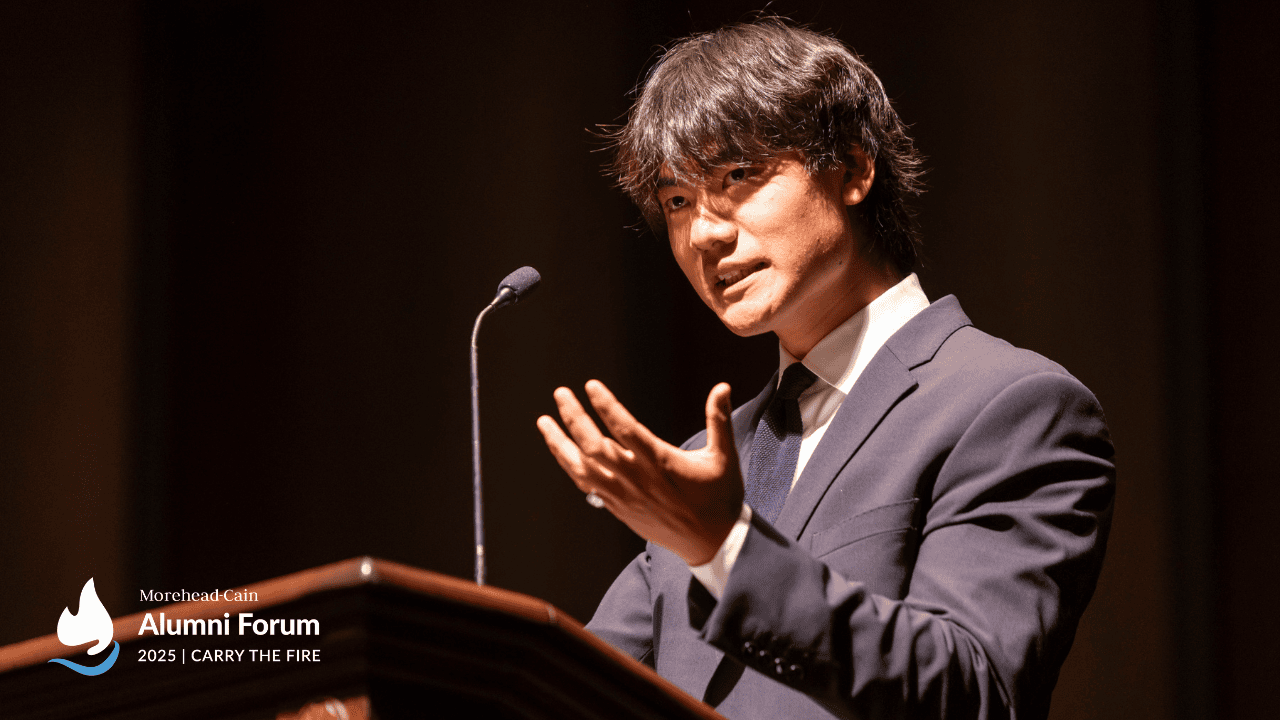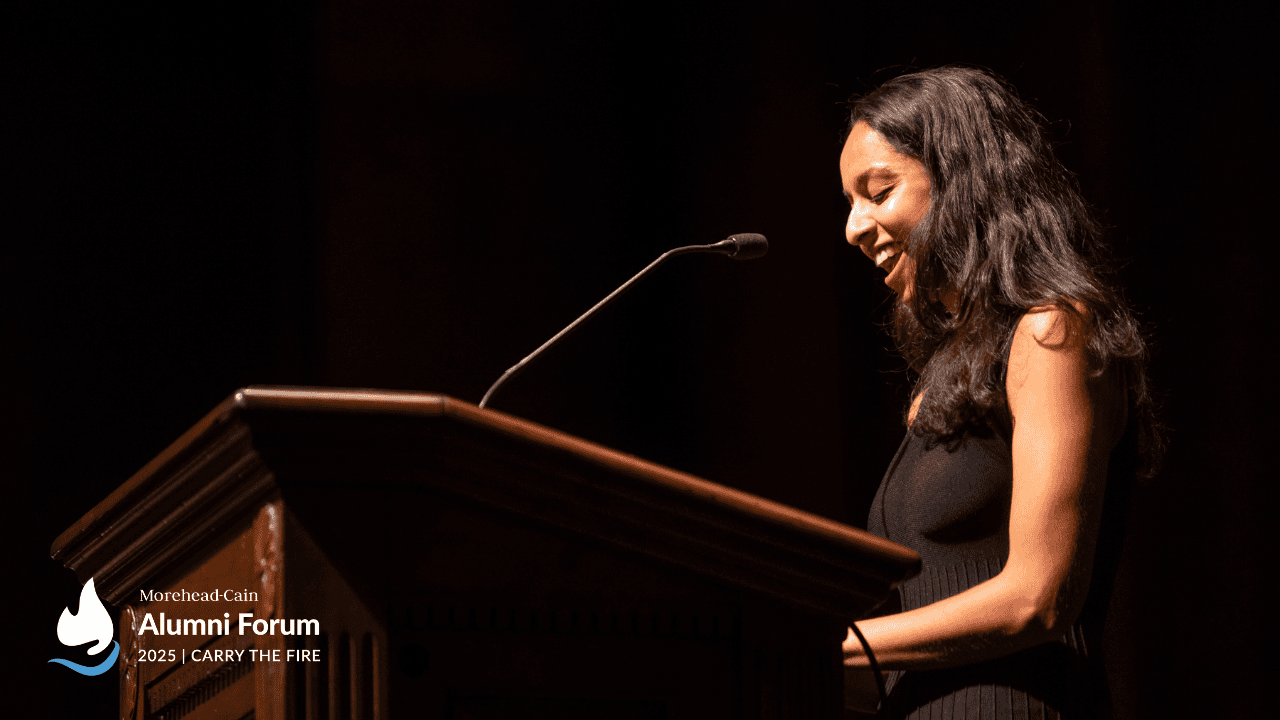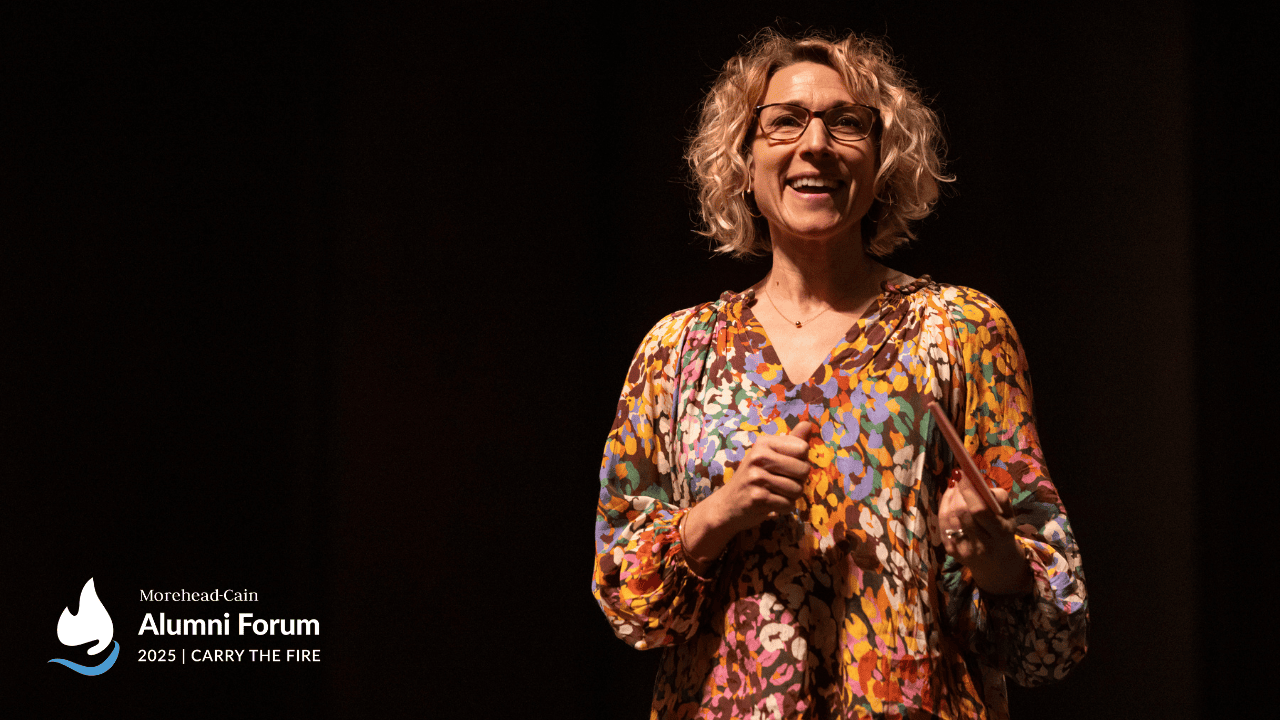
Robin Berholz Cory ’98 (photo by Leon Godwin)
Robin Berholz Cory ’98 delivered a SEVEN Talk at the 2025 Alumni Forum in Chapel Hill on October 19. Robyn is a partner and the founder of Colbeck Strategic Advisors.
About SEVEN Talks
Every class of Morehead-Cain Scholars connects with seven others: the three classes ahead, its own, and the three that follow. The idea of SEVEN is to strengthen connections across generations of Morehead-Cains.
The Alumni Forum embodies this spirit through SEVEN Talks—seven alumni and scholars on Saturday, and seven more on Sunday—each sharing seven minutes of wisdom with the Morehead-Cain community.

How to listen
On your mobile device, you can listen and subscribe to Catalyze on Apple Podcasts or Spotify. For any other podcast app, you can find the show using our RSS feed. You can let us know what you thought of the episode by finding us on social media @moreheadcain or you can email us at communications@moreheadcain.org.
Episode transcription
I remember the moment it all began.
It was a fall night exactly ten years ago, and my husband and I heard a call to action on the radio by an organization called Lifeline Syria. They were calling on ordinary Canadians to do something extraordinary: to sponsor a Syrian family for their first year in Canada, providing both time and financial support.
If you recall, at the time a civil war was raging in Syria. On a daily basis, we were seeing images of families fleeing chaos and violence. Five million Syrians had fled the country—it was the largest refugee crisis since World War II—and most countries were turning them away.
And even still, there were so many reasons not to do this. I had three young kids. I worked in the nonprofit sector already. We had means, but not that much. There had to be plenty of people who would do this, right?
But we realized this was one tangible thing we could do in the face of unrelenting bad news.
Within weeks, we had gathered a group. I remember that first fateful conference call with our Google Docs and spreadsheets open—planning and action. We were Norwegians, Canadians, Palestinians, and Americans, spanning backgrounds, religions, and professions. We were book club friends, neighbors, work colleagues, and family.
Among us were four more Head Cane scholars, including Scott and Julie Weary and Jordy Koski, who are here with us this weekend.
We called ourselves True North.
Over the next year, we raised enough money to bring two Syrian families to Canada. Within the next five years, we expanded—our group raised almost $200,000 and helped bring fourteen Syrians to Canada, transforming all of us in the process.
And we weren’t unique. This experience was being replicated across towns and cities all over Canada. I remember the immigration minister at the time famously saying, “We cannot provide Syrian refugees fast enough for all the Canadians who want to sponsor them.”
Underlying this program are two simple and connected ideas.
The first is that if governments trust and invite citizens to act, the impact can be multiplied many times over.
The second is that by engaging deeply across difference, we don’t just help others integrate—we change ourselves.
Because the private sponsorship program blurs the line between the helper and the helped. It’s not charity; it’s the slow, beautiful process of building community, one relationship at a time.
I wish I could stand here and tell you about each and every one of these extraordinary humans. But instead, I’ll give you a glimpse into a couple of them.
The first family we welcomed was Khaled and his mother, Amira.
Khaled was a young dentist in Syria at the time the war broke out. He shifted to providing humanitarian support to civilians resisting the Assad regime. And when it became too dangerous to stay, he fled with his mother to Turkey.
Khaled and Amira arrived during a Canadian blizzard like no other. I remember the night before—Julie and I had stocked the fridge of the temporary place where they would be living. Folks in our group had collected winter clothes, and Julie even found the Turkish coffee she knew they would love.
They got off the plane terrified, speaking very little English, but were greeted by warm and eager faces. I remember Julie, who’s from Florida, saying that was the first night she felt truly Canadian.
In those first weeks, we helped them find an apartment and work. Khaled dreamed of requalifying as a dentist in Canada, but after so much time and effort, that proved impossibly steep. Still, he ended up working in a dental clinic, got married, had a child, and built a life in Canada.
I remember a common refrain from him: “I hope one day I can make Canada proud.”
And then there’s Ayat—the warmest twenty-two-year-old biology student who fled Syria with her family and ended up in Canada on a leadership scholarship.
We met her because she had been paired with our sponsorship group through a program that connected Arabic-speaking university students to private sponsor groups. While juggling a full course load and a part-time job, she showed up to translate at key appointments and helped our families navigate the health and education systems—forming a bridge between our two worlds.
In the process, we formed a very special bond.
I was there for her wedding, for the devastating loss of her eighteen-year-old sister, and for the birth of her babies. I still remember the smell of the meal she prepared for us in her dorm room, where my family came for dinner and we pulled the table up to her radiator, which doubled as a bench.
I also remember the dinners she continues to prepare for us to break the Ramadan fast—meals my Jewish family has come to love. Nights filled with crying babies, laughter, and cross-cultural chaos.
And yet for my children, courage and resilience now have faces and names.
Two years after Khaled arrived, we were able to bring his sister, brother-in-law, and their two kids to Canada—reuniting at least one branch of that family.
We were also able to sponsor Ayat’s mother and sister, who, after five agonizing years of waiting, finally arrived earlier this year. Twelve years after fleeing the war, this family was finally reunited together in safety.
When the private sponsorship program began, the Government of Canada pledged to bring 25,000 Syrians to Canada. In the end, we welcomed 70,000.
This model has been replicated in the U.K., New Zealand, Ireland—and even in the U.S. In many ways, it was a bold experiment, testing whether public systems could be designed not just to serve citizens but to activate them.
And it worked.
The Syrian families integrated faster. They were five times more likely to find employment and significantly less likely to need public assistance after their first year. Most strikingly, this didn’t cost taxpayers more—public spending was amplified by private generosity, by civic energy hiding in plain sight.
I’ve come to believe through this experience that citizenship is not a legal status. It is a practice.
We don’t belong to a country because we were born there. We belong because we build it together.
And at a time when polarization and othering are dominating public life, I believe this program offers an antidote.
For me, it has reinforced that curiosity and compassion can be civic virtues.
Earlier this year, a WhatsApp message popped up on my phone from Khaled. He said, “I’m moving back to Syria. My country needs me to rebuild.”
With the fall of the Assad regime, he felt called to contribute. Now he wanted to make his country proud.
Julie has a photo on her desk of Khaled and his mother’s Canadian reunion with his sister. It’s accompanied by a quote that reads, We are all waves from the same sea.
And that’s really what this experience has felt like for me—the realization that we are all moved by the same tides of hope, loss, and love.