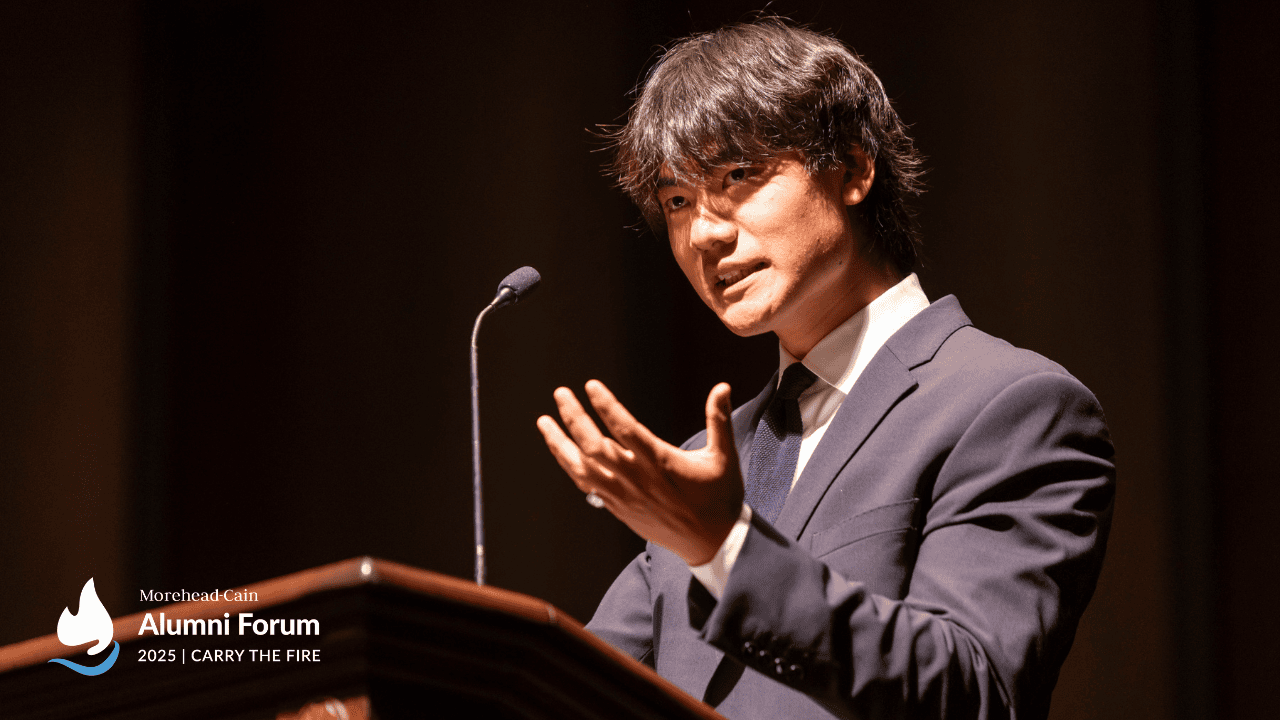
Randy Chang ’28 (photo by Leon Godwin)
Randy Chang ’28 delivered a SEVEN Talk at the 2025 Alumni Forum in Chapel Hill on October 19. Randy is a mathematics and politics double major at Carolina.
About SEVEN Talks
Every class of Morehead-Cain Scholars connects with seven others: the three classes ahead, its own, and the three that follow. The idea of SEVEN is to strengthen connections across generations of Morehead-Cains.
The Alumni Forum embodies this spirit through SEVEN Talks—seven alumni and scholars on Saturday, and seven more on Sunday—each sharing seven minutes of wisdom with the Morehead-Cain community.
How to listen
On your mobile device, you can listen and subscribe to Catalyze on Apple Podcasts or Spotify. For any other podcast app, you can find the show using our RSS feed. You can let us know what you thought of the episode by finding us on social media @moreheadcain or you can email us at communications@moreheadcain.org.
Episode transcription
Good morning. It’s my first time telling this story, so bear with me.
I was born with a rare overgrowth genetic condition that gave me a 93 percent chance of never being able to speak. If you’d like to imagine that 93 percent, just stick your tongue out as far as it can go and imagine it stays in that position forever. I essentially had 7 percent odds of being able to eat, drink, and speak normally in my life. Crazy coincidence.
See, my birth was fairly complicated. My parents always wanted a child. They tried for years. So I decided to arrive very ahead of schedule—you’re welcome, Mom. And I was also very big. My dad lovingly described me in the Mandarin which translates lovingly into “fat meat caterpillar.” It’s true. I barely fit into the incubator, and my tongue was no exception. It didn’t fit into my mouth.
There was a surgery that would reduce my tongue and allow me to eat and speak like other children. But no Canadian surgeon was, quote unquote, “confident” in their ability to perform this surgery. My parents usually want their surgeons to be confident in their ability, and so they were about to give up when the phone rang. My mom had signed up for a comfort call, and a parent had selected them because her husband’s name was also Randy. And by pure coincidence, she worked with a doctor in St. Louis named Dr. Marsh.
For context, about eight successful tongue reduction surgeries happen every year in Canada. Dr. Marsh did eight successful tongue reduction surgeries before lunch on Tuesday. He was essentially the Michael Jordan of tongue reduction. So of course, we went to St. Louis, but that implied America, and American health care implied American prices. So just as I was getting accustomed to Canada and getting to know these two nice people, they had remortgaged their house in order to remodel my tongue.
At first, the gamble paid off. I could speak, and I seemed on track to live a healthy, normal life. But when I started school, it was like the surgery never happened. I essentially became mute because of how terrified I was of the people around me. I spent most of my time reading books and listening carefully in social situations just in case I was called on. And after crying through four straight class presentation attempts, my sixth-grade teacher involuntarily signed me up for the debate team as a form of speech therapy.
And to my surprise, I found the years of quietly reading and quietly listening to other people had prepared me extraordinarily well. All I was doing was telling stories and retelling the ones that I understood more deeply. And I got hooked. Suddenly, being a baby was helpful because I could bluff about my age to enter tournaments.
One of my first tournaments was Harvard’s championships, and to everyone’s surprise, including my own, I ended up reaching the finals against Canada’s national debate team. I am Canadian. These are the best debaters in the country—my country. Of course, I’m worse than them. So to nobody’s surprise, we lost horribly. But shockingly, I’d been named the best individual speaker at the age of fourteen, and Canada’s coach came over to shake my hand. One thing led to another. Later that year, I became their youngest national team member. And from there, things exploded. A few months after getting my driver’s license, I was part of the team that won the World Championships. I had gone from almost permanent silence to speaking publicly and winning on the international stage. My mom never missed a tournament. She couldn’t stop smiling.
And I was now a debater who won. I never wanted to be seen again as the silent boy with a broken tongue. I wanted to be the perfect winner, the silver-tongued champion. And I learned over the years, just as I assume many of our politicians are trained to do, how to maximize winning, even at the cost of intellectualism. I began thinking of facts that aligned with my arguments rather than arguments that aligned with the facts. I learned to speak faster against younger opponents because they couldn’t process as quickly. I used my reputation to deliver weight behind increasingly hollow talking points. I just saw no other choice. I thought this was what being a winning debater meant. It wasn’t about being a better advocate or a better listener. It was about owning the competition. Success was making the other team cry. Success was about confident guesses and Ivy League degrees. Success was a well-worn path to law school.
My senior year, my best friend took his life a few days before Halloween, and I had to miss the funeral because I had to debate the next day. That is still a decision I regret to this day, and I can’t speak into words how badly it affected me. And for the first time in four years, I decided to take some time off debating—not because I wanted to but because my school psychiatrist forced me. And after a couple weeks of not going to tournaments but still listening because I wanted to stay sharp, I realized how meaningless this all was—how meaningless it was that I was a bully and I could convince people of anything and that I could pick a side at the drop of a hat. I didn’t want to just be an empty, sharp suit. I wanted to be something more.
And even though I didn’t want to debate anymore, I returned to debating for just a single tournament, our last tournament ever with my partner, the Canadian National Championships. I went back to default settings. We breezed through our first few rounds. A person cried—sorry. And we ended up reaching the finals. And on the day of finals, I woke up with the worst illness I have ever had. My throat essentially became a piece of wood. I could no longer speak. My voice again had been taken from me. I could no longer shout and assert my way to victory. And I lost my ability to use my tactics. So what could I do? What would I do when the outcomes and the titles didn’t matter? Who did I want to be?
I still don’t know why, but in the finals, it felt more right to listen carefully to our opponents, to acknowledge their best points, and to avoid verbal semantics and complex jargon. And during the round, that felt quite pleasant. But then the award ceremony started, and my heart started pounding. My body physically rejected what I had just done. Would I be willing to accept this inevitable loss? Why had I debated like such a weakling? Was this a way to honor my friend’s memory?
But then it was announced—by the grace of God—that we had won. And I felt this electric wave of light rush through my body. There was nothing but pure childlike excitement. In retrospect, it’s clear that this win felt different because it was the quiet little kid in me who was celebrating, not the empty suit.
And a few days later, my voice returned. And a few days later I signed the papers to come to Carolina.
At Carolina, I’m on a very different path. I don’t debate much anymore. I do some dialogue work that seems to fulfill the debater with a much healthier set of noncompetitive discussions. I ended up studying the humanities, but I also study math. I work in AI policy research, which is, I think, the opposite of law school—or maybe not, if you consider the panel yesterday. And this is in fact the first public speech I’ve given in years.
And in one last cosmic twist, I can feel seven minutes in my bones because, ironically, seven minutes is the precise length of a debate speech. I’ve given thousands of seven-minute speeches, all of them concluded with the same debate speech.
I’ve given thousands of seven-minute speeches. All of them concluded with the same debate saying: “I’m proud to propose.”
I must admit, cousins, I was never proud of what I said in seven minutes. I was often dishonest. I was never vulnerable. And I found doing these seven-minute performances over and over supplied me with a voice. But it wasn’t my voice.
I always thought I was honoring the silent kid of my past by erasing him, pretending like I was just any other outspoken leader, any other outspoken debater.
What this opportunity has given me, the Foundation, is given me the freedom to live differently, to listen more intentionally, and to speak authentically about who I was.
I now have the confidence to be proud that I’m here, proud of who I will become, and deeply proud of the little boy that I was.
And for those reasons, at last, I can finally say, “I’m very proud to propose.”
Thank you.