Niman Mann ’18 (photo by Leon Godwin)
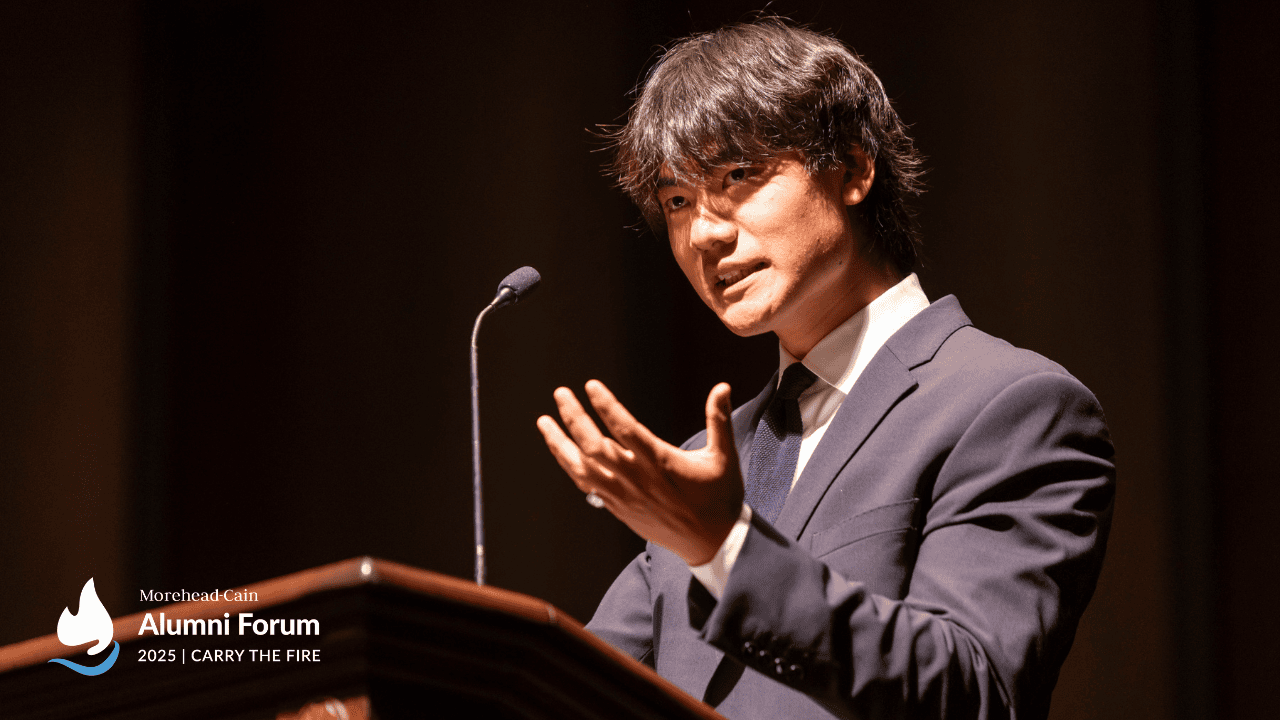
Niman Mann ’18 delivered a SEVEN Talk at the 2025 Alumni Forum in Chapel Hill on October 19. Niman works in strategic finance at Zipline.
About SEVEN Talks
Every class of Morehead-Cain Scholars connects with seven others: the three classes ahead, its own, and the three that follow. The idea of SEVEN is to strengthen connections across generations of Morehead-Cains.
The Alumni Forum embodies this spirit through SEVEN Talks—seven alumni and scholars on Saturday, and seven more on Sunday—each sharing seven minutes of wisdom with the Morehead-Cain community.

Watch SEVEN Talks on YouTube.
How to listen
On your mobile device, you can listen and subscribe to Catalyze on Apple Podcastsor Spotify. For any other podcast app, you can find the show using our RSS feed. You can let us know what you thought of the episode by finding us on social media @moreheadcain or you can email us at communications@moreheadcain.org.
Episode transcription
Good morning. So my name is Niman. When the foundation asked me to do this SEVEN Talk, my first thought after “What am I going to talk about?” was a sense of awe that I’ve been a part of this Morehead community for over a decade now. Time has truly flown. I thought back to my first days at Carolina and started to wonder, “What did I even think about back then? What was going through my young mind as I walked from South Campus to Franklin Street, traveled abroad alone for the first time over a summer, and just generally navigated that formative era of life?”
I’ve always been an avid journaler, so I conveniently do have a way to access my thoughts from Carolina. So today, back in Chapel Hill, I thought it would be fun to share some of my unfiltered college-era thoughts—very vulnerable, thank you for laughing—and what I learned from stepping back into the world of my younger self.
So in the summer of 2014, I was seventeen years old and thought—and was confident—that I was at the top of the world. I had overachieved my way through high school, gotten the Morehead, and was anticipating the amazing adventures Carolina would bring my way. My first adventure? Backpacking in Alaska for a month over the summer. I was not at all outdoorsy before this, so this wasn’t necessarily on my bucket list. I went to REI an embarrassing number of times before the trip to ask the sales associates, who are honestly a captive audience, all of my questions.
Backpacking with forty pounds on my back, rationing food by the calorie, and being away from friends and family and, admittedly, my cell phone was all outside of my comfort zone. I began to journal daily that summer, honestly as a coping mechanism. It helped me slow down and process each day’s happenings.
On day one of the trip, my reflections were honestly very straightforward. All I wrote was, “Today was insane. We started the trip by hiking straight uphill for over a mile. This was a reality check. This is going to be intense. FML.”
Just forty-eight hours later, but many miles later, I wrote, “Today was less intense than yesterday. It was honestly hell during the hike, but fine when I got to campsite. I think my main problem is my mentality. I need to stay positive and present when I’m hiking rather than constantly thinking about how much longer we have to go and how much discomfort I’m in. I think it might take some time, but hopefully I can work on it.”
So when I read this a few weeks ago, I was honestly impressed. Who knew I was thinking about the importance of staying present way back then? This is something I have to remind myself of today. So I thought maybe my college-era self had more figured out than I thought. But not so fast. As I continued to read journal entries, I was quickly humbled.
One entry from a few months into my freshman year reads, “I loved journaling in Alaska, but I wish I did it more now that I’m back in the lower forty-eight.” For someone from Nashville who had only spent a few weeks in Alaska, I hate to admit that I used the term “lower forty-eight” a few other times as well.
The next summer I journaled from Peru, where I was living in a rural homestay with fellow Morehead Elizabeth Nichols. It was winter there, and the sun set early, so after dinner we’d retire to our room and spend the next few internet-free hours reading, talking, and honestly, mostly watching bootleg episodes of Modern Family on one of our laptops. This calmer pace of life was quite the adjustment for me. I was used to going a hundred miles an hour all the time.
That summer I once again had to just slow down. As I sat in my twin bed in my homestay, far, far away from Chapel Hill, I wrote, “I figured out why I felt so weird last night. It’s so strange to be living such a relaxed lifestyle—no to-do list, no places to be on time, no plans during the weekends. It’s just so different from what I’m used to. I like feeling productive, having plans and activities all day. This makes me even more sure that I want to go into medicine.”
First of all, it’s funny that my takeaway from “Huh? It’s kind of weird to have downtime” was “Time to go into medicine.” But I wish I could tell my eighteen-year-old self that a future version of her would actually jump at the chance to have an incredibly slow summer. And by the way, despite her inflated sense of confidence, she never even went into medicine.
A couple of years after Peru, I was in the thick of my senior year. I accepted a job offer in the fall and finally felt relief that I had postgrad plans. Now I could finally just be present and enjoy my senior year. But then it came up again. I started anticipating my postgrad life while also trying to make the most of my final year at Carolina. On a plane home to Nashville for the holidays, I wrote, “I want to focus on enjoying the moment I’m experiencing and simultaneously letting go of expectations. I think not anticipating the future will allow me to appreciate the present more. Easier said than done, but if I can improve even a bit, I’ll be happy.”
Earlier in college, only external forces like a remote backpacking trip or a remote summer could slow me down. I still didn’t have it all figured out, but now there was clearly a shift. I was myself hitting the brakes, all with the intention of savoring the temporary here and now.
Apart from honestly just being entertaining, reading through my admittedly jumbled college-era thoughts taught me a few things. One, staying in the present clearly takes practice. My neurotic but well-meaning college self realized this and started the effort, but it’s now on me to keep applying that lesson. Two, I remember those college days so fondly, so it was interesting to realize that they hadn’t always been easy to appreciate in the moment. When I struggle to stay present today, I remind myself that a future version of myself will likely remember this time with a sense of nostalgia. This helps me slow down and view the current moment, despite its potential complexity, with a bit more appreciation.
Finally, my college-era self clearly didn’t have it all figured out, but she was on the right track. It’s a reminder to lean into the process of becoming, slowing down, appreciating the current moment, and trusting wherever it may take us.
Thank you.