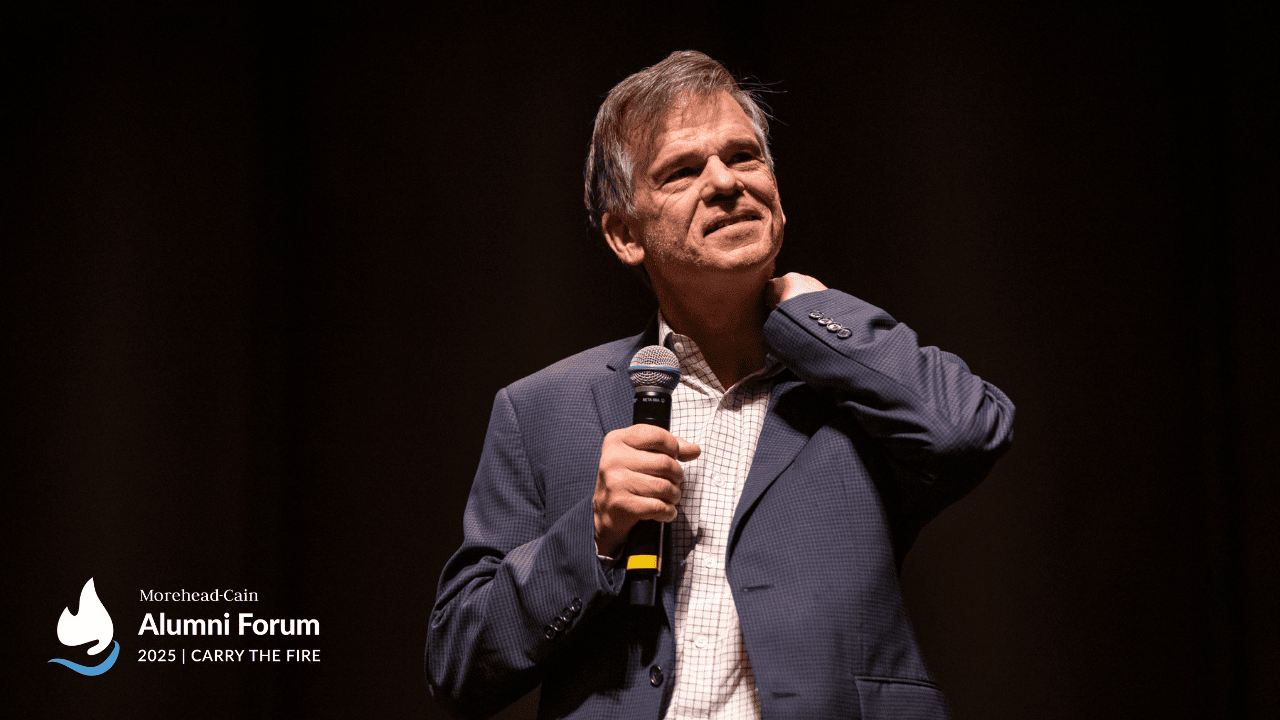
J.B. Howard ’85 (photo by Leon Godwin)
J.B. Howard ’85 delivered a SEVEN Talk at the 2025 Alumni Forum in Chapel Hill on October 19. J.B. is a freelance lawyer and former counsel at Cadwalader, Wickersham & Taft LLP.
About SEVEN Talks
Every class of Morehead-Cain Scholars connects with seven others: the three classes ahead, its own, and the three that follow. The idea of SEVEN is to strengthen connections across generations of Morehead-Cains.
The Alumni Forum embodies this spirit through SEVEN Talks—seven alumni and scholars on Saturday, and seven more on Sunday—each sharing seven minutes of wisdom with the Morehead-Cain community.

How to listen
On your mobile device, you can listen and subscribe to Catalyze on Apple Podcasts or Spotify. For any other podcast app, you can find the show using our RSS feed. You can let us know what you thought of the episode by finding us on social media @moreheadcain or you can email us at communications@moreheadcain.org.
Episode transcription
When David Greer contacted me this summer and asked if I would give a SEVEN Talk, I was a little nervous. I asked one of my sons, “Have any advice or suggestions?” He said, “Dad, don’t try to be wise or funny or smart. Just be yourself.” That’s what you’re going to get, I hope. I’m going to try to do that.
The great poet Mary Oliver in her magnificent poem “The Summer Day” ends with a challenge to the reader: “Tell me, what is it you plan to do with your one wild and precious life?” In another poem, she makes some suggestions about how to figure that out. It’s instructions for living a life: pay attention, be astonished, tell about it.
I’ve listened to, as you have, amazing SEVEN Talks, and just listen to how my fellow scholars and alumni have accomplished amazing things through their grit and perseverance. I think I’m the only one who’s been asked to talk because I quit. To back up, I resigned earlier this year in protest from a law firm where I loved the firm, I loved the job, and I wanted to continue working there. But the firm made a decision I deeply disagreed with.
To back up, this spring, the Trump administration began to issue or threatened to issue a number of executive orders to essentially settle some scores, going back to the dossier or the Russia investigation or some of the prosecutions before the reelection, and targeting specific law firms. And these executive orders would prevent members of the firms from having any interaction with the federal government, entering federal buildings, speaking to agency personnel. They would terminate contracts the firms had, terminate contracts their clients had. I mean, these were existential threats.
Some firms stood up, went to court, and challenged the orders. I think it was obvious at the time—and the courts have since held—flagrantly unconstitutional. Other firms made a different decision, wanted it to go away, cut a deal with the administration to avoid the issuance of the orders. The principal feature of these deals was to provide one hundred million dollars in free legal services to causes of the president’s choosing.
My firm decided to cut a deal. I did not feel like I could continue practicing law there. I had taken an oath, as all lawyers do, to uphold the Constitution and laws of the United States and also critically to protect the honor and integrity of the legal profession. In my mind, when I took an oath to become a lawyer—just the time is going fast—that involved a commitment to protect the system of laws. That’s a special obligation of lawyers. I didn’t think we had any right to make a livelihood from the system of laws unless we were willing to stand up for it. That’s how I felt. I’m not going to judge anyone else.
I tried to articulate this in a resignation letter. I shared it with some family and friends. It found its way into the New York Times and was published in full, which I was grateful for, but I was especially grateful for hearing from so many friends from childhood, from law school, some really special people in this room I hadn’t heard from. It was interesting because the gist of these notes that I got was, “I’m just proud of you. Commend you on a courageous decision or principled decision.”
It was a little bewildering because it didn’t feel that way for this particular decision. It was reflexive. I mean, it was really visceral for me, which is totally different from how I usually make decisions. I usually take a walk by a mountain stream, and I’ll weigh the pros and cons and talk to people. And only then will I decide to put the decision off and watch some Netflix. But this one was like if your child wanders into a bus lane, oncoming bus, and you just grab and take him back.
I thought, “Why was it so different?” I began to think. These scenes from my life came to mind, and I thought about being a ten-year-old sitting in my dad’s law library and just soaking up the atmosphere of the books on the shelf. I thought about being a lacrosse goalie at summer camp, and at the award ceremony I won the Courage Award because I played with these older kids. That was, other than Morehead, the most special award I’d ever gotten. I read the book The Brethren about the Supreme Court during the 1970s during a Morehead summer. I was just mesmerized. As a young lawyer, I was involved in the tobacco litigation. We had some of the big guns from around the country come in—I was at the Maryland Attorney General’s Office—and really try to threaten us to back off, and that only energized me all the more.
So I started to think, “This is interesting. These things happened and led to a moment when I faced a major life decision, and I just instinctively felt I knew what I should do.” That gave me the opportunity to think about, “Well, I can do this intentionally now going forward. What are the experiences that I’m having that energize me in the same way, that make me more the person I want to be? How do I spend my time? Who do I spend my time with? What books do I read? How do I feel when I’m experiencing these things?” I hope that will lead me to act instinctively in a way that I’m proud of if I face one of these decisions again.
I want to end by reading something. I’ll see if I can get through—I rarely get through this without crying, but I got a note from my oldest son, who’s a second-year law student, when I was going through this, when I told him what I was going to do. He wrote, “Seeing you through this time”—I’m sorry. “Seeing you through this difficult time has given me a master class in what being a lawyer is really about. I can’t think of a better example to follow as I embark on my own career. I love you, Dad.”
Done. Thank you.