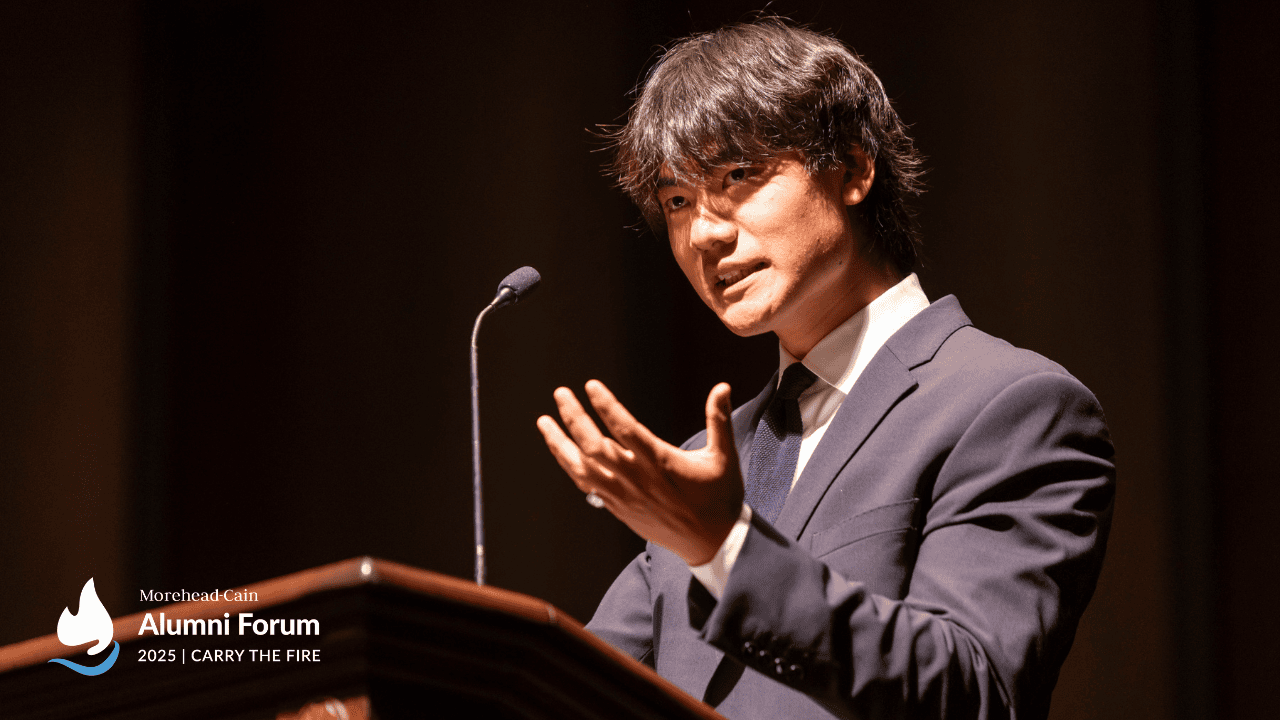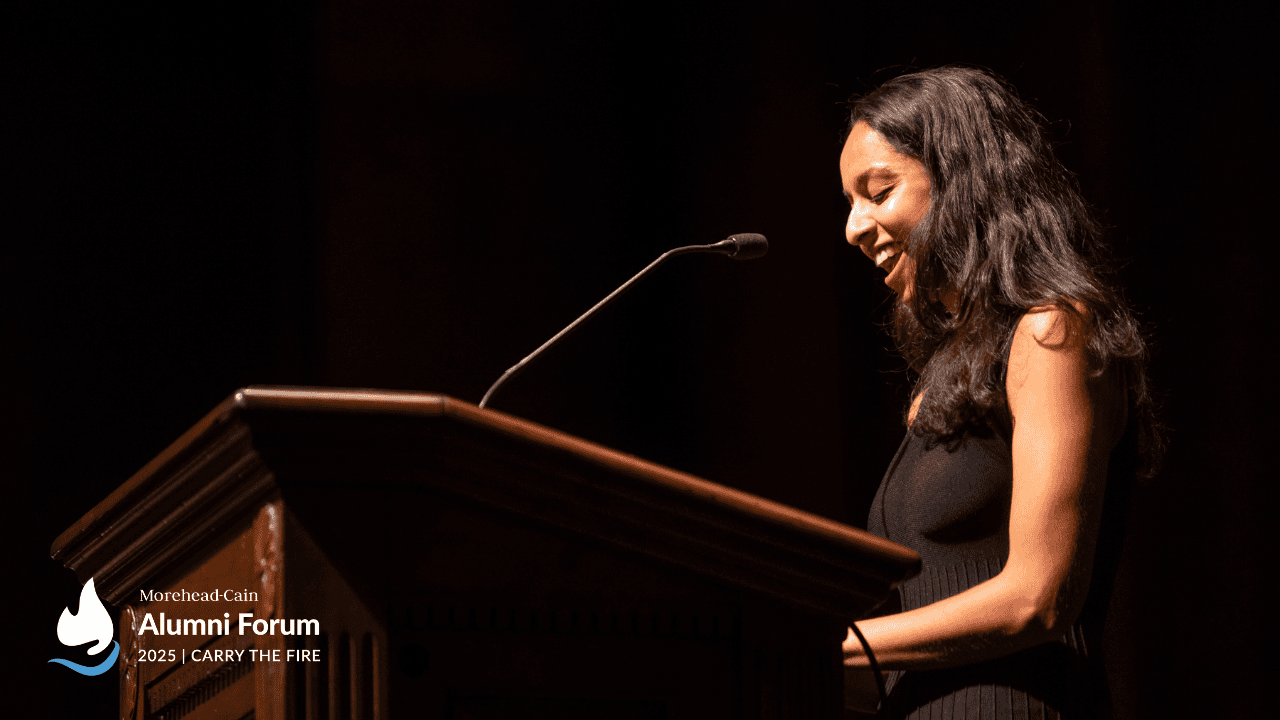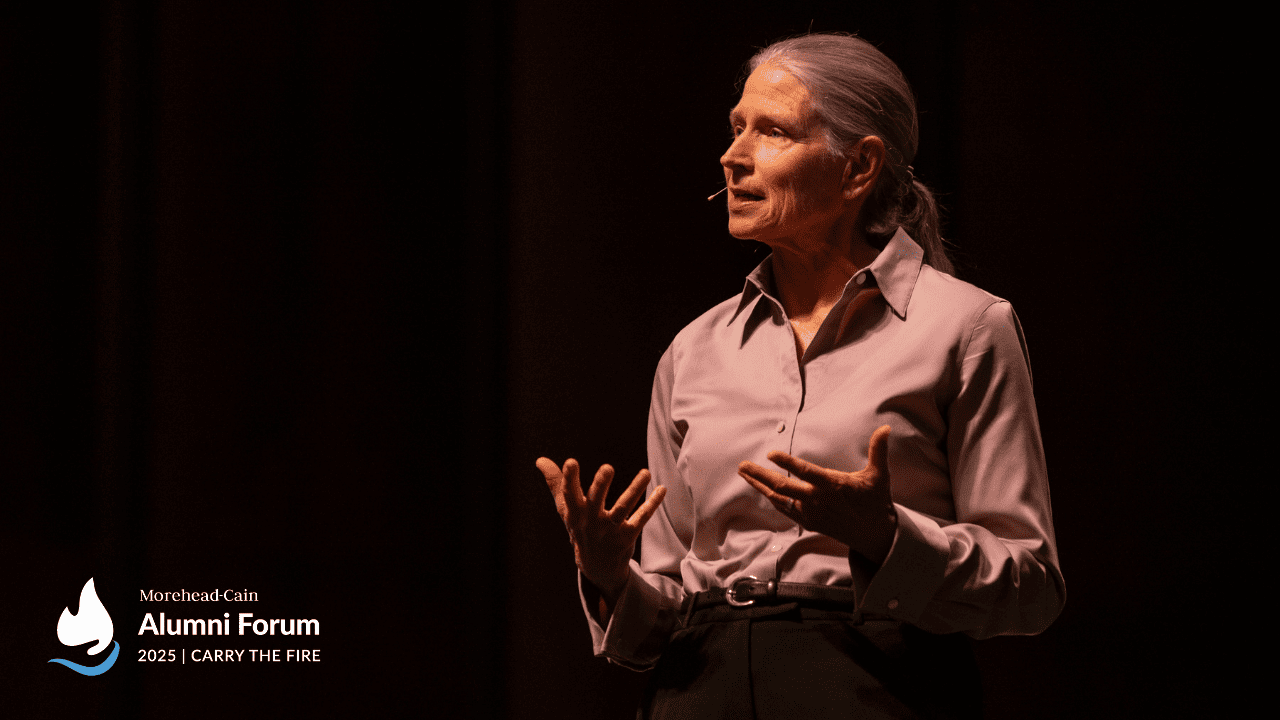
Frances Seymour ’81 (photo by Leon Godwin)
Frances Seymour ’81 delivered a SEVEN Talk at the 2025 Alumni Forum in Chapel Hill on October 18. Frances is a senior policy advisor at the Woodwell Climate Research Center and IPAM Amazonia.
About SEVEN Talks
Every class of Morehead-Cain Scholars connects with seven others: the three classes ahead, its own, and the three that follow. The idea of SEVEN is to strengthen connections across generations of Morehead-Cains.
The Alumni Forum embodies this spirit through SEVEN Talks—seven alumni and scholars on Saturday, and seven more on Sunday—each sharing seven minutes of wisdom with the Morehead-Cain community.

How to listen
On your mobile device, you can listen and subscribe to Catalyze on Apple Podcasts or Spotify. For any other podcast app, you can find the show using our RSS feed. You can let us know what you thought of the episode by finding us on social media @moreheadcain or you can email us at communications@moreheadcain.org.
Episode transcription
It was sixty-seven years ago when my father received an offer of a job in Chapel Hill to be the first pastor of a newly organized Baptist church focused on the issue of racial inclusion. At the time, he had a secure job as the senior minister of a Baptist church in a Baptist college town in western North Carolina, where my mother was on the music faculty and served as church organist.
My father was very excited about this opportunity because his passion was racial justice, and he saw an opportunity to advance that agenda at that time in this place. I suspect my mother was a little less enthusiastic about the move. She had a toddler at home and a baby on the way. But she was a basketball fan, so she asked the pulpit committee, “Could they sweeten the deal with access to Carolina basketball tickets?” And they said, “Oh, yeah, sure. Can do that. Absolutely.”
Turns out they had no clue how they were going to deliver on that promise. But my parents took a leap of faith and left behind secure jobs and a comfortable community and moved to Chapel Hill right after I was born. They took up with this fledgling congregation that didn’t even have a church, so they actually were worshiping next door in Gerrard Hall.
But it all worked out. That thing about the basketball tickets? Solved when Dean Smith joined the church.
So they got busy with their mission of integrating this town, and they started by welcoming Black members to the church, which generated headlines and hate mail from across the state. They then fanned out: one ran for school board to integrate the schools, another one ran for mayor, and a third was assigned to recruit the first Black basketball player in the ACC. And you guys all know how that turned out.
So I faced a similar dilemma soon after graduate school, when I had a choice between signing up with the World Bank in Washington and a riskier move to the Ford Foundation in Jakarta. But I had to pick Jakarta because my passion was saving the tropical rainforest, and Indonesia was the place to do that.
But I do have a vivid memory of driving in my Ford Fairlane down the 15-501 bypass and thinking that I was pretty competent navigating around in my hometown of Chapel Hill, and I was about to throw all that away and move to the other side of the world where I was guaranteed to be incompetent as I learned how to drive on the other side of the road, as I learned how to speak a new language and navigate a whole set of unfamiliar cultures.
But I took a leap of faith and moved to the other side of the world and figured out how to help people and organizations doing important work to save the forest. So just one example was supporting Indigenous groups to map their territories as a first step toward asserting their rights over the forest that the government was then claiming. And under Suharto’s administration, that was a subversive thing to do. So for me, twenty years later, it was like a miracle that the Indonesian Constitutional Court ruled in favor of protecting those Indigenous rights.
In the intervening decades, we’ve learned a ton about forests, including that, yes, Indigenous peoples are the best forest stewards. We’ve learned that forests produce cooler temperatures and the rainfall across continents that’s necessary to support agricultural sustainability. We’ve also learned about the importance of forests to climate change. Forests store a lot of carbon, and when they’re cleared and burned, all that carbon goes up into the atmosphere, to the extent that if we don’t halt and reverse tropical deforestation within the next five years, the goals of the Paris Agreement are completely out of reach.
And yet we are going in the wrong direction. And in fact, 2024 was a record-breaking year for the loss of primary tropical forests, driven by the relentless expansion of agriculture to produce the commodities that we all consume. And last year, that was compounded by unprecedented wildfires, driven by the warmer and drier conditions that both global climate change and deforestation produce.
So it seems pretty hopeless. But I think about my dad, and I think about how from the perspective of the late 1950s, the prospects for success of the civil rights movement probably seemed pretty bleak as well. I mean, even in the liberal enclave here in Chapel Hill, the public schools didn’t integrate until I was in the third grade. And when Martin Luther King came to Chapel Hill in 1960 and spoke across the street at Hill Hall, my father was there and also joined a private lunch for local clergy to have a chance to talk with Dr. King. So when he was assassinated several years later, not only was that a significant setback to the movement, but I’m sure it hit my father as a personal blow. And so I can only imagine what a miracle it seemed like for my father when my husband accompanied him to Washington to witness the inauguration of the first Black president of the United States.
Now, clearly, that agenda is not over. And sadly, just a few days after my father died five years ago, somebody torched the Black Lives Matter banner outside of Binkley Church. And I’m sure my father would have been distressed, as we all are, by watching the systematic dismantling of the Voting Rights Act and other civil rights infrastructure. But I’m quite confident that my father would not have given up.
So I’m not giving up on the forest agenda either. So many of you probably know that next month, the governor of Brazil is hosting the next round of global climate negotiations in a city in the Amazon. So the spotlight is going to naturally be on tropical forests. So I’ve spent the last several months working with several dozen governments—notably not including the government of the United States—to develop a framework for shifting financial flows in ways that will shift incentives away from forest destruction and provide financial reward for the countries and the companies and the communities that protect forests for us.
But the headwinds are strong. We have declining development assistance budgets. We have blowback from agribusiness interests, and we have just an incredibly fraught geopolitical landscape that I don’t need to tell you about. But I will be there taking a leap of faith that change is still possible before it’s too late, and I’m sure my father would be proud of me.
Wish me luck.