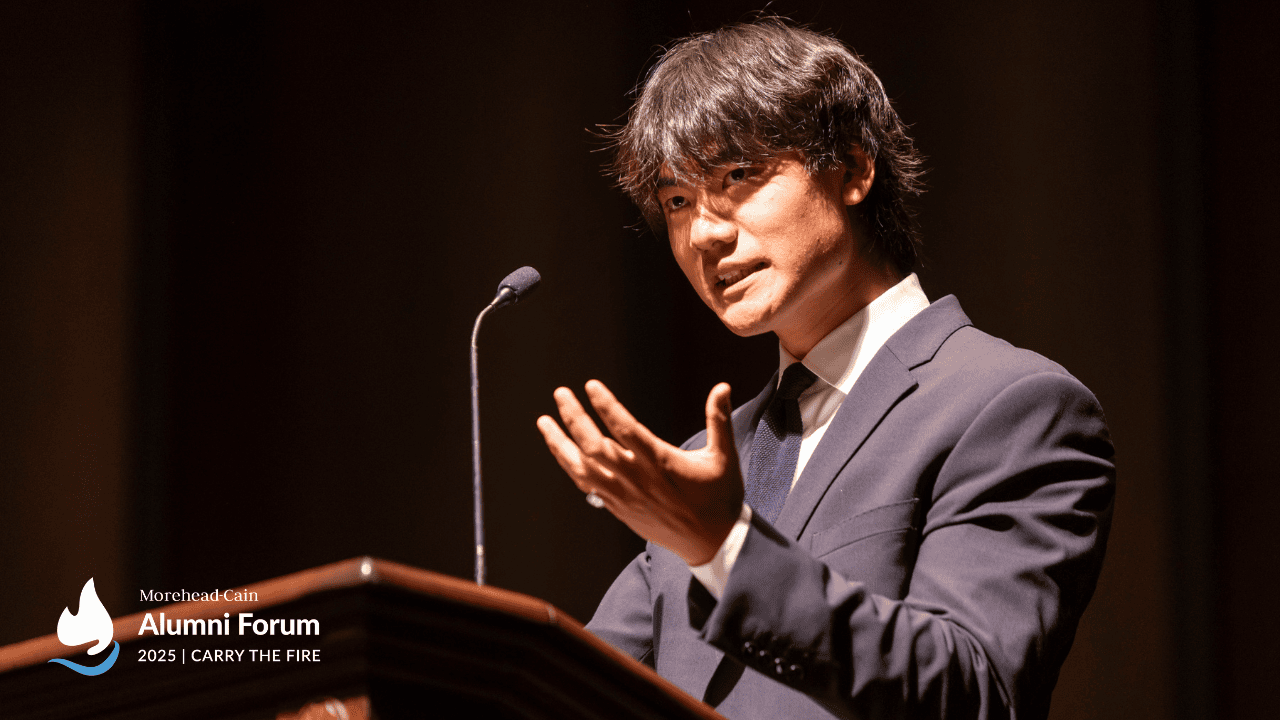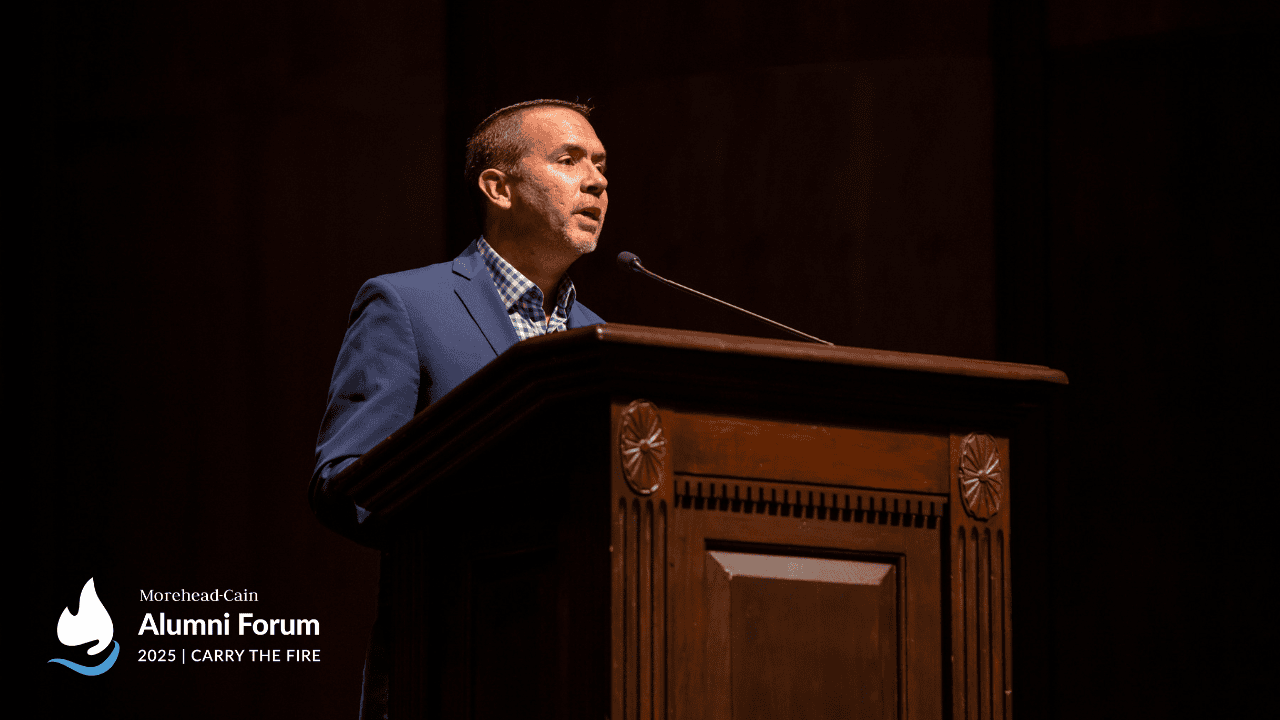
David Jernigan ’00 (photo by Leon Godwin)
David Jernigan ’00 delivered a SEVEN Talk at the 2025 Alumni Forum in Chapel Hill on October 18. David is the former CEO of Boys & Girls Clubs of Metro Atlanta.
About SEVEN Talks
Every class of Morehead-Cain Scholars connects with seven others: the three classes ahead, its own, and the three that follow. The idea of SEVEN is to strengthen connections across generations of Morehead-Cains.
The Alumni Forum embodies this spirit through SEVEN Talks—seven alumni and scholars on Saturday, and seven more on Sunday—each sharing seven minutes of wisdom with the Morehead-Cain community.

How to listen
On your mobile device, you can listen and subscribe to Catalyze on Apple Podcasts or Spotify. For any other podcast app, you can find the show using our RSS feed. You can let us know what you thought of the episode by finding us on social media @moreheadcain or you can email us at communications@moreheadcain.org.
Episode transcription
A gulp from my glass of Chardonnay was unsuccessful in stopping the wave of emotions that swept over me that day six months ago. Three minutes of awkward silence followed as I wiped away tears and struggled to gather myself to answer a rather simple question from the audience. Countless deep breaths later, coupled with an encouraging standing ovation, bought me enough time to finally answer the question that hit me like a ton of bricks that day: What do you want your legacy to be?
I’m not sure when I first started thinking about legacy, but it probably goes back at least as far as the summer of 1997, when I found myself in a Summer Bridge classroom in Houston, Texas, looking into the eyes of my seventh- and eighth-grade students—April Balthazar, Louis Amager, Fernando Montoya, Rafael Rodriguez, and many others—and realizing that I was put on this earth to do more than just make money.
I knew after that Morehead summer enrichment experience that my calling was to serve young people. And as I embarked on a rewarding career focused on serving the children of Atlanta, the question of what my legacy of impact might be was both a source of inspiration and, yet, at times it felt like a burden.
After spending two years teaching third graders in the heart of the city, I felt an overwhelming conviction to do more for the students who I saw in front of me each day—students who were beautiful and talented but whose zip code would likely set them on an educational trajectory of low expectations and poor achievement.
So I soon found myself driving through the vibrant but challenged neighborhoods of West Atlanta, looking for a building where I might birth a college preparatory charter school, a building that I hoped to be the launching pad for brilliant scholars who would soon forge their own legacy of impact. One school led to eight schools, and before I knew it, I was getting a phone call from the superintendent of Atlanta Public Schools asking me to serve as her number two.
As I took the deputy superintendent role on, the passion to have an enduring impact on the kids in my community never faded. But what did begin to change was how I started to think about my legacy.
There’s something about hitting your forties that leads one to think differently about what matters most in life. If I’m being honest, that little pesky question of legacy started to gnaw at me more and more—not because my resume felt incomplete but because my life felt incomplete.
A series of events that transpired over the last three years forced me to confront the tension that I had been neglecting, that tension between impact versus presence.
In September 2022, I found myself in the Northside Piedmont Hospital, holding the cold hand of my son, Jose, just a few blocks from where he had taken his life on the side of the road earlier that morning. I couldn’t have been prouder of Jose. As a child born into poverty with unimaginable life challenges, he wasn’t supposed to graduate from high school, but he did. And he even graduated from college despite having spent two years locked up in a juvenile detention facility. And while I celebrated his grit and determination that led to those educational achievements, what I primarily focused on in his eulogy was how he loved so selflessly. Even as life was weighing down on him during his final weeks on earth, he kept calling me to check on me, to see how I was handling my brother’s recent cancer diagnosis—a diagnosis that led to a second eulogy two months later, one where I stood in the pulpit of a small country church in Elizabeth City, North Carolina, and said little about my brother’s impressive resume and everything about how he lived his life with passion and pursued every hobby with unmatched vigor.
Little did I know at that time that just two years later, I would be back in Elizabeth City, standing in the chapel of Twiford’s Funeral Home, holding my sister’s hand as we wiped each other’s tears and attempted to capture in words the legacy of our mother, who was suddenly and unexpectedly taken from us earlier this year. We found inspiration from the red-and-black dish towel that hung in my mom’s kitchen for years, likely unnoticed by most who visited the home. The dish towel read, “Live every moment, laugh every day, love with all your heart.” There likely isn’t a mantra that better captures the way our mom approached life.
What do you want your legacy to be?
There’s no way the gentleman who asked the question on that day could have known how deeply the question of legacy had recently been weighing on me. I think what prompted his question was the fact that I had shared with the audience that in just a few days, I would be stepping down from my role as president and CEO of the Boys and Girls Clubs of Metro Atlanta. Yes, at forty-seven, I was retiring.
I never could have imagined that my neurology appointment at Grady Hospital on October 7, 2024, would have led to this. I remember staring at the pale sterile walls of the examination room after having been poked and prodded for what felt like hours of an EMG test. I had no reason to believe it was anything serious until I saw the doctor’s face as he slowly closed the door behind him and took a deep breath.
Of course, I had heard of ALS, otherwise known as Lou Gehrig’s disease, but I wasn’t very familiar with it. He patiently explained that it’s a nervous system disease that affects nerve cells in the brain and spinal cord, causing loss of muscle control and eventually affecting control of the muscles needed to speak, move, eat, and breathe.
“Do I have any questions?”
Of course, I had lots of questions. But the only one that I could articulate in that moment was, “Will I die from this?”
He graciously explained that there’s currently no cure for this disease and the average life expectancy is two to five years, but that he’s seen people live much longer.
I fought back the tears until I got outside and called my best friend, who came immediately to the hospital to comfort me.
In the quiet stretch of days and weeks that followed, I wandered through deep reflection, pondering how to give meaning to the life I had left. Having just delivered three heart-wrenching eulogies, I couldn’t help but think about my own funeral and what might be said of me. I decided that my resume had largely been written, and it was time to focus on being present and living my best life. Hence, my retirement on May 1, 2025.
It’s probably no surprise that since my retirement a few months ago, I’m still very engaged in my community and through several nonprofit organizations, and I hope to continue to have an impact on Atlanta for many years to come. At the same time, the things that are bringing me the most joy these days are typically not in the boardrooms or the Zoom meetings where I used to spend so much of my time.
The things that are bringing me joy are the mornings where I take a little extra time to sip my coffee while taking in the city skyline, or the nights where I sit on my couch with a bag of French onion potato chips and binge-watch a Netflix series into the early morning hours, or the lunches, dinners, and coffee dates with former students, colleagues, and friends that go on for hours because there’s white space on my calendar I’ve never seen before, or the nights out with friends who call on a random Monday and want to know if I can join them at our drinking spot and shoot pool, or beach trips with my sister and nephews, or random excursions with friends that will hopefully continue to take me to places around the world I haven’t yet seen.
Those experiences and how I choose to just be present will hopefully be threaded into my legacy story because they represent the totality of who I am beyond David Jernigan, educational leader and nonprofit executive.
You see, when I finally mustered up the strength to answer that gentleman’s powerful legacy question, my answer felt incomplete. I could only string together six words of what I would want my legacy to be: “He loved the children of Atlanta.”
If I were given the opportunity to amend that simple answer, I think I would just add four more words: “And he loved life.”
Thank you.