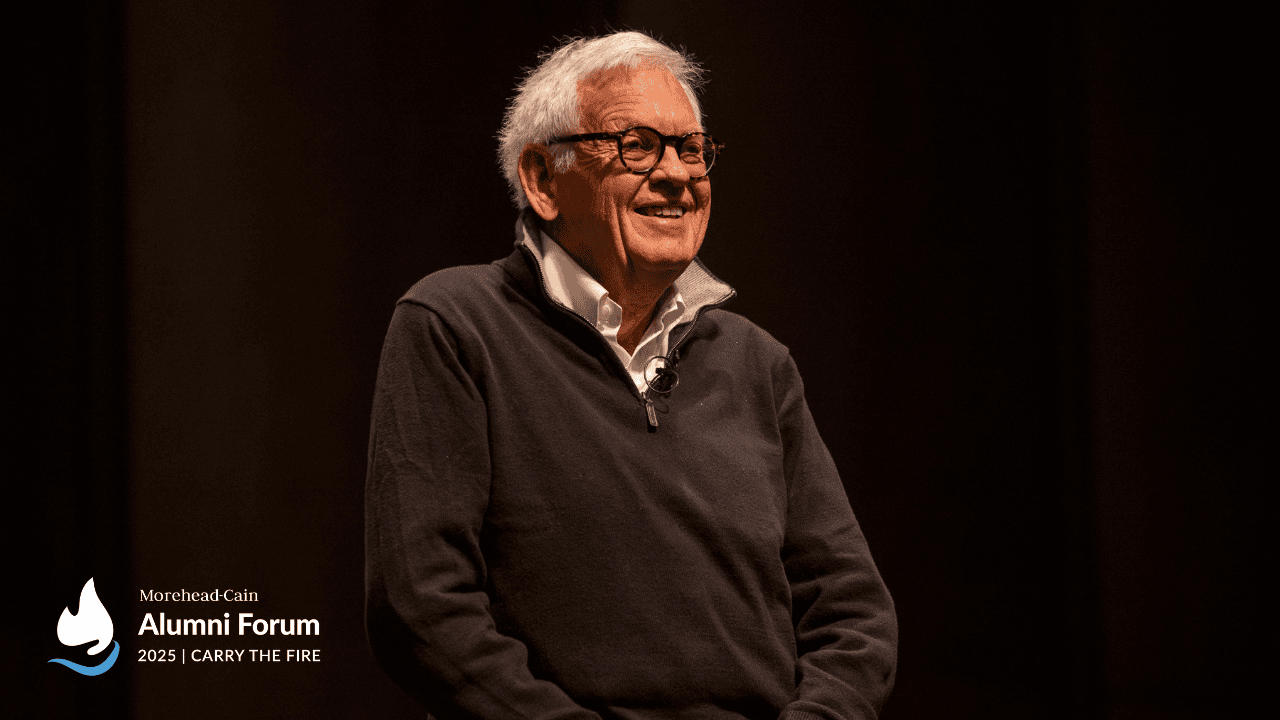
Bill Bates ’62 (photo by Leon Godwin)
Bill Bates ’62 delivered a SEVEN Talk at the 2025 Alumni Forum in Chapel Hill on October 18. Bill is the founding dean of the Thomas F. Frist, Jr. College of Medicine at Belmont University.
About SEVEN Talks
Every class of Morehead-Cain Scholars connects with seven others: the three classes ahead, its own, and the three that follow. The idea of SEVEN is to strengthen connections across generations of Morehead-Cains.
The Alumni Forum embodies this spirit through SEVEN Talks—seven alumni and scholars on Saturday, and seven more on Sunday—each sharing seven minutes of wisdom with the Morehead-Cain community.

How to listen
On your mobile device, you can listen and subscribe to Catalyze on Apple Podcasts or Spotify. For any other podcast app, you can find the show using our RSS feed. You can let us know what you thought of the episode by finding us on social media @moreheadcain or you can email us at communications@moreheadcain.org.
Episode Transcription
I was nervous that morning.
It was a windy Friday, mid-March 1958.
I was interviewing for the Morehead scholarship.
After a few questions, Mr. John Motley Morehead asked me, “What are you going to do when you finish college?”
I responded, “I want to be a pediatrician.”
He pointed his finger at me. He turned to the committee. He said, “Give that boy a scholarship.”
Immediately, he was my Uncle Mot.
The years to come have been incredible. It was a rare opportunity, an unusual opportunity.
My talk this morning is about making babies—miracle and mystery, my experiences with in vitro fertilization.
It was an unlikely occurrence, almost providential. I was a third-year resident in OB-GYN at North Carolina Memorial Hospital. I was working in a research laboratory. Across the bench from me was a physiology professor on sabbatical from Cambridge University. He identified himself as Robert.
I asked, “Robert, what are you investigating?”
He said, “Sperm capacitation.”
I had no idea. I said, “What is sperm capacitation?”
He said it’s the ability of a sperm to penetrate an egg and create an embryo.
That was Dr. Robert Edwards, of Steptoe and Edwards, who announced the birth of the first in vitro fertilization baby in 1978, Louise Joy Brown.
In the early days, IVF programs were developing in Amsterdam, Australia, and the first in this country, in Norfolk, Virginia. I had just finished my research fellowship at the University of Texas Southwestern Medical School in Dallas and had been recruited to the University of Mississippi to begin an IVF program. Working with talented faculty, we produced our first IVF baby in the spring of 1982.
When I looked through the microscope and saw those developing cells, embryonic cells, I said, “I have seen the face of God.”
The success rates were not good. There were a lot of problems.
The first problem was the age of the woman. Women older than age thirty-two had a progressively decreasing probability of pregnancy with each cycle. To compensate for this, we would transfer two, maybe three embryos into the uterine cavity, producing triplets and twins. Yesterday, when we arrived at RDU, I saw a mother with a stroller with twins, and I asked myself, “Are those IVF babies?” Probably so.
But the problems were this: Despite the age of the woman, we also could only see one surface of the ovary. We were using a technique we call laparoscopy, a surgical procedure where we had to use general anesthesia, and we would aspirate the eggs, but we could only get half the eggs available to us. This problem was solved ten years later with three-dimensional ultrasound.
Another problem: we had to use follicle-stimulating hormone, FSH, which is a natural hormone that stimulates both sperm and egg production. But the only source of FSH for us at the time was from the urine of menopausal women collected from Swiss nuns, pooled in a vat, then distilled, and we got it as a product that we would inject. But the batches were inconsistent. Some batches would overstimulate the ovaries; some batches would understimulate the ovaries. This problem was solved later with DNA technology.
The final problem: we could grow embryos only to an eight-cell stage. Under natural conditions, embryos enter the uterine cavity between sixty-four and 128 cells. Thus, we had a big gap, a big lag between natural implantation and when we were trying to implant the eggs. This problem was resolved because someone recognized that if we added estrogen to the incubation mixture, we could double the number—we could get to sixty-eight- to 128-cell development. So pregnancy rates doubled within a year of that discovery.
Science progresses through failure, persistence, technological innovation, and new ideas.
This talk, though, is not about science. It’s about the joy of doing in vitro fertilization.
When Louise Joy Brown was born forty-seven years ago, it changed everything. Today, IVF is worldwide. Over 13 million babies have been born since forty-seven years ago.
Also, we have problems. The problem today: first, cost. Cost is expensive, and many couples who need in vitro fertilization can’t obtain it. And second, we’re confounded by political and religious ethical concerns.
So when I think back, and Mr. Morehead pointed his finger at me and said, “Give that boy a scholarship,” he changed my life.
So together, scholars, let’s say thank you. Thank you, Uncle Mot.
This story is about life—human life, all life. Life is a miracle, but it still has its many mysteries.