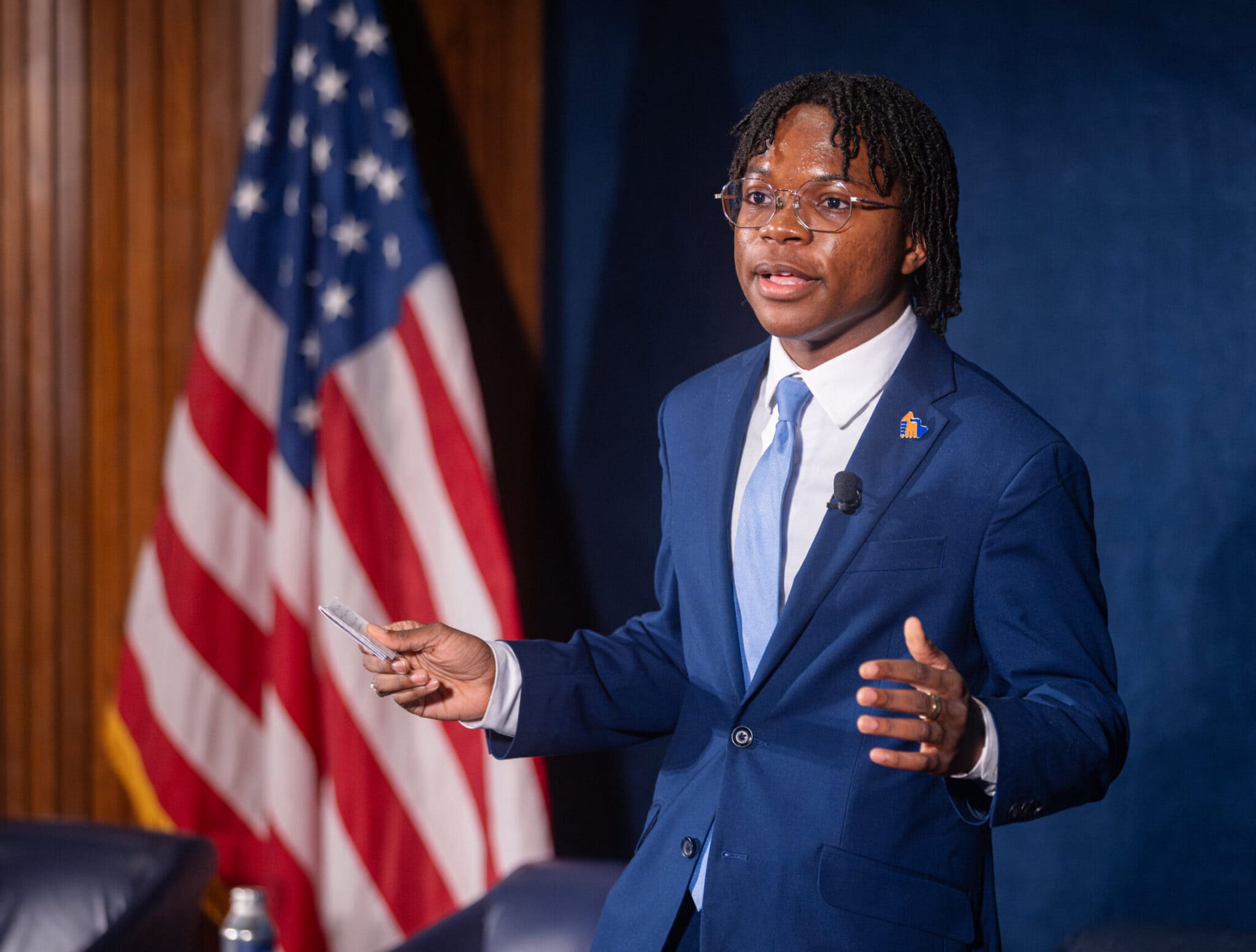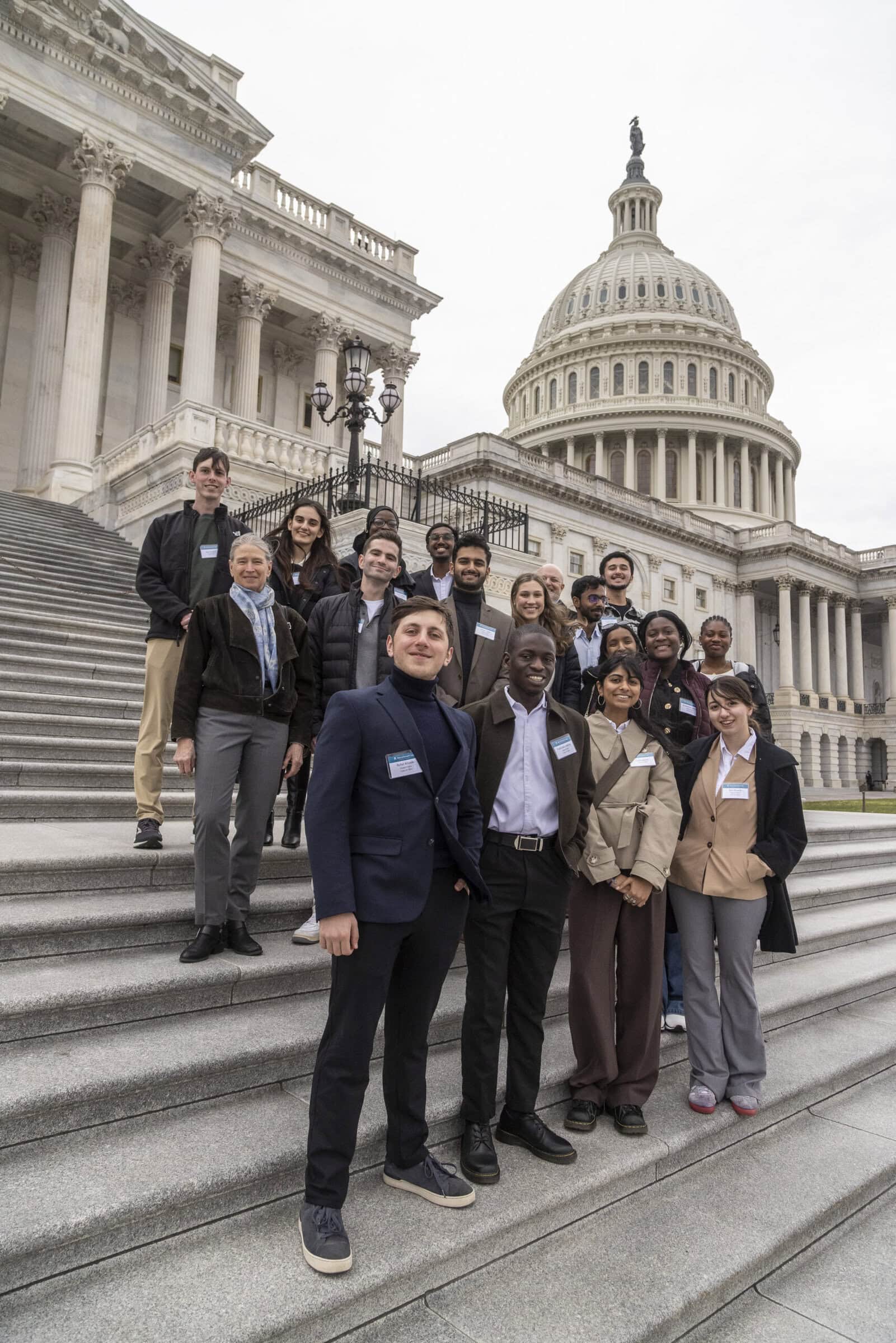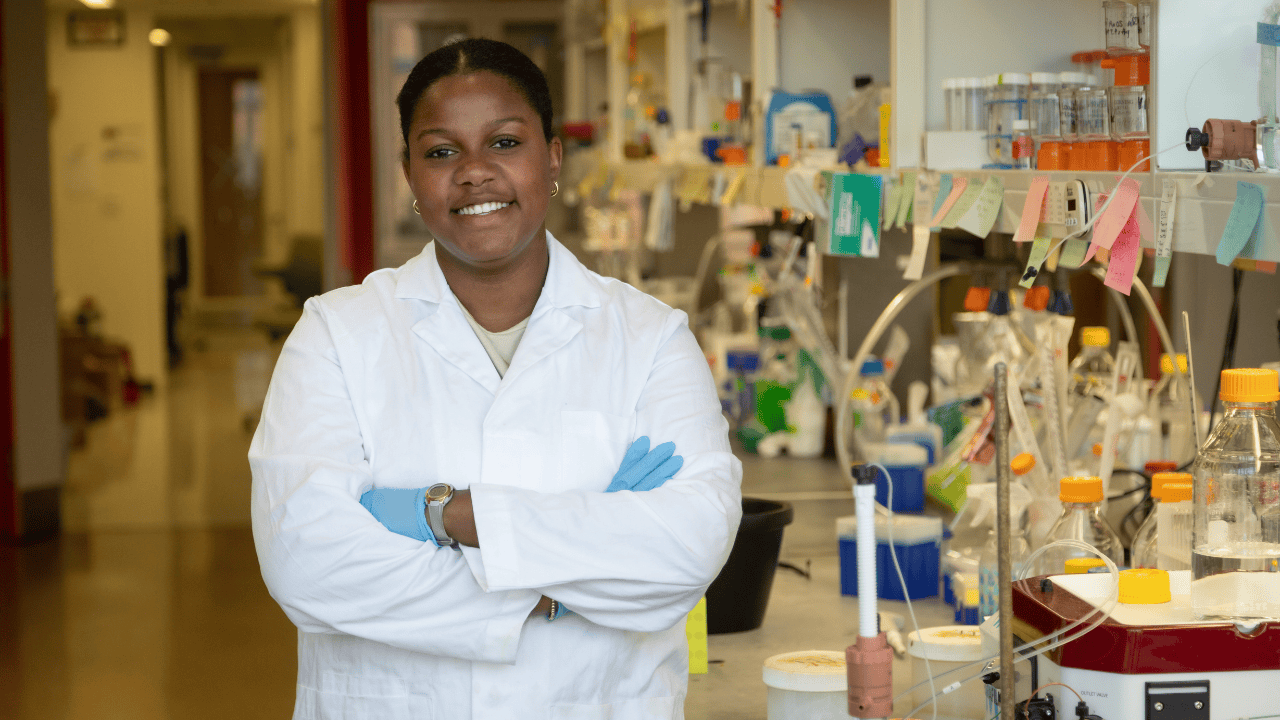
Emilie Garrabrant ’29, on left, with Amy Gao (UNC–Chapel Hill ’29) at the Old Well at the University of North Carolina at Chapel Hill. (Photo by Derin Sola)
When Emilie Garrabrant ’29 first worked alongside women entrepreneurs through a micro-loans program in Uganda in 2023, she noticed a pattern. As families gained financial stability, many mothers reinvested profits directly into their children’s education by paying school fees, buying notebooks, and doing whatever they could to support learning.
What they couldn’t provide, however, were the resources that make learning joyful, engaging, and sustainable.
Three years later, Emilie and Amy Gao (UNC–Chapel Hill ’29) are addressing that gap. The first-year students have been awarded a Projects for Peace grant to launch the Bukedea Learning Lab, a community-based, game-centered educational space for primary school children in the Bukedea District of northeastern Uganda.
Emilie and Amy are the first freshman team from Carolina ever selected for a Davis Projects for Peace award.
A community-rooted vision
The Bukedea District faces significant educational challenges. According to local survey data, nearly 96 percent of children ages 13–17 cannot fluently read material at a Primary Grade 3. Schools operate under severe resource constraints, with crowded classrooms, few books, and limited opportunities for interactive learning. During school holidays, many children are confined to their homes without access to structured or enriching activities.
The Bukedea Learning Lab is designed as a direct response to these conditions. Serving 80 children ages 6–13, the Lab will provide a welcoming, after-school environment where students learn literacy and numeracy skills through play-based, hands-on activities rather than rote instruction, Emilie said.
“Games allow children to learn by doing,” the scholar said. “They create confidence, curiosity, and motivation, all of which are essential not just for academic success, but for long-term stability in a community.”
The Lab will be managed by the Murphy Charitable Foundation (MCF) Uganda, a long-standing local nonprofit that supports more than 2,500 women and 3,000 children in the region. A donated six-room facility within walking distance of local public schools will house the program, ensuring safe and equitable access.
Why game-based learning?
Research consistently shows that interactive, student-centered learning improves engagement and outcomes, especially in under-resourced settings. In Bukedea, where teachers often rely on lecture-based methods out of necessity, opportunities for exploration and collaboration are rare.
To address this, Emilie and Amy partnered with My Home Stars, a Ugandan education organization founded by education innovator and TED Fellow Joel Baraka. The Lab’s core curriculum features 5 STA-Z, a low-cost board game developed in consultation with Ugandan teachers and aligned with national exams. Played in small groups, the game integrates mathematics, English, science, and social studies while fostering teamwork and problem-solving.
Additional activities include reading games, chess, counting tools, locally recommended board games, and a small library, many of which were sourced directly from Ugandan suppliers. Through Amy’s work with Mission:MathMinds, the Lab will also receive a donation of 1,000 children’s English books.
“We were very intentional about cultural relevance,” Amy said. “Every tool in the Lab was selected with local teachers, families, and education experts to make sure it fits the students’ developmental needs and lived experiences.”
Peace defined as opportunity
Projects for Peace asks students to articulate what peace means in practice. For Emilie and Amy, peace is not simply the absence of conflict, but stability built through opportunity.
“Peace starts when children have access to education that feels achievable,” Emilie explained. “When academic success feels out of reach, young people disengage, and that instability ripples outward to families and entire communities.”
The Bukedea Learning Lab fosters peace on multiple levels. Children experience joy, confidence, and belonging through play. Parents gain peace of mind knowing their children have a safe place to learn. And communities benefit as young people develop skills that open pathways to economic mobility.
The Lab will also host motivational programming, including films highlighting successful Ugandan innovators, helping students imagine futures that once felt distant.
Sustainable impact and long-term partnership
Because of current travel restrictions, Emilie and Amy will lead implementation virtually, coordinating curriculum design, ordering materials through Ugandan retailers, and conducting regular check-ins with local staff. MCF will oversee daily operations and maintain long-term ownership of the Lab.
The grant will fund the program’s first year, including teacher stipends and materials, while the team actively pursues additional funding to expand the model.
Success will be measured through academic diagnostics, attendance tracking, and guardian feedback—data that will help refine the program and demonstrate its impact.
For Emilie, the project represents a continuation of relationships built over years of community-based work in Uganda.
“It is incredibly fulfilling to continue working with the community partners I’ve collaborated with for so many years,” she said. “My biggest hope now is to connect with alumni who are working in this space, people who can share insights, challenge our thinking, and help this project grow.”
The Projects for Peace program encourages young adults to develop innovative, community-centered, and scalable responses to the world’s most pressing issues.